Proposed in the 20s but Discarded
Not Properly Discussed in the National Assembly
Political Neutrality, Local Government Financial Disparities,
and Cooperation with National Police
Issues Need Reconsideration from the Start
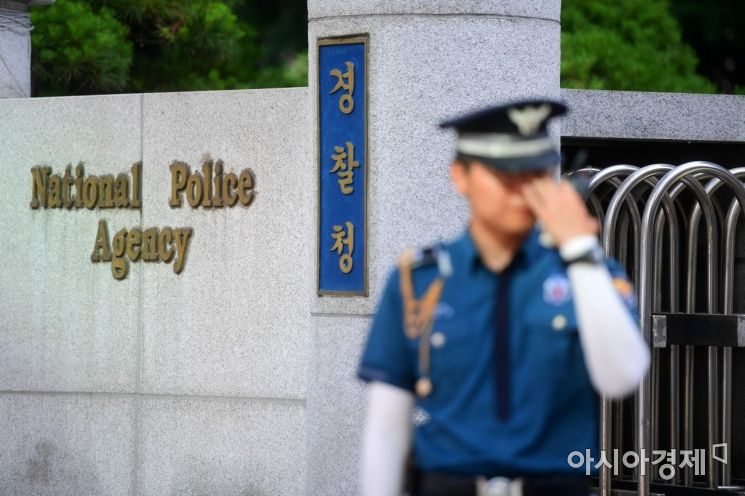 Police officers are on duty in front of the National Police Agency in Seodaemun-gu, Seoul. Photo by Moon Honam munonam@
[Asia Economy Reporter Lee Gwan-ju] As the 21st National Assembly opens, the introduction of the 'Autonomous Police,' one of the core tasks of police reform, is expected to be re-pushed. While the passage of the bill itself is expected to be smooth, many issues such as securing political neutrality are anticipated to cause noise during the discussion process.
According to the National Police Agency on the 3rd, the 'Police Act Comprehensive Amendment Bill,' mainly proposing the introduction of autonomous police and sponsored by Hong Ik-pyo of the Democratic Party of Korea, was introduced in the 20th National Assembly but was discarded due to the expiration of the term. Therefore, to promote the autonomous police system, the bill needs to be reintroduced in the 21st National Assembly. Currently, since the ruling party holds the majority, it is expected that the previous bill will be reintroduced as is. However, the content of the autonomous police bill must be discussed from the beginning. During the 20th National Assembly, due to the fast-track (rapid processing agenda) conflict and other incidents, the autonomous police system was not properly discussed even in the related subcommittee.
The three major issues currently identified regarding the introduction of autonomous police are ▲political neutrality ▲financial disparities among local governments ▲cooperation between national police and autonomous police. According to existing laws, autonomous police belong to metropolitan local governments. Since mayors and governors have personnel authority, concerns inevitably arise that the political neutrality of autonomous police could be compromised. The previously introduced bill stipulated the establishment of a city/provincial police committee composed of external members to control major policies and operations of the autonomous police. However, experts demand stronger measures to guarantee neutrality, such as introducing a personnel hearing system for the head of the autonomous police headquarters. Professor Hwang Moon-gyu of the Department of Police Administration at Joongbu University emphasized at a recent autonomous police academic seminar, "A substantial system and democratic control measures, such as introducing a personnel hearing system for the headquarters chief, guaranteeing their term, and establishing an autonomous police workplace council, must be sufficiently prepared."
Regional security imbalances caused by financial disparities among local governments also need to be addressed. The problem is that the existing bill stipulates that the state supports the expenses required for autonomous police. Ultimately, if autonomous police are operated with budget support from the central government, it may conflict with the purpose of 'fiscal decentralization' in local autonomy. Therefore, various measures such as expanding the scale of local taxes, utilizing non-tax revenues, issuing local bonds, and establishing a new autonomous police grant tax are expected to be discussed in the future to secure funding for autonomous police.
Building a cooperation system between autonomous police and national police is also crucial. As in the early days of the introduction of Jeju Autonomous Police, confusion inevitably occurs initially in cases such as duplicate dispatches or handling complaints. Researcher Jang Il-sik of the Security Policy Research Institute said, "As seen in the expanded operation of Jeju Autonomous Police, there have been visible achievements such as improving the crime prevention environment and establishing an emergency medical center for intoxicated persons," but he also suggested, "It is necessary to enhance understanding of the nature and authority of autonomous police duties by strengthening job training on work procedures to resolve duplicate dispatches of 112 calls."
© The Asia Business Daily(www.asiae.co.kr). All rights reserved.

















