May SME Loans Increase by 7.4329 Trillion Won
Credit Loans Surge by 1.0689 Trillion Won
Savings and Deposits Decrease by 8.2 Trillion Won in April-May
[Asia Economy Reporter Kangwook Cho] As the Bank of Korea continues to lower its benchmark interest rate, interest payments have decreased, leading to a decline in customers depositing money in banks, while the number of borrowers has increased. In particular, the ongoing rise in loans to small and medium-sized enterprises (SMEs) and personal credit loans, which have been affected by the COVID-19 pandemic, has put market banks on high alert regarding risk management.
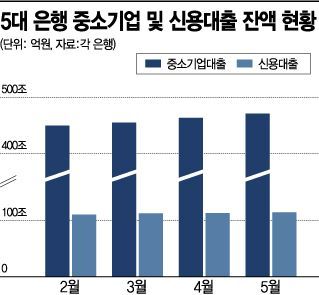
According to the banking sector on the 3rd, the outstanding SME loans at the five major domestic banks?KB Kookmin, Shinhan, Woori, Hana, and NongHyup?amounted to 471.362 trillion won at the end of May, an increase of 7.4329 trillion won compared to the end of April. This is the second-largest increase since September 2015. The largest increase occurred in April, when financial support for small business owners began in earnest amid the COVID-19 crisis, with an increase of 8.4379 trillion won. The continued rise in SME loans is analyzed as reflecting the worsening business conditions of small business owners and SMEs.
In particular, the government’s call to expand financial support for small business owners and SMEs has influenced banks to actively increase related loans. According to the Financial Services Commission, since the implementation of the Livelihood and Financial Stability Package Program announced on March 24, a total of 528,000 cases amounting to 54.1 trillion won have been supported through market banks as of the 29th of last month.
Personal credit loans have increased significantly. At the end of May, the outstanding personal credit loans reached 114.6858 trillion won, up 1.0689 trillion won from the end of April. This is more than twice the increase in April (497.5 billion won). It is analyzed that due to the impact of COVID-19, household financial conditions have worsened, leading to increased borrowing through overdraft accounts and other loans. Credit loans had increased by 1.1925 trillion won in February and 2.2408 trillion won in March.
On the other hand, as the deposit interest rates of major market banks have been steadily lowered, the outflow of deposit customers is accelerating. Over the two months of April and May, the balance of deposits and savings at major market banks decreased by about 8.2 trillion won. When limited to time deposits excluding savings, a massive 8.5578 trillion won was withdrawn during this period. With deposit interest rates falling to the 0% range in this ultra-low interest rate era, more customers have judged that there is no reason to keep their money in banks.
As SME and personal credit loans increase while deposit customers withdraw funds, concerns about the profitability and risk management of market banks are growing. Due to the economic downturn and intensified competition among banks, the net interest margin (NIM), a key profitability indicator for banks, is already on a declining trend.
Kim Widae, a senior researcher at the International Finance Center, said, "Given the high economic sensitivity of the banking industry, a slowdown in profits is expected from the second quarter onward, so proactive management to reduce costs is necessary." He added, "Due to the inevitable low interest rate environment, as bank deposits move to stock and real estate markets, there is also a need to be cautious about the potential overheating of asset prices."
© The Asia Business Daily(www.asiae.co.kr). All rights reserved.

















