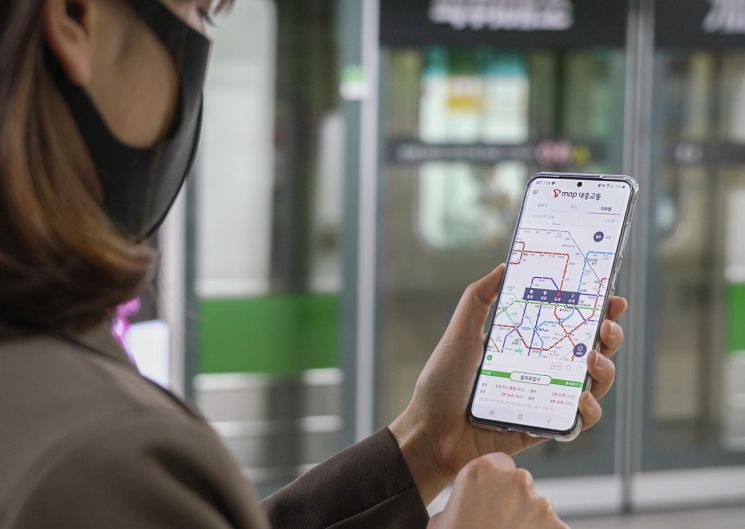
[Asia Economy Reporter Joselgina] From now on, the congestion level inside trains on Seoul metropolitan subway lines 1 to 8 can be easily checked through SK Telecom's T map Public Transportation application.
SK Telecom announced on the 3rd that it will provide the nation's first subway train congestion prediction information through an update to the integrated navigation, bus, and subway information service app, 'T map Public Transportation.'
The train congestion information is provided in four stages?Spacious, Normal, Caution, and Congested?on all screens where train arrival information for metropolitan lines 1 to 8 is checked in the 'T map Public Transportation' app. It is classified as Spacious when some passengers can stand comfortably, Normal when standing passengers each hold one handrail without inconvenience in movement, Caution when standing passengers occupy the aisle and bump into others while moving, and Congested when standing passengers' shoulders are pressed together and movement is impossible.
SK Telecom planned this service based on the analysis of congestion by train, car, time, and route using big data from base stations and Wi-Fi information at 596 stations on metropolitan lines 1 to 9 from November last year to April 5 this year.
With the resurgence of COVID-19 increasing public interest in 'social distancing in daily life,' this service allows passengers to check congestion levels before boarding the subway, helping them avoid crowded trains and use the subway more safely.
SK Telecom plans to continuously enhance the system by adding more data to improve the accuracy of the prediction information. In cooperation with Seoul Metro, it aims to provide car-specific congestion levels as early as September and more accurate real-time congestion information in the future.
This service is also expected to contribute to reducing social costs caused by subway congestion. Passengers can avoid unnecessary contact with others in crowded trains, and delays caused by congestion can be reduced. According to the Seoul Institute, the social cost due to subway congestion in Seoul is estimated to exceed 700 billion KRW (based on 2016 data).
Additionally, this update provides real-time arrival information for metropolitan lines 2 to 8 based on Seoul city data. Route guidance during the last train hours has also been improved from the passenger's perspective. For example, when traveling from Seoul Station on line 4 to Oido Station late at night, if only the train bound for Namtaeryeong remains, it was previously displayed as 'train service ended,' but now the Namtaeryeong-bound train is guided. This update applies to both Android and iOS versions.
Lee Jong-ho, head of SK Telecom's Mobility Business Unit, said, “The subway congestion service is significant in that it allows customers to choose whether to use the train themselves, considering customer inconvenience and COVID-19 infection concerns,” adding, “We will strive to contribute to securing social safety nets in various fields beyond telecommunications services.”
© The Asia Business Daily(www.asiae.co.kr). All rights reserved.

















