[Asia Economy Reporter Kwangho Lee] A system will be established to enable tracking and management of wild animals imported from overseas even after their entry. Quarantine of wild animals will be conducted, and inspections at customs will be strengthened through inter-ministerial cooperation. Additionally, hygiene and disease management standards will be established according to the scale of wild animal exhibition and experience facilities.
On the 3rd, the government held a National Policy Issue Inspection and Coordination Meeting chaired by Prime Minister Chung Sye-kyun at the Government Seoul Office, where the "Improvement Plan for the Management System of Overseas Imported Wild Animals" containing these measures was reviewed and finalized.
This improvement plan was established by referring to the international quarantine recommendation standards of the World Organisation for Animal Health (OIE) and the wild animal management systems of advanced countries such as the United States, the European Union (EU), and Australia.
First, a system will be built to enable tracking and management of wild animals imported from overseas even after their entry.
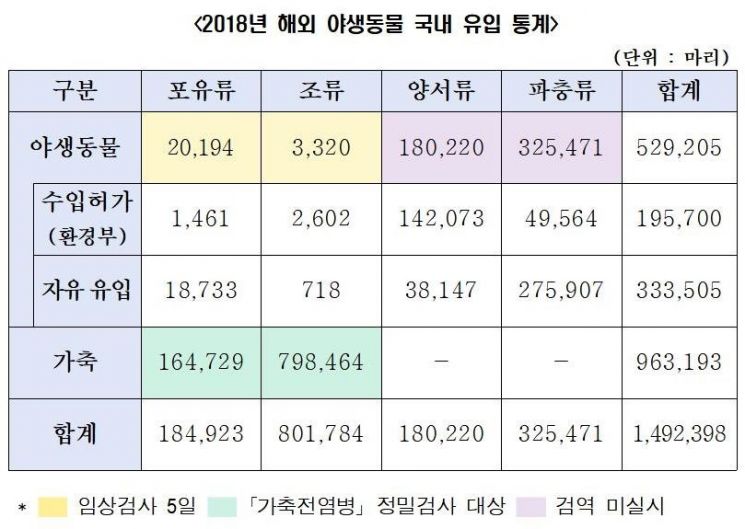
A comprehensive database (DB) for tracking and managing overseas imported wild animals will be constructed to consolidate the wild animal status data that had been dispersed across seven regional environmental offices and 226 basic local governments, and to track and manage distribution routes.
Quarantine of wild animals will also be conducted, and inspections at customs will be strengthened through inter-ministerial cooperation.
Until now, quarantine has been conducted focusing on livestock infectious diseases (targeting mammals and birds), and quarantine procedures for amphibians and reptiles, which had been imported without quarantine, will be newly established.
Furthermore, for wild animals that were already subject to quarantine, high-risk groups will be designated to extend quarantine periods, and detailed inspections will be mandated for wild animals with a high risk of transmitting major zoonotic diseases.
In addition, to efficiently allocate wild animal quarantine and customs infrastructure, airports and ports where wild animals can be imported will be designated and operated.
The government will establish hygiene and disease management standards according to the scale of wild animal exhibition and experience facilities.
Unlike zoos, small-scale exhibition and sales facilities such as wild animal cafes, which had been in a management blind spot, will have new business categories created to enable proper management through system improvements.
Along with this, the "risk of infectious disease transmission" item will be added to the risk assessment of wild animals, and the inter-ministerial zoonotic disease monitoring system will be strengthened.
The risk assessment of overseas wild animals will be improved from focusing mainly on ecosystem impact analysis to also considering the risk of diseases, so that animals with a high risk of infectious disease transmission can be proactively prevented from entering.
An official from the Office for Government Policy Coordination said, "We will check the detailed progress of each ministry semiannually to ensure that the improvement plan is implemented without any setbacks."
© The Asia Business Daily(www.asiae.co.kr). All rights reserved.

















