International Credit Rating Agencies' North Korea Economic Outlook
Worst Since the 1994 Arduous March
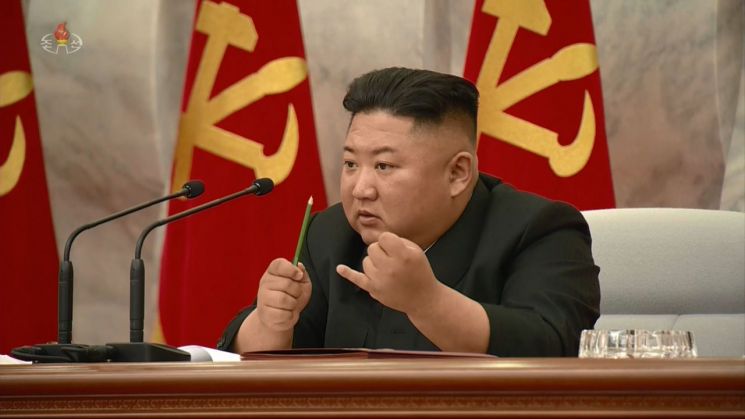 North Korea held the 4th Enlarged Meeting of the 7th Central Military Commission of the Party, presided over by Chairman Kim Jong Un, according to a report by Korean Central TV on the 24th of last month. Chairman Kim Jong Un, holding a pencil in one hand, is explaining while counting numbers on his fingers.
North Korea is expected to record an economic growth rate of -6% this year amid the dual hardships of international sanctions and the novel coronavirus disease (COVID-19). This is the worst figure in 23 years since the -6.5% recorded during the Arduous March period in 1997.
Fitch Solutions, a subsidiary of the international credit rating agency Fitch, recently released a report forecasting that North Korea's economy will contract by 6% this year, according to a report by the Voice of America (VOA) on the 2nd (local time).
The growth rate forecast for this year's gross domestic product (GDP) was sharply revised downward by nearly 10 percentage points from the 3.7% projected at the beginning of the year. This is due to the shockwaves COVID-19 has dealt to China and the global economy. North Korea's dependence on trade with China exceeds 90%.
There are widespread forecasts that North Korea's economy will suffer a shock similar to that during the Arduous March this year.
According to the May issue of the North Korean Economy Review by the Korea Development Institute (KDI), titled "North Korean Economy in 2020: A D?j? Vu of 1994," the pattern of economic shocks facing North Korea this year resembles that of 1994 when the Arduous March began.
Both this year and in 1994, the North Korean economy has accumulated damage from prolonged structural shocks over several years, followed by an unexpected immediate shock.
First, strong international sanctions against North Korea are cited as the structural shock factor currently affecting the North Korean economy. Under the impact of sanctions, trade volume between North Korea and China shrank from $2.6 billion in 2016 to $200 million in 2019.
The immediate shock is the COVID-19 shock. Since January this year, North Korea has completely closed its border with China and implemented COVID-19 prevention measures, delivering a fatal blow to North Korea-China trade.
In March this year, North Korea's exports to China decreased by 96%, and imports by 90%, with exports and imports each dropping by about 90% again in April.
The report even stated, "To put it somewhat exaggeratedly, one of the economies most severely affected by the COVID-19 crisis this year is the North Korean economy."
© The Asia Business Daily(www.asiae.co.kr). All rights reserved.

















