Financial Struggles Due to Minimum Wage and COVID-19
Flood of Court Auctions Expected in Second Half
Factory Auctions Lead to Equipment Being Scrap Metal Worth 'Jaegibulgeung'
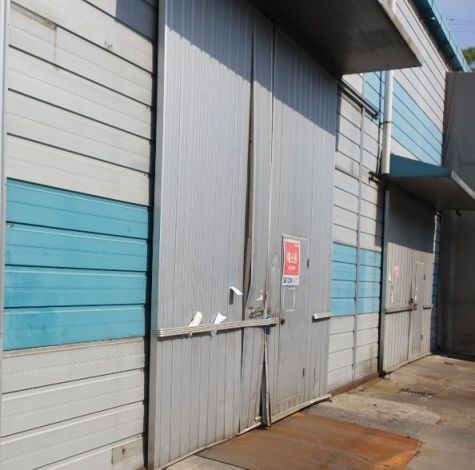
[Asia Economy Reporter Kim Daeseop] The mailbox of heat treatment company A, located in Namyang-eup, Hwaseong-si, Gyeonggi Province, is overflowing with dust-covered mail. The factory doors have been firmly closed for a long time. The situation is similar at mold company B nearby. Although the factory doors are open, the interior is dark. It is 3 p.m., a peak operating time, but no workers are visible. The sound of machinery operating cannot be heard. Both companies have put their factories up for sale, but since no transactions have occurred for several months, they are currently leasing them out to find tenants.
The representative of real estate brokerage firm C, specializing in factory listings in the area, said, "Including these companies, about 4 to 5 factories within a 500-meter radius have been put up for sale," adding, "Due to the economic downturn, businesses are struggling, leading to factory closures or factories that remain open but are not operational, with only machines left inside." He added, "If factories do not sell, they are sometimes put up for lease, but recently the number of listings has increased, and given the poor business environment for manufacturing, this situation is expected to continue for at least a year or more."
Factory listings from companies experiencing financial difficulties due to the economic downturn are accumulating. Considering the difficult situation of small and medium-sized manufacturing companies, the number of factories that fail to be sold in the market and are subsequently auctioned off is expected to increase after the second half of the year. Due to the global economic downturn, COVID-19, and several years of minimum wage increases, small and medium-sized manufacturers facing management crises are expected to flood the auction market with factory listings from as early as the second half of this year through early to mid-next year.
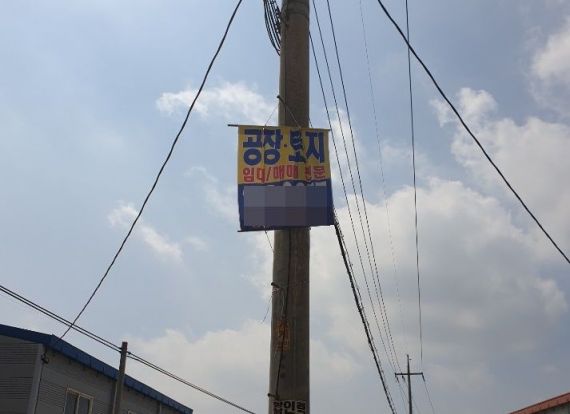 Banners advertising factory and land rental and sales are hung on utility poles around the complex where factories are gathered.
The atmosphere in the Banwol-Sihwa National Industrial Complex is gloomy due to COVID-19. The representative of company D, located in the Banwol-Sihwa National Industrial Complex, said, "Recently, many factory listings have appeared in this area, but no one wants to buy factories in this situation," adding, "There are only people looking to buy real estate, not companies. They do not buy the assets (machinery and equipment) owned by the companies but only purchase the factory buildings and land, intending to sell the real estate once the economy recovers."
From raw material procurement (imports) to domestic sales, exports, and employment, nothing is functioning properly, according to the small business community. The situation has worsened since COVID-19, and there is no quick breakthrough to resolve it.
The situation becomes more serious if factory listings go to court auctions. When factories are sold through regular sales, the machinery and equipment used in the factory can be valued to some extent, but this is usually not the case in auctions.
The representative of company D said, "When a factory is auctioned, the real estate price drops, and machinery is sometimes treated as scrap metal, making it impossible for the company to recover from debt," adding that an executive of a factory automation machinery company operating a second factory in the Banwol-Sihwa Industrial Complex expressed concern, saying, "The production volume of clients in the Banwol-Sihwa Industrial Complex has halved, and if this situation continues, the management of companies will become even more difficult."
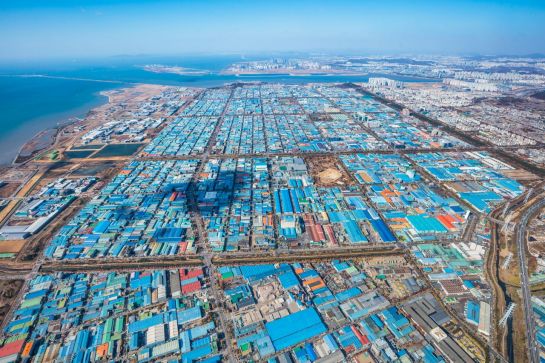
According to the Korea Industrial Complex Corporation, as of March this year, the operating rates of Banwol National Industrial Complex and Sihwa National Industrial Complex were 68.0% and 72.8%, respectively. This represented only a 1.3 percentage point and 1.1 percentage point increase compared to the previous month. Employment rates from February to March this year recorded a decline.
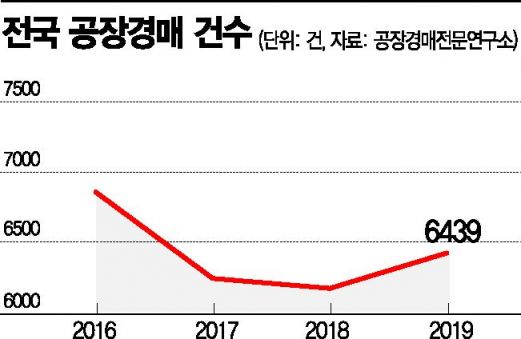
The difficulties faced by small and medium-sized manufacturers are not sudden. Looking at nationwide factory auction statistics over the past three years, it is evident that the financial difficulties of small and medium-sized manufacturers have become pronounced since last year. According to the Factory Auction Research Institute, the number of factory auctions decreased from 6,259 in 2017 to 6,182 in 2018, then increased to 6,439 in 2019. This year, over 2,275 factory auction listings have appeared up to May.
The Banwol-Sihwa National Industrial Complex, the largest domestic parts and materials cluster, is also showing an increasing trend in factory auctions. The number of factory auctions in Danwon-gu, Ansan-si, and Jeongwang-dong, Siheung-si, where the Banwol-Sihwa Industrial Complex is located, nearly doubled from 61 in 2018 to 119 last year. Most factories currently under auction were listed in the first half of last year. Considering the court auction process, the visible closure of factories due to COVID-19-related bankruptcies is expected from the second half of this year or around the first half of next year.
Factory listings can help companies overcome financial crises if sold or at least leased. However, if even this is not possible, they may end up in the auction market. When listings go to auction and fail to sell, prices plummet, and companies may give up on restarting their businesses without receiving fair value.
Jung Aram, team leader at the Factory Auction Research Institute, said, "Court auctions proceed with a process where public notices accessible to the general public appear about six months to a year and a half after the filing date," adding, "Since the second half of 2018, the manufacturing industry has deteriorated due to the global economic downturn, rising raw material prices, and minimum wage increases. This year, the impact of COVID-19 has added to the shock, leading to financial difficulties and factory listings. It is expected that a large number of these will appear in the auction market from as early as the second half of this year or early next year."
Meanwhile, the management performance of small and medium-sized enterprises is expected to worsen in the second quarter following the first quarter. According to the 'Small Business Employment Difficulty Status and Minimum Wage Opinion Survey' released on the 1st by the Korea Federation of SMEs and the Korea Employers Federation, based on a survey of 600 small businesses, 76.7% of respondents said their current management situation had "worsened" compared to the previous year. 75.3% reported worsened performance in the first quarter, and 65.7% forecast further deterioration in the second quarter. Lee Taehee, head of the Smart Job Division at the Korea Federation of SMEs, said, "Small businesses are currently fighting for survival."
© The Asia Business Daily(www.asiae.co.kr). All rights reserved.



















