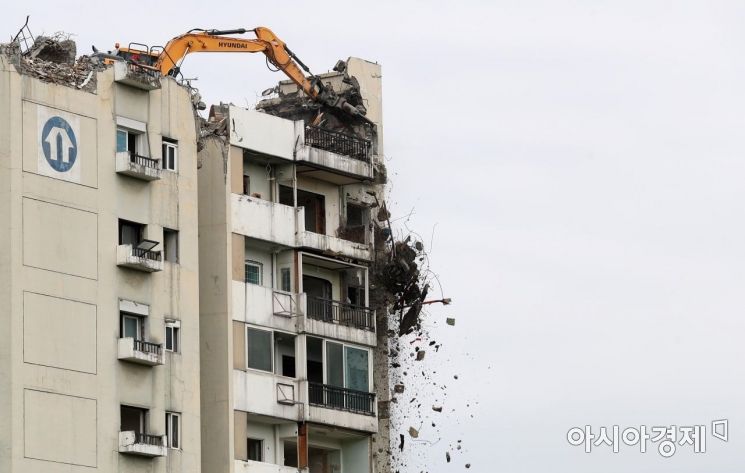
 Demolition work is in full swing at a reconstruction site in Seoul for rebuilding. Photo by Mun Ho-nam munonam@
[Asia Economy Reporter Lee Chun-hee] The government is set to fully implement the Reconstruction Excess Profit Recovery System by revising the criteria related to reconstruction burden charges. With the five-year grace period and legal obstacles such as constitutional complaints all removed, the plan is to organize related laws and regulations and proceed in earnest starting this year.
The Ministry of Land, Infrastructure and Transport announced on the 2nd that it will publicly notify the revision proposals for the "Enforcement Decree of the Reconstruction Excess Profit Recovery Act" and the "Recovery Work Guidelines" to reflect the evaluation indicators for the distribution of the state's share (50%) of reconstruction burden charges to local governments. The public notice period will be 40 days from the 3rd of this month to the 12th of next month.
A Ministry of Land official explained, "This was prepared following the Constitutional Court's ruling in December last year that upheld the constitutionality of the reconstruction burden charge system, which means the collection of reconstruction burden charges will be fully enforced starting this year." The imposition of reconstruction burden charges, which had been delayed due to lawsuits, is now being intensified.
According to the Ministry, a total of five reconstruction sites, all located in Seoul, have been subject to reconstruction burden charges so far. A total of 2,241,350,000 KRW has been imposed.
However, only 44 million KRW, or 4.4%, of the charges have been paid to date. This is because the Hannam Yeonrip in Hannam-dong, Yongsan-gu (currently Hannam Paragon), which was charged 1,718,730,000 KRW, and the Dosan Yeonrip in Cheongdam-dong, Gangnam-gu (currently Cheongdam e-Pyeonhansesang 3rd), which was charged 431,170,000 KRW, have not paid and have been engaged in legal battles. The Constitutional Court's ruling last year upholding the reconstruction burden charge was made after the Hannam Yeonrip association filed a constitutional complaint in 2014 arguing that "taxation on unrealized gains is unfair."
The Jungnang-gu Muk-dong Jeongpung Yeonrip (currently Hyosan Center Ville), Myeonmok-dong Woosung Yeonrip (currently Daemyung Mirte), and Songpa-gu Pungnap-dong Ihwa Yeonrip (currently Samsung World Ville), which have already fully paid the charges, had average charges per association member ranging from 340,000 to 3,520,000 KRW, but in the case of Hannam Yeonrip, the average per member was as high as 55,440,000 KRW. However, since the lawsuit took five years, some association members have become unreachable, and there are forecasts that the actual burden charge could rise to around 100 million KRW per person.
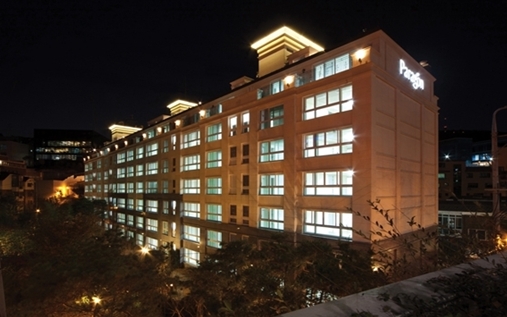 Night view of Hannam Paragon (formerly Hannam Yeonrip) in Yongsan-gu, where a lawsuit to cancel the imposition of the reconstruction excess profit charge was filed.
The Reconstruction Excess Profit Recovery System was implemented in 2006 during the Roh Moo-hyun administration. Its purpose is to recover excess profits generated from reconstruction projects to prevent privatization of development gains, thereby stabilizing housing prices and promoting social equity. However, due to reasons such as the housing market downturn, its application was deferred for five years from December 2012 to December 2017. After the grace period ended, all reconstruction sites that received management disposition plan approval became subject to burden charges.
The burden charge is calculated by multiplying the charge rate by the amount obtained by subtracting the housing value at the start of the project, the normal housing price increase (based on regular deposit interest rates or average housing price increase rates), and development costs from the housing value at the end of the project. If the average profit per association member is 30 million KRW or less, the charge is exempted. Conversely, if the average profit exceeds 110 million KRW, the charge rate is progressively increased up to a maximum of 50%. According to a Ministry of Land simulation targeting 20 reconstruction sites in Seoul, burden charges per association member are known to range from 160 million to 840 million KRW.
The enforcement decree and guideline revision proposals publicly notified this time concern the redistribution of 50% of the recovered reconstruction burden charges that belong to the state as the Housing and Urban Fund. Currently, the recovered charges are distributed to local governments in two stages. In the first stage, 50% belongs to the state, and of the remaining 50%, 20% is distributed to the relevant metropolitan local government and 30% to the relevant basic local government. For special local governments such as Sejong and Jeju, the entire first-stage share goes to the metropolitan local government.
Then, the 50% belonging to the state is redistributed the following year through evaluation, split evenly between metropolitan and basic local governments. Previously, 45 million KRW of the recovered amount was distributed in 2015 as 22.5 million KRW each to Incheon City and Seongnam City in Gyeonggi Province.
The revision proposal adjusts the evaluation items for this second-stage redistribution and specifies detailed indicators. Previously, local governments were evaluated on five items through a public contest: ▲level of residential infrastructure installation (20%), ▲housing welfare status evaluation results (20%), ▲efforts to improve housing welfare (20%), ▲public housing project performance (25%), and ▲utilization and operation plans for reconstruction burden charges (15%) to distribute the charges.
However, after receiving criticism that the efforts to improve housing welfare and public housing project performance items overlapped, the public housing performance was integrated into the housing welfare improvement efforts item, and the weight of this item was set as the highest at 45%. Detailed evaluation indicators include 20% for the supply of housing welfare-linked facilities such as housing welfare centers and public office complex developments, 15% for the proportion of long-term public rental housing supply, and 10% for budget allocation and ordinances related to housing management cost support.
Additionally, to strengthen housing welfare, the weight of the housing welfare status evaluation results was increased from the previous 20% to 30%. Evaluation indicators include the rate of housing benefit recipients, housing supply rate, and the proportion of buildings over 30 years old.
Detailed information on the revision proposals publicly notified this time can be found in the legislative notice section on the Ministry of Land, Infrastructure and Transport website. If there are any opinions, they can be submitted to the Ministry's Housing Maintenance Division.
© The Asia Business Daily(www.asiae.co.kr). All rights reserved.
![User Who Sold Erroneously Deposited Bitcoins to Repay Debt and Fund Entertainment... What Did the Supreme Court Decide in 2021? [Legal Issue Check]](https://cwcontent.asiae.co.kr/asiaresize/183/2026020910431234020_1770601391.png)