[Asia Economy Reporter Joeslgina] "What kind of 'Korean New Deal' is it when even the 'data utilization' emphasized by the president himself is completely blocked by subordinate laws?" "Without radical regulatory innovation, the same futile situation could repeat itself."
The ICT industry views the Moon Jae-in administration's 'Korean New Deal' project, which emphasizes the Digital New Deal, with great concern. Despite the government's earlier pledge to open the era of the data economy, the 'Data 3 Laws (Personal Information Protection Act, Information and Communications Network Act, Credit Information Act)' have become shackled by enforcement ordinances, making any progress impossible. There is anxiety that the process might inadvertently produce only new regulations.
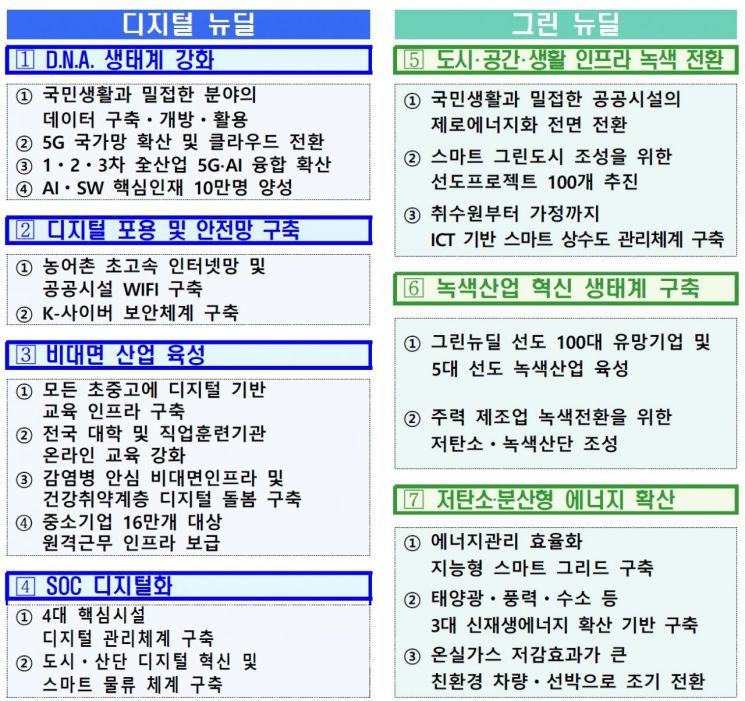
According to government ministries and industry sources on the 2nd, the Korean New Deal unveiled by the government the previous afternoon focuses on the Digital New Deal, which includes ▲strengthening the Data, Network, and Artificial Intelligence (D.N.A) ecosystem ▲building digital inclusion and safety nets ▲fostering non-face-to-face industries ▲digitalization of SOC, with an investment of 13.4 trillion won. The goal is to create 330,000 jobs. The ministries plan to supplement additional tasks and finalize a comprehensive plan by July.
◆ "No Korean New Deal Without Radical Regulatory Innovation" = The ICT industry expresses cautious optimism that the Korean New Deal could accelerate the 4th Industrial Revolution based on 5G, Artificial Intelligence (AI), and cloud computing, but they do not hide their concerns. They argue that without radical regulatory innovation, no matter how massive the government and corporate investments are, it will be difficult to achieve meaningful results.
An IT industry official said, "The biggest concern in the industry right now is the possibility of new regulations emerging during policy implementation," adding, "For the Digital New Deal and Korean New Deal to succeed, regulations must first be eradicated. Otherwise, it will be a regression."
A prime example of such regression is the Data 3 Laws. When passed by the National Assembly earlier this year, it was expected to mark a turning point for the big data industry. However, the Ministry of the Interior and Safety has been criticized for making data utilization more difficult during the revision of the enforcement ordinance of the Personal Information Protection Act, failing to align with the law's original intent.
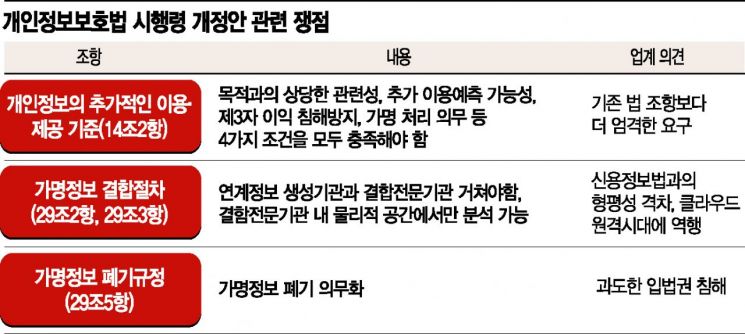
A representative from a major corporation remarked, "It would be better if it didn't exist at all," criticizing, "The president emphasizes the data economy and data utilization, but the Ministry of the Interior and Safety does not even consider the law's intent." A startup official also sighed, "President Moon Jae-in has been calling for 'regulatory innovation' since his first message of the new year, but the actual outcome is like this," adding, "Small and medium enterprises are too worried about legal disputes to even dare to try."
Since the Moon Jae-in administration has declared that 'data utilization' must be prioritized for the successful implementation of the Korean New Deal, there are continuous calls to drastically revise key regulations, starting with the enforcement ordinance amendments of the Data 3 Laws, which have become a 'toxic' issue due to inter-ministerial discord. The government also identified that, besides promoting data utilization and infrastructure, essential measures include promoting 5G investment, expanding smart factories, revising AI legislation, and establishing a foundation for non-face-to-face industries.
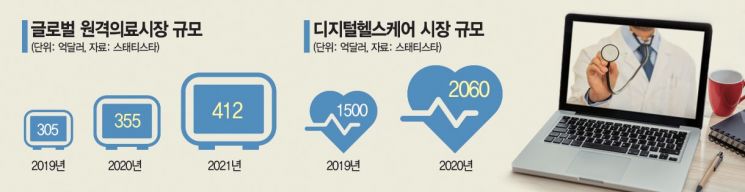
◆ "Lack of Consideration for Regulatory Improvement, Patchwork of Existing Content" Draws Criticism = The Korean New Deal does not include specific measures on telemedicine, which has gained public consensus amid the COVID-19 pandemic. This contrasts sharply with countries like the United States, China, and Japan, which have allowed telemedicine and are opening an era of convergence across various industries. The global telemedicine market is expected to reach $41.2 billion in 2021, and the digital healthcare market, including smartwatches, is projected to reach $206 billion.
Another ICT industry official said, "Considering the sensitivity of the issue, it is still disappointing," adding, "It would have been better if more detailed content on regulatory improvements within the Digital New Deal had been included."
According to the 'Policy Proposal Report for Startup Ecosystem Activation' by the Asan Nanum Foundation, Google Startup Campus, Startup Alliance, and Korea Startup Forum, 53% (by investment amount) of the top 100 global cumulative investment companies face regulatory hurdles when operating in Korea. Such regulations are seen as a reason why domestic companies with technological capabilities and growth potential turn their eyes overseas. This explains the frequent criticism that the Korean New Deal lacks sufficient consideration for regulatory improvement.
To achieve results, the Korean New Deal also requires large-scale support measures such as tax incentives to attract massive investments. There is also disappointment that much of the content included in the Digital New Deal, such as the expansion of the 5G national network and public Wi-Fi infrastructure, merely repeats projects already underway.
A telecommunications industry official said, "We have expectations for the government's direction to pour financial support into infrastructure investment," but also noted, "At this point, it is uncertain how much practical support the additional measures will include." Ultimately, there is a possibility that the investments will be squeezed from the industry, becoming a burden for the sector hit hard by COVID-19.
© The Asia Business Daily(www.asiae.co.kr). All rights reserved.

![User Who Sold Erroneously Deposited Bitcoins to Repay Debt and Fund Entertainment... What Did the Supreme Court Decide in 2021? [Legal Issue Check]](https://cwcontent.asiae.co.kr/asiaresize/183/2026020910431234020_1770601391.png)