Seoul City-Seoul Institute Analysis: Duty-Free Store Sales Plummet 91%... Travel Agencies Down 66%
Only 34% Remain Among 190,000 Short-Term Foreign Visitors
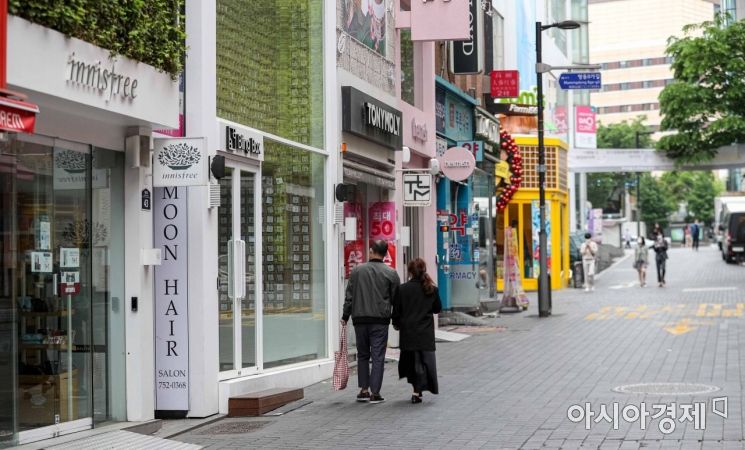 On May 12, the Myeongdong street in Jung-gu, Seoul, where cosmetic stores are concentrated, is seen looking quiet. Photo by Jinhyung Kang aymsdream@
[Asia Economy Reporter Jo In-kyung] Since the outbreak of the novel coronavirus disease (COVID-19), sales at stores located in Seoul have decreased by approximately 3.2 trillion KRW over four months. Due to international travel restrictions, the number of foreigners visiting Korea has sharply declined, causing the daytime population in major business and commercial districts to drop to as low as 78% of usual levels.
According to a report by the Seoul Metropolitan Government and the Seoul Institute examining the social and economic changes in Seoul since the spread of COVID-19, the total card sales at stores in Seoul from February 10 to May 24 amounted to 25.9081 trillion KRW, a 12.3% decrease compared to 29.0961 trillion KRW during the same period last year.
In particular, sales during the last week of February, the first week of March, and the last week of March fell by more than 20% compared to the previous year, but the rate of decline steadily decreased in April and May, with a slight increase (1.8%) recorded during May 18-24.

By industry, over the 15 weeks from February 10 to May 24, Korean cuisine businesses experienced the largest sales decline of about 740 billion KRW compared to other sectors. This was followed by department stores, other food services, academies, and clothing/apparel industries, with the top five sectors accounting for approximately 1.9 trillion KRW (about 58%) of the total sales decrease.
In terms of sales decline rate, duty-free shops were hit the hardest with about a 91.0% drop in sales, followed by travel agencies (-65.9%), comprehensive leisure facilities (-61.8%), early childhood education (-51.7%), and hotels/condominiums (-51.3%), all experiencing sales decreases of over 50%.
Looking at sales decreases by administrative districts, Samsung 1-dong, Seogyo-dong, Sinchon-dong, and Myeong-dong saw sales drop by more than 100 billion KRW each. Significant declines were also observed in business and commercial areas such as Banpo 4-dong, Sogong-dong, Yeoksam 1-dong, Jongno 1, 2, 3, and 4-ga dong, Hangangno-dong, and Jamsil 3-dong.
The daytime population in Seoul also generally decreased compared to the pre-COVID-19 period (January 6-19, 2020), with larger declines on weekends than weekdays.
The decrease in daytime population was due to reductions in visits from residents of other regions (provinces) coming to Seoul for work, study, medical care, or shopping, as well as fewer short-term foreign visitors coming for tourism or business purposes.
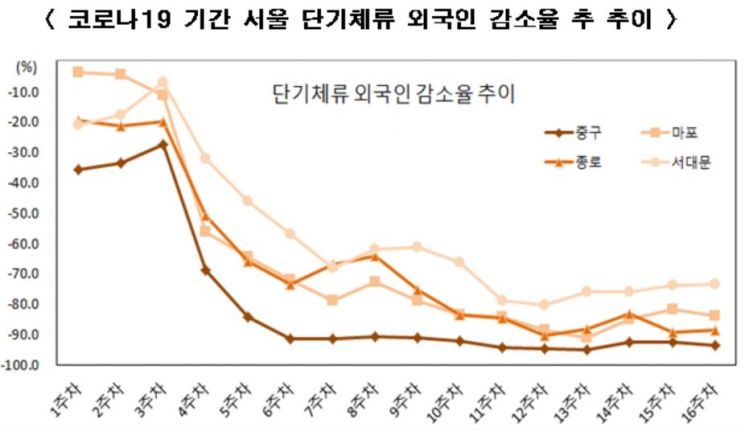
The daytime population residing outside Seoul who used to visit on weekends dropped from 1.51 million on regular weekends to 840,000 during the first weekend after the infectious disease alert was raised to a serious level (February 29-March 1), a decrease of about 56%. Although this number has gradually been recovering, it remained at about 76% of the usual level (1.14 million) as of the fourth weekend of May (~May 24).
Short-term foreign visitors for tourism and business purposes sharply declined from late February, recording a 66.5% drop to 64,000 during the first weekend of May (May 2-3), which is only 33.5% of the usual weekend figure of 191,000.
These changes in daytime population varied by region. Based on weekdays (May 18-22), seven autonomous districts including Gangdong-gu, Seongbuk-gu, Dobong-gu, and Gwangjin-gu exceeded their usual daytime population, whereas recovery was slower in areas such as Jung-gu (77.7%), Jongno-gu (91.4%), and Mapo-gu (93.5%), showing a contrast between residential and business/commercial districts.
Seo Wang-jin, President of the Seoul Institute, stated, "Since March, as citizens' outdoor activities have gradually increased, the decline in store sales has somewhat lessened. However, with cumulative sales losses reaching 3.2 trillion KRW over the past three months, it will take more time for these difficulties to be resolved."
© The Asia Business Daily(www.asiae.co.kr). All rights reserved.



















