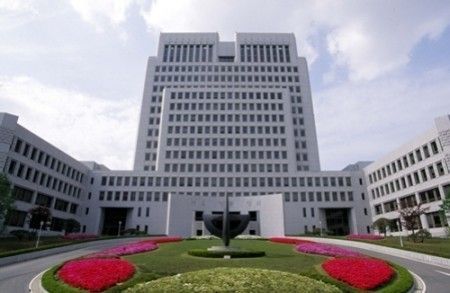
[Asia Economy Reporter Kim Hyung-min] The Supreme Court has ruled that family courts specifying not only the amount of child support for divorced couples but also the method of use, such as requiring the creation of a joint account, excessively restricts the discretion of the caregiver and is therefore unfair.
The Supreme Court's 3rd Division (Presiding Justice Kim Jae-hyung) announced on the 1st that it overturned only the child support payment part of the lower court ruling that accepted the divorce claim filed by Taiwanese woman A against her husband B, and remanded the case to the Incheon Family Court.
The court stated, "At the time of divorce by judicial decision, one parent designated as the guardian and caregiver may claim child support from the other, and in this case, it is reasonable for the family court to determine only the appropriate amount of child support that the other party should bear."
It added, "Specifying the method of using child support, such as requiring expenditures via a check card, excessively restricts the discretion of the caregiver A. Furthermore, requiring regular disclosure of bank account details without mutual agreement between both parties is likely to cause additional disputes."
A married B in July 2016 and gave birth to their daughter C in January the following year. However, due to personality differences and child-rearing issues, they frequently quarreled and eventually filed for divorce in November of the same year.
The first trial ordered the couple to divide their assets and designated A as the child's guardian and caregiver.
B was granted visitation rights with specified periods to meet the child. Additionally, B was ordered to send A between 500,000 and 900,000 KRW monthly as child support until the child reached adulthood.
The second trial maintained the property division from the first trial but ruled differently on child support.
The court held that caregiver A also has a responsibility to bear child support according to income and assets, ordering A to pay 300,000 KRW and B to pay 500,000 KRW monthly.
Child support was to be transferred to an account jointly named under caregiver A and daughter C, and expenditures were to be made using the check card linked to this account.
Additionally, to prevent misuse of child support and increase transparency, the court imposed a condition that expenditure details must be periodically reported to B.
© The Asia Business Daily(www.asiae.co.kr). All rights reserved.
![Clutching a Stolen Dior Bag, Saying "I Hate Being Poor but Real"... The Grotesque Con of a "Human Knockoff" [Slate]](https://cwcontent.asiae.co.kr/asiaresize/183/2026021902243444107_1771435474.jpg)
















