Q1 Net Profit 246.3 Billion
Top 10 Companies Earn 70%
Concentration Worsens Compared to Last Year
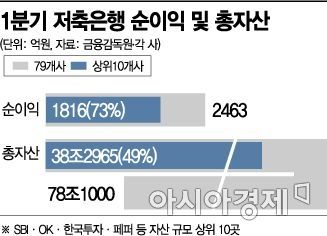
[Asia Economy Reporter Kim Min-young] In the first quarter of this year, the top 10 savings banks accounted for more than 70% of the industry's total net profit. The polarization between large metropolitan savings banks and small- to medium-sized regional savings banks is increasingly widening. Some experts point out that urgent measures are needed as concerns over insolvency are growing, especially among small savings banks.
According to financial authorities and the industry on the 1st, the net profit of 79 savings banks in the first quarter amounted to 246.3 billion KRW, of which 10 large banks including SBI Savings Bank earned 181.6 billion KRW (73.73%).
This concentration phenomenon has intensified compared to last year's 103.3 billion KRW out of 206.3 billion KRW, representing a 50.07% market share.
By company, the industry leader SBI Savings Bank posted a net profit of 68.1 billion KRW in the first quarter alone, an increase of 31.6 billion KRW (86.57%) from 36.5 billion KRW last year. Within the savings bank industry, there are remarks that “SBI is rapidly increasing profits and assets through aggressive lending operations.”
Second-ranked OK Savings Bank also posted a net profit of 39.5 billion KRW, earning 22.2 billion KRW (128.32%) more than last year's 17.3 billion KRW. Third-ranked Korea Investment Savings Bank posted a net profit of 18.6 billion KRW.
Among the top 10, some companies posted losses. Fourth-ranked Pepper Savings Bank recorded a net loss of 1.7 billion KRW, and tenth-ranked OSB Savings Bank posted a loss of 800 million KRW. These companies are known to have taken a conservative view of the business environment due to the impact of COVID-19 and did not significantly increase their loan assets. This indicates that profit polarization has deepened even among the top-tier companies.
Total assets also showed a strong concentration, approaching half (49.03%). The total assets of savings banks in the first quarter were 78.1 trillion KRW, with the top 10 companies accounting for 38.2965 trillion KRW.
SBI Savings Bank holds 9.3246 trillion KRW, nearing the 10 trillion KRW mark. This single savings bank accounts for 11.93% of the total.
Following are OK Savings Bank with 7.3026 trillion KRW, Korea Investment Savings Bank with 3.5036 trillion KRW, Pepper Savings Bank with 3.4548 trillion KRW, and Welcome Savings Bank with 3.2356 trillion KRW.
Among mid-tier and financial holding company-affiliated banks, many posted losses or saw reduced net profits. Sangsangin Plus Savings Bank and IBK Savings Bank recorded net losses of 2.3 billion KRW and 3.3 billion KRW respectively in the first quarter. JT, DB, Aju, Baro, and KB Savings Banks saw their net profits decline compared to the same period last year. Daeya Savings Bank in Pohang, Gyeongbuk, with total assets under 50 billion KRW (2.35 billion KRW), and Daewon Savings Bank in Gyeongju, with total assets of 1.53 billion KRW, posted net losses of 300 million KRW and 200 million KRW respectively in the first quarter. In fact, they are practically unable to conduct proper business operations.
The industry and financial authorities are considering ways to resolve this concentration in large banks. A representative from the Korea Federation of Savings Banks said, “The concentration in the metropolitan area is intensifying, so it is time to consider policy support that can help regional savings banks overcome difficulties.” A financial authority official stated, “Large metropolitan banks have been operating aggressively, while regional savings banks have taken a conservative approach due to the economic downturn. We are discussing appropriate development plans for savings banks.”
© The Asia Business Daily(www.asiae.co.kr). All rights reserved.

















