COVID-19 'Untact' Consumption Drives Rise in Internet Scams
Police to Intensify Crackdown Until October
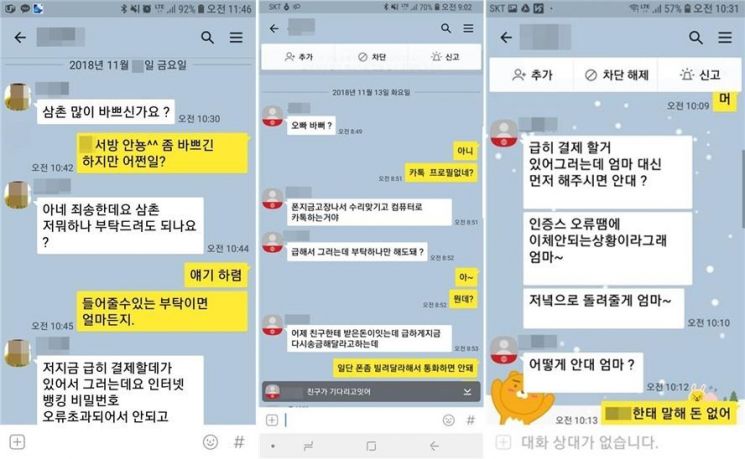
[Asia Economy Reporter Lee Gwan-ju] The nature of economic crimes threatening ordinary citizens is undergoing significant changes. While traditional forms such as voice phishing and insurance fraud have decreased, online economic crimes like messenger phishing using smartphone messengers and cyber fraud have increased.
According to the National Police Agency on the 1st, the number of voice phishing cases from January to April this year was 10,332, a 23.2% decrease compared to 13,455 cases during the same period last year. The number of detected insurance fraud cases, where false insurance claims are made, also dropped by 13.8% to 754 cases compared to last year. On the other hand, messenger phishing, which involves impersonating acquaintances on smartphone messengers such as KakaoTalk to extort money, increased by 132% to 3,957 cases compared to 1,705 cases last year. The amount of damage also rose by 121% to 10.4 billion KRW during the same period.
Messenger phishing is considered a 'substitute crime' for traditional voice phishing. While public vigilance has been strengthened through extensive prevention campaigns by financial authorities and investigative agencies against voice phishing, messenger phishing remains one of the relatively unfamiliar economic crimes. Although messenger phishing was only about one-seventh the scale of voice phishing last year, it has now increased to about two-fifths. In particular, middle-aged and older adults who are less familiar with messenger use are vulnerable to messenger phishing impersonating their children or siblings, requiring caution.
Internet fraud, taking advantage of the spread of untact (non-face-to-face) consumption amid the COVID-19 pandemic, is also rampant. The number of internet fraud cases from January to April was 50,517, an 18.5% increase compared to the same period last year. This is attributed to the rise in false sales of masks through secondhand trading sites. Bodycam phishing and smishing cases increased by 13.7% and 162.9% to 595 and 163 cases, respectively. In particular, various text message scams related to COVID-19 appear to have increased. The police will launch an intensive crackdown on such crimes harming the ordinary economy for five months from today until October 31.
© The Asia Business Daily(www.asiae.co.kr). All rights reserved.
![Clutching a Stolen Dior Bag, Saying "I Hate Being Poor but Real"... The Grotesque Con of a "Human Knockoff" [Slate]](https://cwcontent.asiae.co.kr/asiaresize/183/2026021902243444107_1771435474.jpg)
















