Martial Arts, China Passes 'Hong Kong Security Law' with Report on 'US-China Conflict over Hong Kong Security Law and Impact on Our Exports'
US Sanctions on China May Expand to Memory Semiconductors
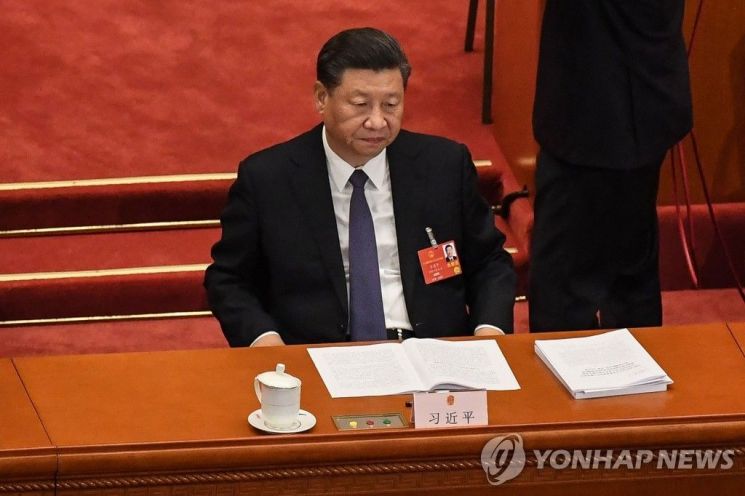
[Asia Economy Reporter Hwang Yoon-joo] The National People's Congress of China held a plenary session on the 28th and passed the "Decision on Establishing the Legal System and Enforcement Agencies for the Hong Kong National Security Law" (Hong Kong Security Law), which monitors and punishes anti-government activities in Hong Kong. This has led to analyses that domestic semiconductor exports and consumer goods exports such as cosmetics and agricultural and marine products are inevitably going to be impacted.
On the 29th, the Korea International Trade Association (KITA) stated in a press reference titled "US-China Conflict Related to Hong Kong Security Law and Its Impact on Our Exports" that "Considering the future impacts through financial (exchange rate), service, investment, and logistics channels, the weakening of Hong Kong's hub function will have a greater impact on the international economy."
If the United States revokes Hong Kong's special trade status, Hong Kong's exports to the US will also be negatively affected, increasing the likelihood of Hong Kong's hub function weakening.
The report explained, "Because the retaliatory tariffs applied by the US to China will be immediately applied to Hong Kong as well," and "If Hong Kong's special trade status is revoked, the existing 1.6% tariff on exports to the US could increase up to 25%." However, the proportion of goods exported from South Korea to Hong Kong that are re-exported to the US was only 1.7% in 2019, so the export impact is expected to be limited.
If US sanctions against Hong Kong are strengthened, it may become difficult to use Hong Kong as a transit country for re-export trade. In this case, KITA's analysis suggests that short-term export disruptions will occur and a shift to direct exports to China will be inevitable. This is because South Korea's re-exports to China via Hong Kong account for 98.1%, the second highest after Taiwan.
The report also pointed out, "Overall export logistics hub function reduction will increase costs and weaken export competitiveness," adding, "In particular, while semiconductors can be shifted to direct exports to China, small and medium-sized export companies other than domestic semiconductor conglomerates are expected to face short-term disruptions due to increased logistics costs and securing alternative air routes."
It continued, "For consumer goods such as cosmetics and agricultural and marine products, China's customs and quarantine procedures are stricter than Hong Kong's, raising concerns about export volume clearance delays," but added, "Recently, quarantine on goods coming from Hong Kong has been strengthened, reducing the advantages of transiting through Hong Kong, and there has been an increase in direct exports to China and use of e-commerce."
It advised preparing countermeasures in case Hong Kong's hub function is lost in the mid to long term, although the likelihood is low. In the worst case, the withdrawal of Chinese Hong Kong sales corporations and the loss of Hong Kong's function as a financial hub (ease of financial procurement and freedom of foreign exchange transactions) cannot be ruled out. This is because switching from re-exports via Hong Kong to direct exports to China increases buyers' purchasing cost burdens.
The report pointed out, "Currently, US sanctions on China are limited to system semiconductors, but there is a possibility of expansion to memory semiconductors, which are our main products," and "70% of exports to Hong Kong are semiconductors (memory semiconductors account for 79.5%, system semiconductors 18.8%)."
However, the report emphasized that even amid escalating US-China conflicts, there are opportunity factors for domestic export companies.
The report stated, "If the US-China conflict escalates and China’s exports to the US via Hong Kong are blocked, our companies can secure a relative competitive advantage in exports to the US," adding, "Due to the strengthening of US sanctions on China, our exports are expected to gain a reflective benefit in sectors with high export competition such as petrochemicals, home appliances, medical and precision optical devices, steel products, and plastics." This is because our companies’ global market share can expand in smartphone and telecommunications equipment markets, which are currently in competition with China due to US sanctions.
Meanwhile, the Hong Kong Security Law, which includes monitoring anti-government activities in Hong Kong and prohibiting foreign forces from interfering in Hong Kong's internal affairs, was passed by vote at the National People's Congress of China.
In response, the US pressured China by threatening to revoke Hong Kong's special status, which it had recognized in tariffs, investment, and visa issuance, if China enacts the Hong Kong Security Law. If Hong Kong loses its special status, it will have to bear additional tariffs of up to 25% imposed by the US, just like mainland China, and a massive outflow of foreign capital is expected due to the loss of its role as a financial hub.
© The Asia Business Daily(www.asiae.co.kr). All rights reserved.
![Clutching a Stolen Dior Bag, Saying "I Hate Being Poor but Real"... The Grotesque Con of a "Human Knockoff" [Slate]](https://cwcontent.asiae.co.kr/asiaresize/183/2026021902243444107_1771435474.jpg)
















