[Asia Economy Beijing=Special Correspondent Park Sun-mi] Despite opposition from the United States and other Western countries, the draft of the Hong Kong National Security Law (Hong Kong Security Law) was overwhelmingly passed at the closing meeting of the National People's Congress (NPC) on the 28th.
◆ Passed by an overwhelming majority... Li Keqiang: "One Country, Two Systems is a fundamental national policy"= At 3 p.m. local time on the 28th, during the closing meeting of the NPC held at the Great Hall of the People in Beijing, the draft of the Hong Kong Security Law was passed by vote. The draft was the fifth of nine agenda items to be voted on that day. A total of 2,885 NPC delegates participated in the vote, with 2,878 in favor, 1 against, and 6 abstentions.
After the vote on the draft of the Hong Kong Security Law, the Standing Committee will convene to proceed with the legislative process. The content of the Hong Kong Security Law will be implemented by inserting it into "Annex III of the Hong Kong Basic Law."
The Hong Kong Security Law prohibits and punishes foreign forces' interference in Hong Kong's internal affairs, acts of secession, subversion of state power, terrorism activities, and establishes institutions within Hong Kong to enforce these provisions. Despite the United States' blatant attacks opposing China's enactment of the Hong Kong Security Law, China has emphasized that this law is necessary for national security and has pushed it through.
Immediately after all nine agenda items were voted on and passed, Li Zhanshu, Chairman of the NPC Standing Committee, explained regarding the passed Hong Kong Security Law, "It is a significant measure to uphold and improve the One Country, Two Systems framework, aligning with the fundamental interests of the entire China, including Hong Kong citizens." He added, "The NPC Standing Committee will enact the Hong Kong Security Law and safeguard national sovereignty, security, and development interests according to the law to maintain the stability of 'One Country, Two Systems.'"
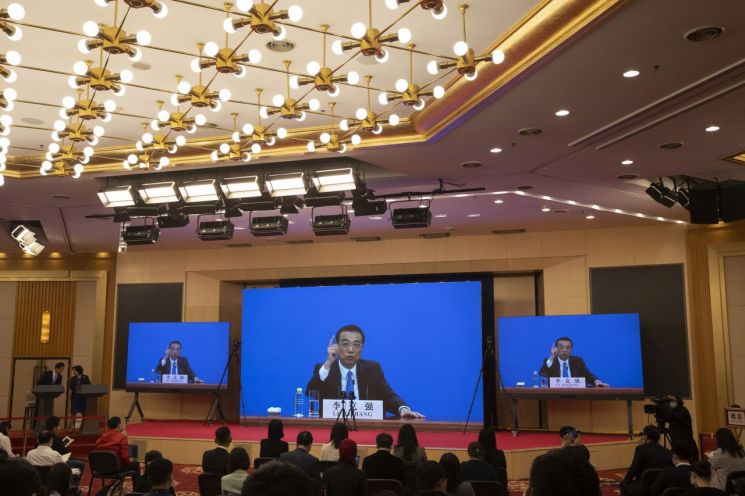
Chinese Premier Li Keqiang also emphasized at a press conference following the NPC closing that the enactment of the Hong Kong Security Law is to maintain the stability of One Country, Two Systems and Hong Kong's long-term prosperity.
When asked whether the Hong Kong Security Law could be interpreted as abandoning One Country, Two Systems, Premier Li responded, "One Country, Two Systems is a fundamental national policy." He added, "The central government has consistently emphasized One Country, Two Systems and Hong Kong people's governance of Hong Kong with a high degree of autonomy. Our position to support the rule of law by the Hong Kong Special Administrative Region government and the Chief Executive in accordance with the Constitution and the Basic Law remains consistent."
With the draft of the Hong Kong Security Law passed and entering the formal legislative process, protests by Hong Kong citizens and the pro-democracy camp are expected to intensify. Large-scale protests opposing China's enforcement of the Hong Kong Security Law were held in Hong Kong the previous day, with police arresting more than 360 protesters carrying illegal weapons on the spot. Over 3,000 police officers were deployed for riot control, and tear gas was also used.
Following the passage of the Hong Kong Security Law draft at the NPC, the Hong Kong financial market reflected unease. The Hang Seng Index closed at 23,132.76, down 0.72% from the previous trading day. Following the People's Bank of China’s announcement that the yuan's central parity rate against the dollar rose 0.26% to 7.1277 yuan in the morning, the offshore and onshore yuan-dollar exchange rates traded at elevated levels of approximately 7.17 yuan and 7.15 yuan, respectively. The previous night, the offshore yuan exchange rate surged intraday by 0.7% to 7.1964 yuan, marking the lowest yuan value since the offshore foreign exchange market was established.
◆ Passage of the bill likely to further escalate US-China tensions= Although the detailed provisions of the Hong Kong Security Law have not yet been finalized, based on the case of Macau, there are expectations that China may impose prison sentences of up to 30 years on individuals engaging in anti-China activities under the law.
Given the United States' remarks that "Hong Kong will find it difficult to enjoy a high degree of autonomy" due to China's enforcement of the Hong Kong Security Law, the possibility of revoking Hong Kong's special status, which has been maintained for 28 years, has increased. If the US revokes this status, not only Hong Kong but also the Chinese economy is expected to suffer a domino effect.
If the special status is revoked, the risk of further credit rating downgrades for Hong Kong will increase. In September last year, global credit rating agency Fitch was the first among rating agencies to downgrade Hong Kong's credit rating from 'AA+' to 'AA' and lowered the rating outlook to 'negative.' The reason cited was the loosening of the One Country, Two Systems governance framework, reducing Hong Kong's distinctiveness from China. Subsequently, Fitch further downgraded Hong Kong's rating to AA- in April this year. Moody's also lowered Hong Kong's rating outlook to 'negative' in September last year for similar reasons and downgraded the credit rating from 'Aa2' to 'Aa3' in January this year.
There is also a possibility of large-scale capital outflows from Hong Kong. Due to its financial market openness distinct from mainland China, Hong Kong has been a concentration point for mainland Chinese wealthy individuals' flight capital. For traders, it has served as a stable cash investment destination offering higher interbank market interest rates than the US. If capital outflows worsen, Hong Kong's dollar peg system could be shaken. The Hong Kong Monetary Authority fixes the Hong Kong dollar to the US dollar at a rate of 7.75 to 7.85 HKD per USD through the US-Hong Kong dollar peg system. Maintaining a stable dollar peg requires abundant dollar liquidity, but capital flight could reduce foreign exchange reserves.
If Hong Kong becomes unstable, the Chinese economy is also expected to be adversely affected. Hong Kong currently accounts for less than 4% of China's total GDP, significantly lower than the 18% share when Hong Kong's sovereignty was returned to China in 1997. However, Hong Kong has served as China's offshore financial center and a bridgehead for trade and investment. Last year, 70% of China's foreign direct investment inflow of $138 billion, amounting to $96.3 billion, was conducted through Hong Kong. This indicates that an economic contraction in Hong Kong could directly impact the Chinese economy.
© The Asia Business Daily(www.asiae.co.kr). All rights reserved.

















