“Daesak as an Art World Practice and Contemporary Art Trend?”... 1st and 2nd Trial Judgments Sharply Divided, Drawing Art World Attention
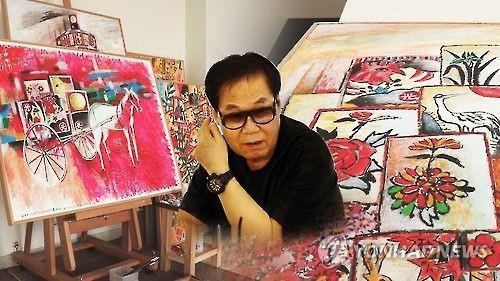 Singer Jo Young-nam. Photo by Yonhap News
[Asia Economy Reporter Choi Seok-jin] Ahead of the Supreme Court's final verdict on Jo Young-nam (75), who was indicted on charges of ‘fraud’ for selling a large-scale forgery painting worth about 150 million won, a public hearing involving senior figures from the art world will be held at the Supreme Court on the 28th.
The first trial, which concluded that Jo committed fraud by deceiving buyers into believing that paintings drawn by others were entirely his own work and sentenced him to a suspended prison term, and the second trial, which judged it as a normal artistic activity using technical assistants, reached completely opposite conclusions in every aspect.
Therefore, attention from the art and legal communities is focused on whether the Supreme Court will uphold the second trial’s acquittal or reverse the decision again.
The Supreme Court’s First Division (Presiding Justice Kwon Soon-il) will conduct a public hearing for the appeal trial of Jo and others indicted for fraud at 2 p.m. at the Supreme Court courtroom in Seocho-gu, Seoul.
At today’s public hearing, Shin Je-nam, a mid-career painter and chairman of the Korea Professional Artists Association, will attend as a prosecution witness, and Pyo Mi-seon, former president of the Korea Gallery Association, will attend as a defense witness, each providing opinions favorable to their respective sides.
Jo was indicted on charges of defrauding 15,355,000 won by selling 21 paintings to 17 victims, which were created by paying painter Song Mo, whom he had known since 2009, 100,000 won per piece to paint his existing collage works as paintings, to replicate his existing paintings, or to paint based on ideas he provided.
It was also investigated that when it was difficult to request works from Song due to disputes, Jo had a person identified as A, a master’s course student in the painting department at Hongik University Graduate School, perform the same tasks.
◆First trial recognizing ‘fraud’ guilt and sentencing a suspended prison term= The first trial, which recognized Jo’s guilt for fraud, judged that Song and A, who painted the works on his behalf, could not be simply regarded as ‘assistants’ playing a technical support role but were independent ‘artists.’
In particular, Song was evaluated by the court as a professional painter with a level of skill and artistic quality far superior to Jo’s, having worked for over 20 years in places like New York, won awards at art exhibitions, and held more than 100 exhibitions.
Therefore, the court viewed the relationship between Jo and Song not as employment paying wages for labor but as a contract for work where payment is made for the completion of a task.
Also, whether Jo personally participated in the entire process of producing the works he sold was considered an essential factor for buyers in deciding whether to purchase and at what price, so Jo had an obligation to inform buyers in advance that the works were not entirely painted by himself.
Ultimately, the failure to fulfill this duty of disclosure was regarded as deception by omission, which is necessary for establishing fraud under criminal law.
In court, Jo argued that his work using Hwatu (Korean playing cards) as a motif belonged to the genre of contemporary art, such as ‘pop art’ or ‘conceptual art,’ which is distinct from traditional ‘painting.’
He claimed that it is a natural phenomenon in mainstream contemporary art for the artist to provide the main ideas or concepts while multiple hired assistants carry out the concrete expressive work.
However, the court rejected this argument, stating that ‘pop art’ or ‘conceptual art’ and painting are not mutually exclusive concepts and thus should not be treated differently.
Statements from victims who purchased Jo’s paintings at high prices also served as important evidence for recognizing guilt. During the investigation, most victims answered that they would not have bought the paintings if they were not painted by Jo himself.
◆Second trial completely overturning the judgment and acquitting= The first trial’s judgment was almost entirely overturned in the second trial.
First, the second trial court judged that the idea of paintings using Hwatu as a motif was Jo’s original creation, and Song was merely a technical assistant, i.e., an ‘assistant,’ who realized the idea into a work.
It was also noted that although not frequent, Song sometimes modified the paintings according to Jo’s instructions.
Therefore, the relationship between the two was seen as an employment relationship where Song provided labor under Jo’s instructions and received a certain payment.
Regarding the essential element of deception for establishing fraud, the second trial court, unlike the first, held that Jo had no obligation to inform buyers that the works were not entirely painted by himself, so it could not be considered implicit deception.
This judgment was based on the view that whether the work was personally painted by Jo was only one of several factors buyers considered when purchasing the paintings.
Although most victims answered that they would not have bought Jo’s works if they had known in advance that they were not personally painted, the court judged that what these buyers cared about was whether ‘this is a work by Jo Young-nam’ or ‘whether this work is circulated in the market as Jo Young-nam’s work,’ i.e., whether it was a fake or genuine, rather than whether it was personally painted by him.
Furthermore, the second trial court acknowledged that hiring assistants for artwork production, as Jo claimed, is one of the phenomena in contemporary art.
Meanwhile, today’s public hearing will be broadcast live through the Supreme Court website, Naver TV, Facebook Live, and YouTube.
© The Asia Business Daily(www.asiae.co.kr). All rights reserved.
















