72.7% Response for 'Utilization' at Introduction · 85.3% Response for 'Utilization When Suspecting COVID-19 Symptoms'
[Asia Economy Reporter Ki-min Lee] A survey has revealed that more than 60% of South Korean citizens have a positive view of telemedicine.
The Federation of Korean Industries (FKI) announced on the 28th that it commissioned the public opinion research firm Monoresearch to conduct a ‘Public Perception Survey on Telemedicine’ targeting 1,021 adults nationwide. The results showed that the proportion of respondents who answered positively to the introduction of telemedicine (62.1%) was about 3.4 times higher than those who answered negatively (18.1%).
Currently, South Korea prohibits telemedicine between medical staff and patients. However, telemedicine is temporarily allowed for telephone consultations and prescriptions when safety can be ensured, as a response measure to the novel coronavirus infection (COVID-19).
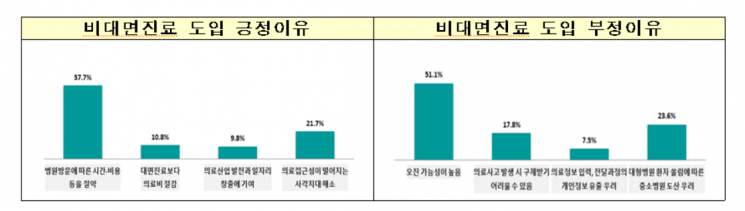
The reasons for positive views on the introduction of telemedicine were ranked as follows: ▲saving time and costs associated with hospital visits (57.7%), ▲resolving blind spots with poor medical accessibility (21.7%), and ▲reducing medical expenses compared to face-to-face consultations (10.8%).
By age group, the positive opinion rate was 65.5% among those aged 40 and above, while 55.6% of those under 40 showed a positive response. The Korea Economic Research Institute explained that those aged 40 and above, who relatively have more experience visiting hospitals, empathize with the necessity of introducing telemedicine.
On the other hand, the reasons for negative views on the introduction of telemedicine were ▲high possibility of misdiagnosis (51.1%), ▲concerns about the bankruptcy of small and medium-sized hospitals due to patient concentration in large hospitals (23.6%), ▲difficulty in receiving compensation in case of medical accidents (17.8%), and ▲concerns about personal information leakage during medical information input and transmission (7.5%).
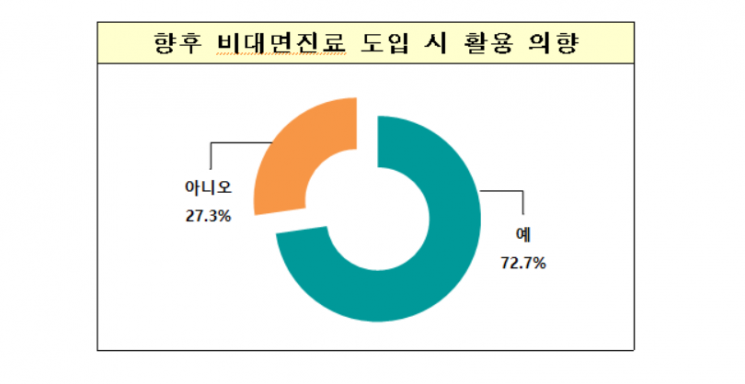
If telemedicine is introduced in South Korea, the response ‘intend to use it’ (72.7%) was about 2.7 times higher than ‘do not intend to use it’ (27.3%). Additionally, nearly half (47.2%) of those who answered that they do not intend to use telemedicine said they would be willing to use it if various side effects such as the possibility of misdiagnosis and medical accident issues during telemedicine were resolved.
In particular, when experiencing suspected COVID-19 symptoms, 85.3% of all respondents said they intended to use telemedicine. This is 5.8 times higher than the 14.7% who said they did not intend to use it.
Challenges for the future introduction of telemedicine include ‘gradual introduction starting with chronic patients, the elderly and disabled, and residents of islands and remote areas’ (46.7%), ‘minimizing the possibility of misdiagnosis through the distribution of excellent medical devices’ (21.5%), ‘legal and institutional improvements to clarify responsibility for medical accidents’ (20.3%), and ‘measures to prevent patient concentration in large hospitals’ (11.5%).
Kim Bong-man, Director of International Cooperation at FKI, evaluated the survey results by saying, “Since the public’s positive perception of telemedicine is significant, it is necessary to ease related regulations on the premise of preparing measures to prevent side effects arising from its introduction.”
© The Asia Business Daily(www.asiae.co.kr). All rights reserved.
![Clutching a Stolen Dior Bag, Saying "I Hate Being Poor but Real"... The Grotesque Con of a "Human Knockoff" [Slate]](https://cwcontent.asiae.co.kr/asiaresize/183/2026021902243444107_1771435474.jpg)

















