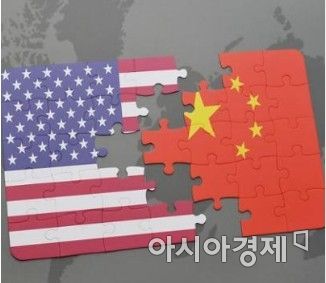
[Asia Economy Beijing=Special Correspondent Park Sun-mi] Regarding the U.S. response to the forced enactment of the Hong Kong National Security Law (Hong Kong Security Law), voices within China are saying that there are sufficient counterattack cards and that a long-term battle must be prepared for.
On the 28th, Chinese state-run media Global Times and Huanqiu Shibao stated in editorials that "the enactment of the Hong Kong Security Law is a bill gaining support momentum even within Hong Kong," and "since China decided to push forward the enactment of the Hong Kong Security Law, it has been prepared for any U.S. response. Sanctions on personal assets and visas by the U.S. will not be effective." They added, "Although a conflict between the U.S. and China is unfolding over Hong Kong, since Hong Kong is under China's governance, any action by the U.S. will become futile."
The newspapers advised, "Long-term competition between the U.S. and China is inevitable," and "China must adopt a calm mindset and prepare for a long-term battle against U.S. attacks."
They continued, "China will not take impulsive actions to sever relations with the U.S. but will rather deepen reforms and open its markets. However, if the U.S. insists on decoupling from China, it can be left as is," explaining, "Decoupling from China is the last card that U.S. President Donald Trump holds." They added that China needs to supplement its capabilities in advanced technology sectors, which are key strengths of the U.S., in preparation for decoupling.
China, which must prepare for a long-term battle, has various counterattack cards it can play against the U.S. In particular, economic experts advise preparing for the possibility that the U.S. may wage a financial war against China in response to the enactment of the Hong Kong Security Law.
One of China's counterattack cards against a financial war is its massive holdings of U.S. Treasury bonds. China is the second-largest holder of U.S. Treasury bonds in the world after Japan. As of the end of March, China's holdings of U.S. Treasury bonds stood at approximately $1.08 trillion. If China were to sell off a large volume of U.S. Treasury bonds all at once, it could trigger a sharp drop in the value of the dollar or a plunge in U.S. bond prices and a rise in interest rates, potentially leading to a collapse of the dollar and financial markets. China's reduction of U.S. Treasury holdings was often mentioned as a "retaliation card" in financial markets last year when tensions escalated during the U.S.-China trade war.
The second counterattack card China could play is imposing sanctions on U.S. companies. When the U.S. sanctioned Chinese companies and government agencies on the 22nd, China also warned that "China will take necessary measures to safeguard the legitimate rights of Chinese companies, national sovereignty, security, and development interests," signaling reciprocal actions. There is speculation that many U.S. companies could be included on China's foreign company blacklist known as the "Unreliable Entities" list.
Dong Dengxin, Director of the Finance and Securities Institute at Wuhan University of Science and Technology, said, "China can dispose of massive U.S. dollar-denominated assets and impose sanctions on U.S. companies that rely on the Chinese market."
The use of the yuan is also a possible counterattack card from China. Yang Zhirong, a researcher at the Chinese Academy of Social Sciences, said, "To balance against U.S. financial sanctions on China, China may accelerate the internationalization of the yuan," adding, "It could promote the use of the yuan instead of the dollar in currency settlements with other countries."
Yuan devaluation could also deal a fatal blow to the U.S. President Trump has been striving to reduce the U.S. trade deficit with China, but if China uses yuan devaluation as a retaliation card, President Trump's efforts will be in vain. Following the example of Australia, which sided with the U.S. and faced economic retaliation from China, there are opinions that China could also expand additional tariffs on U.S. goods and services or halt purchases of U.S.-made products.
© The Asia Business Daily(www.asiae.co.kr). All rights reserved.
















