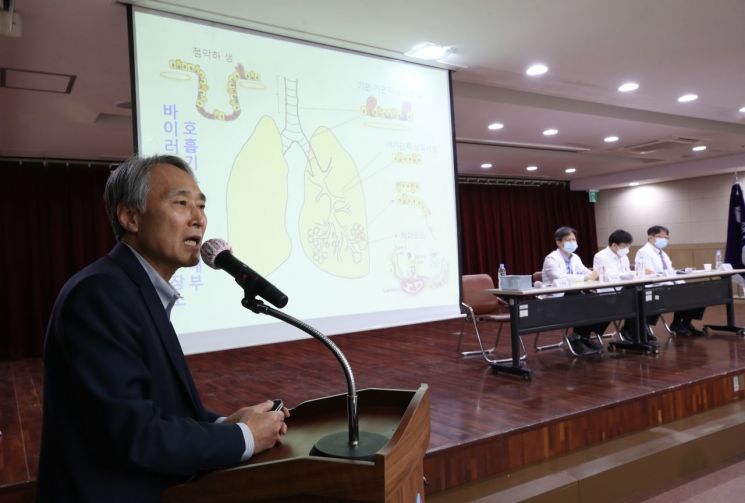
 Professor Oh Myung-don, head of the Central Clinical Committee for Emerging Infectious Diseases and an infectious disease specialist at Seoul National University Hospital, is giving a presentation on COVID-19 treatment at the National Medical Center in April. Professor Oh is conducting domestic and international clinical trials and research on Remdesivir.<이미지: Yonhap News>
[Asia Economy Reporter Choi Dae-yeol] Regarding the antiviral drug 'Remdesivir,' originally developed as a treatment for Ebola virus disease but recently confirmed to be effective against the novel coronavirus disease (COVID-19), the quarantine authorities announced on the 26th that they will decide whether to use it domestically after consulting with clinical experts.
At a regular briefing on the same day, Kwon Jun-wook, Deputy Head of the Central Disaster and Safety Countermeasure Headquarters for COVID-19, stated, "On the 28th, the Central Clinical Committee will discuss Remdesivir, and based on the results, procedures such as special importation and emergency importation will be carried out through the relevant ministry, the Ministry of Food and Drug Safety."
Remdesivir is a treatment developed by the American company Gilead, and a paper containing recent global clinical results was published in the New England Journal of Medicine (NEJM). Professor Oh Myung-don, head of the Central Clinical Committee for Emerging Infectious Diseases and an infectious disease specialist at Seoul National University Hospital, also participated in the research, and clinical trials are being conducted domestically as well. Professor Oh commented, "This means it has been recognized as the first standard treatment for COVID-19," adding, "Future treatments will need to show effects at least similar to or better than Remdesivir."
This treatment is a case of drug repurposing, and due to the advanced progress of clinical trials, it has attracted attention both domestically and internationally. Deputy Head Kwon explained, "It can significantly reduce the hospitalization period for severe and critically ill patients, and by doing so, in the event of a sudden surge in patients, it can save lives and provide some relief in utilizing the medical system."
He continued, "Even though it does not have the function to block transmission early or treat mild patients, and although it is not statistically significant, it is meaningful just by being able to reduce the mortality rate," adding, "We believe it can be meaningfully used for at least 5% or more of critically ill patients domestically."
© The Asia Business Daily(www.asiae.co.kr). All rights reserved.

















