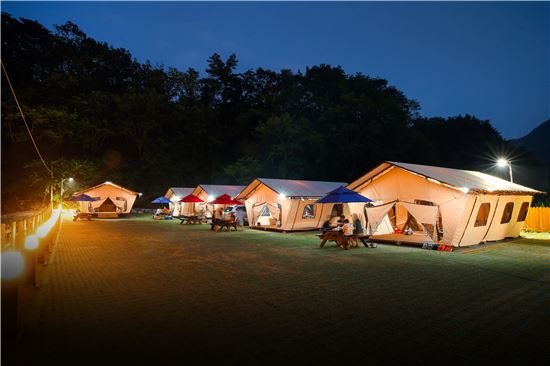
 Yeongwol Glamping Site
[Asia Economy Reporter Kim Heung-soon] The government has decided to ease regulations in related sectors and support growth in the private sector to aid the domestic tourism industry, which has been severely impacted by the novel coronavirus disease (COVID-19). They are considering measures to improve the hotel industry classification system and lower entry barriers in areas where visitors can enjoy tranquility and nature, such as campgrounds, forest recreational tourism, and rural homestays.
At the '5th National Tourism Strategy Meeting' held at the Government Seoul Office at 2 p.m. on the 26th, chaired by Prime Minister Chung Sye-kyun, plans to promote regulatory innovation in the tourism industry, including these measures, were discussed.
◆ Improvement of Hotel Industry Classification System and Reorganization of Registration Standards= The Ministry of Culture, Sports and Tourism, the main government body responsible for the tourism industry, will first improve the hotel industry classification system and reorganize registration standards. The current seven categories?tourist hotels, water tourism hotels, family hotels, medical tourism hotels, small hotels, Korean traditional hotels, and hostels?will be consolidated into two categories: tourist hotels and Korean traditional hotels.
The detailed hotel industry subcategories have become ambiguous due to the creation of new categories whenever new accommodation demands arise, and differing registration standards have been perceived as unnecessary regulations by business operators.
The hotel registration standards will also be reorganized to include ▲ relaxation of the room number requirement for tourist hotels (from 30 rooms to 20 rooms) ▲ easing of ancillary facility requirements for small hotels (requiring two or more ancillary facilities, with area limits) ▲ removal of regulations requiring services for foreigners.
◆ Review of Shared Accommodation and Forest Recreational Tourism= The Ministry of Culture, Sports and Tourism is also considering institutionalizing a system that allows urban homestays, previously permitted only for foreigners, to be used by both domestic and foreign guests, enabling shared accommodation business models like Airbnb to take root in Korea.
To ensure this plan does not hinder the growth of existing accommodation industries such as hotels but rather promotes coexistence, a 'coexistence consultative body' will be operated to gather opinions from various sectors and develop institutional improvement plans. In mountainous areas, the government plans to consider enacting a special law to designate special zones where mountain hotels, similar to those seen in Switzerland, can operate.
◆ Deregulation of Transfer and Assignment in Camping Industry and Rural Homestays= Regulations on the popular camping and other outdoor industries will also be eased. With the revision of the Enforcement Decree of the Tourism Promotion Act, since the 28th of last month, an exception clause has been applied to the floor area ratio restriction that was an obstacle to using closed schools as campgrounds, laying the foundation for 554 closed schools to be transformed into campgrounds. Additionally, a regulatory special case will be pilot-operated to allow glamping facilities, which were previously only allowed to be made with tents for safety reasons, to be constructed using various materials.
Since the introduction of size restrictions on rural homestays in 2005 (currently limited to 230㎡ or less), it has been impossible to newly register homestay businesses exceeding the facility size if they were transferred or assigned. The government plans to improve this by allowing new registration and operation for transferees of businesses that were lawfully reported before the introduction of the size restriction.
Furthermore, the capital registration requirement for general travel agencies will be lowered from the current 100 million KRW to 50 million KRW to facilitate easier startups based on ideas alone.
The Ministry of Culture, Sports and Tourism and related ministries pledged, "We will continue to identify and improve unnecessary regulations to support the tourism industry, which is struggling due to COVID-19, so that it can grow again."
© The Asia Business Daily(www.asiae.co.kr). All rights reserved.
















