Disagreement Over First Meeting Venue
Company Executive at Senior Manager Level as Partner
Unions at 12 Places Including Electronics...Still Weak Momentum
Long Way to Go Until New Relationship Establishment
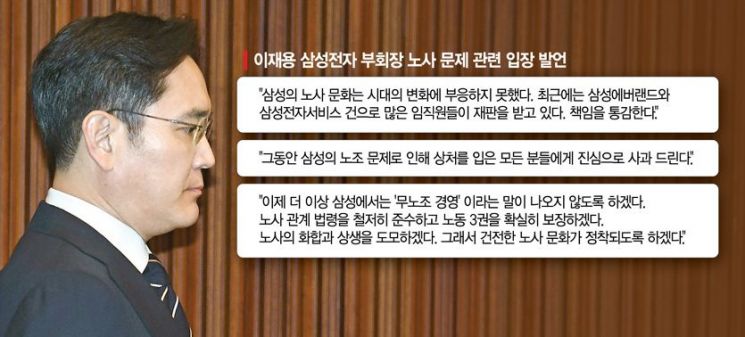
[Asia Economy Reporter Ki-min Lee] As Samsung Display's labor and management began negotiations on wages and collective agreements (wage and collective bargaining, or wage negotiations) on the 26th, Samsung's new labor-management relationship, based on Vice Chairman Lee Jae-yong's declaration to abolish 'no-union management,' has entered a full-fledged test stage. On the 6th, Lee issued a public apology, stating, "We will ensure that the term 'no-union management' will no longer be used at Samsung," declaring the abolition of no-union management and promising the guarantee of the three labor rights. This marks a critical turning point as Samsung parts ways with the no-union management principle it has upheld for 82 years since its founding.
The wage and collective bargaining negotiations at Samsung Display, held amid keen business community interest, began with tense atmosphere. The labor and management sides of Samsung Display showed differences starting from the selection of the meeting venue and the representatives for the main negotiations. The management proposed holding the negotiations at a nearby township office due to concerns about workplace damage from the COVID-19 pandemic and sent a human resources executive at the senior manager level as the negotiation partner. However, the union opposed this, arguing that the absence of the CEO at a non-company location raised doubts about the sincerity of the company’s approach. It remains uncertain whether Samsung Display, which has initiated the first wage and collective bargaining after abolishing no-union management, will be able to narrow these differences and produce smooth results. Some in the business community express concerns that, like Hyundai Motor Company led by a strong union, Samsung might face a situation where it pays high wages but engages in tedious annual salary negotiations with management.
There have been internal attempts to break down Samsung’s no-union management, which has been rooted for over 80 years. Following the will of founder Lee Byung-chul, Samsung forcibly disbanded the CheilMojik union in 1960 and the CheilJedang Mipung factory union in 1977, neutralizing union power. After Lee Byung-chul, Lee Kun-hee, who became chairman of Samsung Electronics in December 1987, also maintained the no-union stance, stating during a visit to a media outlet, "Samsung will manage without the need for unions."
The decisive turning point shaking Samsung’s no-union management trend came last December when Lee Sang-hoon, former chairman of Samsung Electronics’ board, was abruptly arrested on charges of dismantling the Samsung Electronics Service union. At that time, Samsung Electronics, Samsung C&T, and other affiliates officially apologized, stating, "The company’s past views and perceptions of unions did not meet the public’s expectations and societal standards." Recently, Vice Chairman Lee bowed before the public regarding union issues.
The Samsung Compliance Committee also played a significant role in leading the abolition of no-union management. Early this year, Lee established the Samsung Compliance Committee, chaired by former Supreme Court Justice Kim Ji-hyung, to strengthen compliance management. In March, the committee delivered corrective recommendations to the company, urging Vice Chairman Lee to directly address three issues: unions, management succession, and external communication.
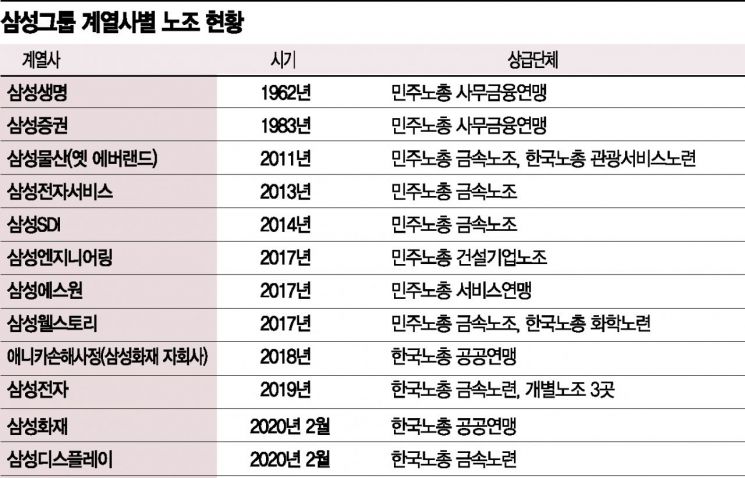
However, there is still a long way to go before Samsung establishes a new labor-management relationship. Labor unions have been established in 12 Samsung affiliates, including Samsung Electronics, Samsung Life Insurance, and Samsung Fire & Marine Insurance. However, due to Samsung’s no-union management policy and the small number of union members, the unions have been considered weak in momentum. According to business and labor circles, the number of union members in Samsung affiliates ranged from several dozen to several hundred but has increased over the past one to two years. Most Samsung affiliates determine wage and welfare levels through labor-management councils involving executives, so direct negotiations between labor and management are relatively unfamiliar.
Within the business community, there are concerns that Samsung’s unions should not repeat the outdated labor-management conflicts seen in the automotive industry, where strong unions are the norm. The aim is to prevent situations where unions make excessive demands in difficult business environments, causing harm to both sides, and to find ways for labor and management to coexist and develop together.
A business community official said, "Starting with Samsung Display, wage and collective bargaining negotiations at major affiliates will continue," adding, "Since Samsung has taken its first step away from no-union management, we hope it will create a model case for establishing advanced labor-management relations."
© The Asia Business Daily(www.asiae.co.kr). All rights reserved.


















