"Chinese Digital Currency Could Threaten the Dollar if Convenience is Proven"
US Federal Reserve Shifts from Negative Stance on Digital Currency... "Digital Dollar Issuance Possible"
Private Sector Including Facebook Libra Also Joins... Issuance Accelerating Within the Year
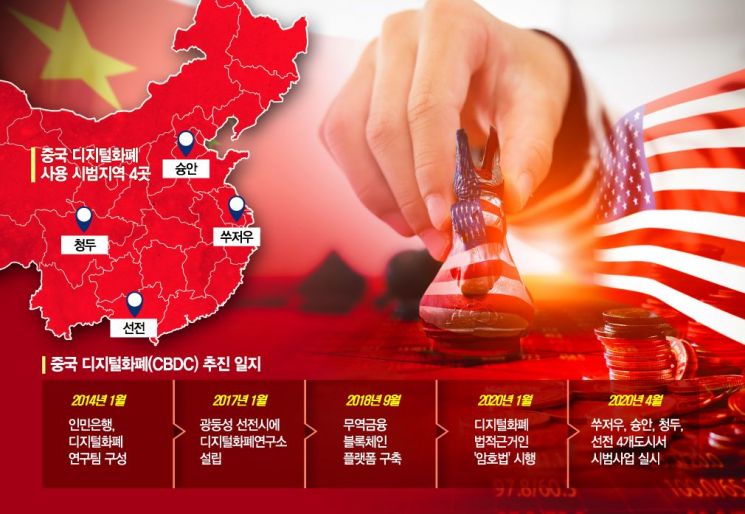
[Asia Economy Reporter Hyunwoo Lee] Concerns have been raised on Wall Street that China's issuance of digital currency (CBDC) could threaten the dominance of the US dollar. Despite the ongoing COVID-19 pandemic, China is pushing forward with pilot projects for its CBDC and plans to issue it within the year, which the US financial sector views as a threatening factor. The US Federal Reserve (Fed) has also shifted from a negative stance on digital currencies to hinting at issuing a digital dollar, signaling that the US-China hegemony battle is spreading into the realm of digital currencies.
On the 25th (local time), according to the US economic magazine Forbes, global investment bank JP Morgan recently released a report stating that "China's issuance of CBDC could threaten the hegemony of the US dollar." JP Morgan's report said, "While CBDCs cannot immediately shake the dollar's status as the reserve currency, if their convenience is proven in trade settlements or international remittances, they could gradually displace the dollar's position." It warned, "If CBDCs are used for international transactions instead of the dollar, it would become significantly more difficult for the US to impose economic sanctions on adversary countries and to clamp down on terrorists' funding channels."
JP Morgan's warning stems from the assessment that China's CBDC expansion is serious. The Chinese government is focused on developing CBDCs to increase the share of the yuan in international settlements. Since 2014, China has been developing digital currency and, despite the ongoing COVID-19 situation, is pushing forward with CBDC pilot projects in four major cities: Suzhou, Xiong'an, Chengdu, and Shenzhen. China plans to officially launch the CBDC within the year and distribute it nationwide before the 2022 Beijing Winter Olympics.
Bloomberg News pointed out that the Chinese government is distributing CBDCs through the Belt and Road Initiative (land and maritime Silk Road) projects and foreign e-commerce to increase the yuan's share in international settlements and, in the long term, to establish a foundation for a reserve currency. According to the Society for Worldwide Interbank Financial Telecommunication (SWIFT) in January, the yuan's share among global payment currencies was only 1.7%. This is smaller than the US dollar (40.8%), euro (33.6%), pound sterling (7.1%), yen (3.3%), and even the Canadian dollar (1.8%).
In response to China's moves, the US Federal Reserve, which had been negative about digital currencies, is also changing its stance by hinting at issuing a digital dollar. Fed Chair Jerome Powell said in an interview with CBS on the 17th, "The Fed has the capability to issue money digitally and could use digital dollars to purchase Treasury bills or government-backed securities," adding, "This could increase the money supply." This marks a significant change from previous positions. Last July, during a US House hearing on Facebook's digital currency Libra, Powell criticized digital currencies, citing serious concerns about privacy, money laundering, and financial stability.
The US-China digital currency hegemony battle is expected to involve not only central banks but also the private sector. Recently, Libra announced it would issue a digital currency pegged to the dollar's value by leveraging existing institutional frameworks. Previously, Libra had maintained a stance to launch a global single virtual currency, but due to regulatory pressures from financial authorities worldwide, it abandoned the original plan and decided to issue a 'stablecoin' pegged to existing currencies like the dollar. Libra's impact is expected to be significant in the online market, as it has partnerships with 21 companies beyond Facebook. Recently, Libra has focused its efforts on launching within the year by recruiting financial regulatory expert Stuart Levy, former US Treasury Deputy Assistant Secretary, as CEO, and Robert Werner, former head of the US Financial Crimes Enforcement Network (FinCEN), as Chief Legal Officer.
© The Asia Business Daily(www.asiae.co.kr). All rights reserved.
![Clutching a Stolen Dior Bag, Saying "I Hate Being Poor but Real"... The Grotesque Con of a "Human Knockoff" [Slate]](https://cwcontent.asiae.co.kr/asiaresize/183/2026021902243444107_1771435474.jpg)
















