Blocked Exports of Recyclables Due to COVID-19... "Need to Open the Way for SRF Power Generation"
Calls for Expansion of EPR Subsidy Benefits and Support in the Recycling Industry
Improvements Needed in Packaging-Related Laws and Systems... "Concerns Over Worsening Financial Difficulties in the Industry"
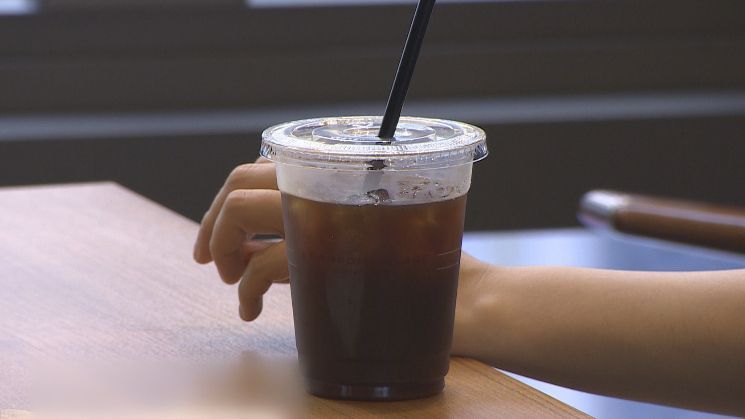
[Asia Economy Reporters Kim Bo-kyung and Moon Chae-seok] The Ministry of Environment plans to impose a deposit on disposable cups used in coffee shops and other places starting in 2022 to increase plastic recycling. This effectively means an increase in coffee prices. Experts are concerned that this could result in shifting the responsibility of recycling onto consumers. They advise that to prevent not only the 'waste crisis' caused by the COVID-19 pandemic but also the collapse of recycling companies, measures must be found to increase domestic demand for recycled materials.
◆ "Waste should be converted into energy through SRF power generation" = At the end of 2017, China implemented a ban on waste imports, causing South Korea's plastic waste exports in January and February 2018 to plummet to 10,600 tons, about one-third of the 30,500 tons during the same period the previous year. Experts agree that the path should be paved for solid recovered fuel (SRF) power generation, which burns waste domestically to generate energy.
SRF is a solid fuel processed from combustible waste and is used as auxiliary fuel in thermal power plants. However, the construction of SRF combined heat and power plants has faced setbacks due to opposition from residents in places like Yangju City, Gyeonggi Province, and Wonju City, Gangwon Province. In October last year, SRF was excluded from renewable energy, cutting off government incentives. Professor Lee Nam-hoon of Anyang University's Department of Environmental Engineering stated, "SRF has been effectively excluded from the renewable energy market, greatly reducing demand. Regulations need to be eased to expand demand and help reduce waste."
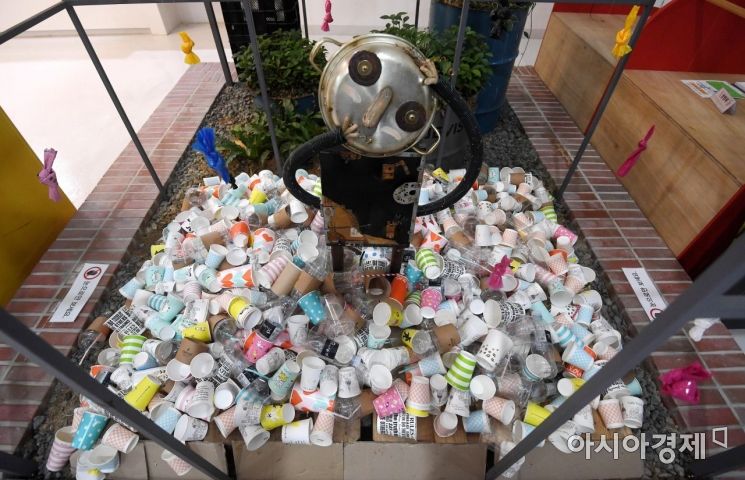
Professor Bae Jae-geun of Seoul National University of Science and Technology's Department of Environmental Engineering said, "Inducing plastic waste power generation through combined heat and power plants is a more fundamental way to handle plastic than the government's public stockpiling measures." He added, "The government restricted SRF use, blaming it as a major source of fine dust, but the Ministry of Trade, Industry and Energy should actively intervene to resolve issues with local residents regarding SRF power plants." Regarding the disposable cup deposit system, Professor Bae emphasized, "If disposable cups are not returned, consumers ultimately bear the loss. The system should be solidified so that the deposit can be used for public benefit."
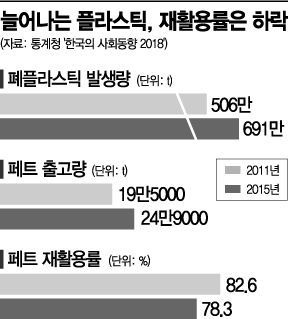
◆ Calls to expand the scope of recycling EPR subsidies = Questions have also been raised about the effectiveness of the 'Extended Producer Responsibility (EPR)' system introduced in 2003. EPR imposes recycling obligations on producers and requires them to pay fees to support recycling companies. Although a revised law strengthening EPR was implemented in 2013, plastic waste generation increased from approximately 5.06 million tons in 2011 to 6.91 million tons in 2015. According to Statistics Korea, the output of PET used for bottled water, coffee containers, and the like increased from 195,000 tons in 2011 to 249,000 tons in 2015, while the recycling rate decreased from 82.6% in 2011 to 78.3% in 2015.
A recycling collection company official criticized, "The Ministry of Environment does not even understand how collection companies operate or whether the items brought in have actual recycling value." There were also opinions that the scope of EPR application and subsidies should be expanded and that companies manipulating recycling performance to embezzle EPR subsidies should be strictly regulated.
◆ Packaging improvements needed to increase recycling rates = There are calls for laws to improve product manufacturing methods to increase recycling rates. South Korea's PET bottles have low recycling rates due to colored coatings and labels firmly attached with adhesives. Japan has banned the use of colored PET bottles other than clear ones and caps and labels that are difficult to recycle since 1992. European countries such as France and the United Kingdom have implemented a 'PET bottle recyclability pre-certification system' by law since 1998.
Professor Lee Deok-hwan, Emeritus Professor at Sogang University, said, "If the system does not change, the use of imported plastic waste from countries like Japan will continue instead of plastic waste collected domestically, worsening the financial difficulties of the recycling industry."
© The Asia Business Daily(www.asiae.co.kr). All rights reserved.
![Clutching a Stolen Dior Bag, Saying "I Hate Being Poor but Real"... The Grotesque Con of a "Human Knockoff" [Slate]](https://cwcontent.asiae.co.kr/asiaresize/183/2026021902243444107_1771435474.jpg)












