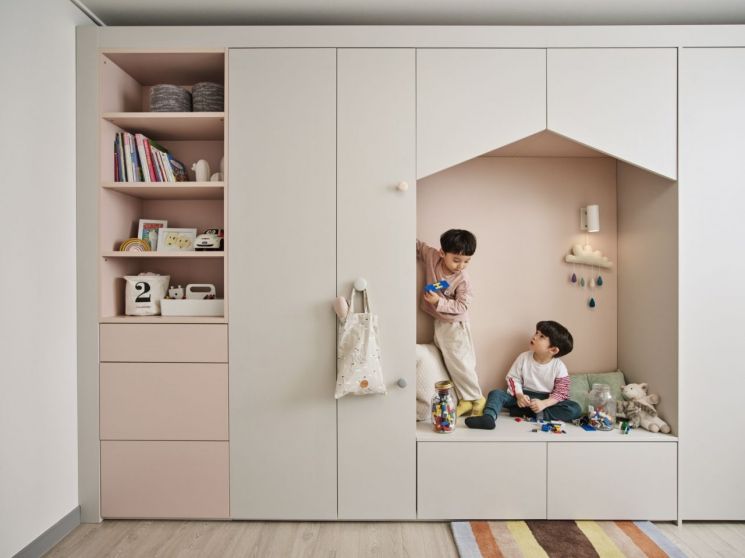
 A children's room in the Hanssem Rehouse Package Modern Gray style, decorated with eco-friendly materials.
 [Photo by Hanssem]
[Asia Economy Reporter Kim Jong-hwa] Formaldehyde, volatile organic compounds (VOCs), toluene?these harmful substances have become all too familiar. Nowadays, it is standard practice to carefully check whether furniture is rated E0 or E1 before purchasing. Although the current domestic recommended and legal standard is E1, Hanssem’s furniture is managed under the more stringent E0 grade.
However, it is premature to feel assured by furniture rated only E0. Indoor harmful substances can be emitted not only from furniture but also from interior materials and auxiliary materials that make up the space, such as wallpaper, flooring, and adhesives.
The largest areas in indoor interiors are wallpaper and flooring. While materials are carefully scrutinized when purchasing furniture, it is easy to overlook walls or flooring materials. Also, basic construction materials that are not visible often go unnoticed in terms of what materials were used and what harmful substances they emit. Therefore, for indoor interior construction, it is essential to carefully examine not only furniture but also basic materials to create a comfortable indoor environment.
Hanssem announced on the 26th that it manages and supplies the harmfulness of all materials used in its Rehouse package. With this, Hanssem has expanded the environmental safety standards it applied to furniture?such as the E0 standard, HB mark (certification for chemical emission intensity of building materials), and Hanssem’s own verification?to all materials used in remodeling.
This decision by Hanssem can be seen as part of a win-win policy to protect customers’ health while supporting dealerships facing difficulties in sourcing eco-friendly materials.
The items managed by Hanssem range from wood and wallpaper paste to wallpaper, flooring, sealants, adhesives, and all materials and finishes used on site. This is because using unverified materials and finishes can emit harmful substances, polluting indoor air quality even if the space is furnished with E0 furniture.
Hanssem directly verifies these materials and supports overall management and supply, including purchasing, logistics, and delivery. In fact, indoor air quality measurements taken at sites where Hanssem purchased, handled logistics, delivered, and installed 42 environmentally friendly basic construction materials across 11 product groups that Hanssem directly verified showed about a 29% improvement in indoor harmful substances compared to before implementation.
Hanssem currently supplies these managed materials to 70% of dealerships in the metropolitan area and plans to expand nationwide within the year. Beyond materials, Hanssem’s direct construction also prioritizes the living environment by providing differentiated processes before and after construction, including design, production, construction, supervision, move-in cleaning, air quality management, A/S, and home care.
Hanssem’s policy is expected to serve as a unique competitive advantage as interest in environmentally friendly spaces is anticipated to increase further. In fact, Kang Sook-young RD, who works at a Jibgeurim dealership, predicted that customer demand for environmentally friendly spaces will continue to rise as a future interior trend.
Kang RD said, “From what I see on site, customers are becoming more interested in environmental issues and fine dust, so the demand for environmentally friendly spaces will likely keep increasing. In fact, many customers now ask first about concerns related to sick house syndrome.”
A Hanssem official stated, “To eradicate sick house syndrome, it is more important to block the causative substances in advance rather than incurring additional costs for construction afterward. We hope that customers can feel more at ease and relax at home through Hanssem’s use of environmentally friendly products and materials.”
Meanwhile, Hanssem integrated and expanded its existing Production Technology Research Institute into the Living Environment Technology Research Institute in 2019, intensifying research and development and verification for eco-friendly spaces. The institute is responsible for comprehensive verification and improvement of product quality and environmental impact.
It strictly manages harmful substances and safety from raw materials to products, materials, and finishes by expanding the scope to include quality testing and verification of interior materials and household goods, as well as tests for harmful substances, indoor air quality, and radioactive materials.
© The Asia Business Daily(www.asiae.co.kr). All rights reserved.

















