NSSC to Amend and Enforce 'Nuclear Safety Act Enforcement Decree' and Related Notices Starting from the 26th
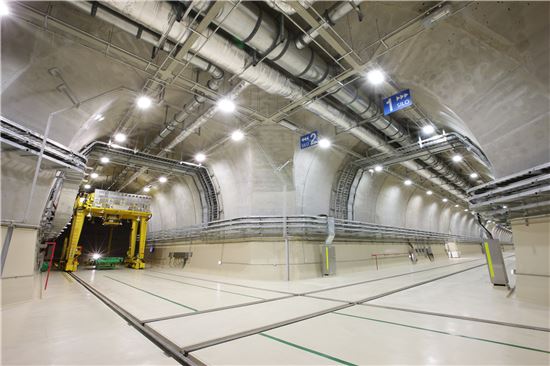 Underground cave facility of Gyeongju low- and intermediate-level radioactive waste disposal site. (Photo by Asia Economy DB)
[Asia Economy Reporter Moon Chaeseok] The government has eased regulations on the management of radioactive waste from medical institutions, which amounts to 1.3 million liters. If the levels are below the values set by the Nuclear Safety and Security Commission (NSSC), the waste is excluded from the self-disposal regulatory requirements.
On the 26th, the NSSC announced that it has revised and implemented the Enforcement Decree and Notices of the Nuclear Safety Act related to the management and disposal of radioactive waste inevitably generated for diagnostic and therapeutic purposes at medical institutions, effective immediately.
The NSSC had restricted the management and disposal of low-radioactivity waste when self-disposed as general waste.
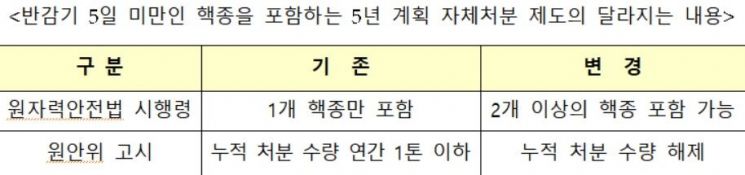
Previously, if two or more radionuclides were included or if the cumulative disposal quantity exceeded 1 ton annually, individual approval from the NSSC was required for self-disposal. Upon approval, autonomous disposal was allowed for five years according to the approved plan.
Because of this, medical institutions faced inconvenience as they had to apply for self-disposal each time, even when using radionuclides with short half-lives and approved radioactive isotopes that did not meet these requirements.
Self-disposal means that if the concentration of radionuclides in radioactive waste is confirmed to be below the values set by the NSSC, it is excluded from the regulatory scope of the Nuclear Safety Act. When designated for self-disposal, it can be managed as general waste.
Accordingly, the NSSC revised the Enforcement Decree to allow disposal for five years even if two or more radionuclides are included. The revision was made to apply the restriction criteria reasonably while maintaining safety.
The NSSC also amended related notices to remove the requirement limiting the cumulative disposal quantity to "1 ton or less annually" even for low-radioactivity concentrations.
An NSSC official expressed hope that "through the rational improvement of the pre-planned self-disposal system, safety will be secured while reducing the regulatory burden of radioactive waste at medical sites."
Although self-disposal regulations have been eased, it is true that medical institutions store a significant amount of radioactive waste, raising concerns about unauthorized disposal.
Previously, on December 26, 2018, the NSSC imposed a fine of 75 million KRW and a penalty of 30 million KRW on the Korea Atomic Energy Research Institute for violating the Nuclear Safety Act by unauthorized disposal of radioactive waste.
In the same year’s national audit, it was revealed that about 1.8 million liters of radioactive waste were stored nationwide at medical institutions, industrial sites, and educational institutions without being disposed of at the Gyeongju Radioactive Waste Disposal Facility.
According to data submitted by the Korea Institute of Nuclear Safety to Representative Kwon Chilseung of the Democratic Party, about 1.32 million liters, accounting for 73% of the total radioactive waste, were stored at medical institutions.
Except for waste eligible for self-disposal, radioactive waste is required to be disposed of at the Gyeongju Radioactive Waste Disposal Facility operated by the Korea Radioactive Waste Agency.
According to the last partial amendment of Article 53 of the Nuclear Safety Act in August last year, the status report submitted by radioactive isotope (RI) waste generators to the Korea Institute of Nuclear Safety does not classify waste by levels such as intermediate-level, low-level, or very low-level waste.
© The Asia Business Daily(www.asiae.co.kr). All rights reserved.
![Clutching a Stolen Dior Bag, Saying "I Hate Being Poor but Real"... The Grotesque Con of a "Human Knockoff" [Slate]](https://cwcontent.asiae.co.kr/asiaresize/183/2026021902243444107_1771435474.jpg)
















