Confirmed 6th Wave Infection from Itaewon Clubs
Some Areas Still Not Wearing Masks... Serious Safety Neglect
Experts "Without Vigilance, a Second Wave Could Occur"
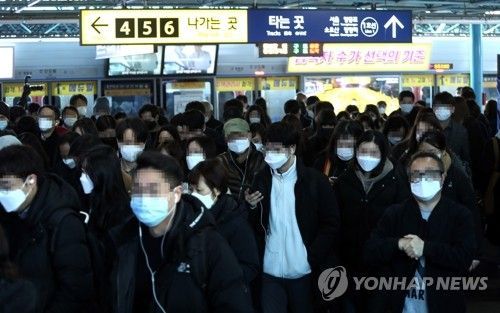 On the morning of March 11, citizens wearing masks are commuting to work through Sindorim Station in Guro-gu, Seoul. Photo by Yonhap News
[Asia Economy Reporter Kim Ga-yeon] As the cluster infection of the novel coronavirus disease (COVID-19) originating from Itaewon clubs in Seoul spreads nationwide, including sixth-generation infections, controversy arises as mask-wearing remains insufficient in some regions. Despite the spread of COVID-19, concerns about continued complacency regarding safety persist.
According to the Central Disaster and Safety Countermeasures Headquarters (CDSCH) as of 12:00 noon on the 25th, the cumulative number of confirmed cases related to the Itaewon club cluster infection was confirmed to be 233. Sixth-generation infection cases originating from Itaewon have been identified up to this date.
According to Seoul City, Mr. A (49), the husband of patient number 18 in Jungnang-gu, was confirmed as a sixth-generation infected person. It was found that the infection chain extended from an unemployed Incheon academy instructor (25) who lied about his employment status after visiting the Itaewon club, to a student (16), a taxi driver (49), a guest at a first birthday party in Bucheon (57), the coworker of the guest who is patient number 18 in Jungnang-gu, and then to Mr. A.
However, in some regions outside the metropolitan area, mask-wearing remains insufficient. Residents in areas where no new confirmed cases have occurred for a certain period reportedly do not feel the necessity of "making mask-wearing a daily habit" and continue their daily lives without masks.
A university student A (23), residing in Wanju-gun, Jeonbuk, said, "I stayed in Seoul and then returned to my dorm, but I was very surprised at first because no one was wearing masks," adding, "It even felt like wearing a mask was unusual, as more people were not wearing masks."
A added, "I sometimes go out to Jeonju City, and there are quite a few people not wearing masks there as well," and continued, "While mandatory mask-wearing on public transportation is a good policy, local residents who only travel on foot seem likely to continue not wearing masks."
Office worker B (28), who recently traveled on business to some regions such as Gyeongsangnam-do and Jeju, said, "In Seoul, people give you looks if you don't wear a mask," and added, "In some provincial cities, many people do not wear masks, which surprised me a bit. Since the population density is not as high as in Seoul, it seems people don't wear them as much."
As a result, concerns have been raised that if confirmed cases occur in these regions, there is a high risk of rapid spread through community transmission. Since COVID-19 spreads through droplets and close contact, not wearing masks could lead to large-scale cluster infections.
Office worker C (31) criticized, "In a situation where sixth-generation infections from Itaewon have occurred, not wearing masks is truly selfish," and added, "It would be best if such things never happen, but if even one confirmed case emerges in that area, the spread could become uncontrollable."
C said, "There are confirmed cases with unknown infection routes, so how can anyone be sure that 'there will be no confirmed cases in this area'?" and added, "For the sake of their own family and others, people must wear masks."
Experts warn that a second large-scale outbreak could occur and urge adherence to personal quarantine rules such as mask-wearing.
Professor Kim Woo-joo, an infectious disease specialist at Korea University Guro Hospital, said, "The current situation, where awareness about COVID-19 is declining, is very concerning," and pointed out, "Until April, personal quarantine rules were observed, but as social distancing shifted to everyday distancing and daily quarantine, awareness has significantly dropped."
Professor Kim added, "Initially, it was expected that summer would pass without major issues because there was relatively good know-how on quarantine and the public followed the rules well, so only small-scale outbreaks might occur. However, what is happening now is that, besides the Itaewon-originated n-th generation infections, many patients with unknown causes unrelated to Itaewon are appearing here and there. These are signs that a second wave could come, so we must remain vigilant."
Meanwhile, quarantine authorities will expand the mandatory mask-wearing measures, previously implemented in some local governments, nationwide starting from the 26th.
The Central Disaster and Safety Countermeasures Headquarters announced on the 25th that it has prepared "Measures to Strengthen Quarantine in the Transportation Sector." Accordingly, passengers not wearing masks will not be allowed to board buses or taxis. The government plans to temporarily exempt transportation operators and workers from penalties such as business suspension or fines if they refuse boarding to passengers not wearing masks on buses or taxis.
© The Asia Business Daily(www.asiae.co.kr). All rights reserved.


















