Selected as the Ministry of Education's 4th Industrial Revolution Innovation Leading University
2 Billion KRW National Funding... Fostering Creative Talent Based on IoT
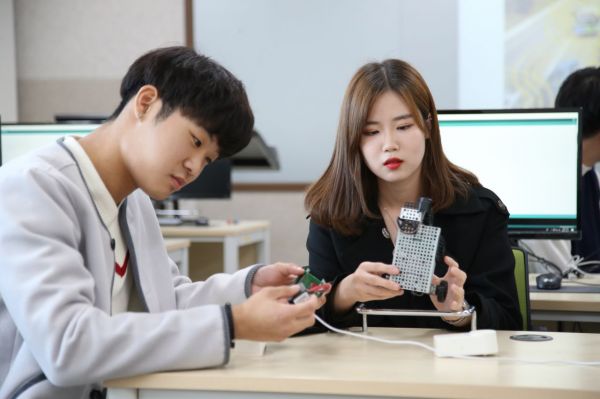
[Asia Economy Honam Reporting Headquarters Reporter Yoon Jamin] Dongshin University is leading the ‘Smart Energy City Industry,’ a core project of Gwangju and Jeonnam in the era of the 4th Industrial Revolution, with government project funding support.
Dongshin University announced on the 24th that it was finally selected as the Ministry of Education’s ‘2020 4th Industrial Revolution Innovation Leading University’ on the 22nd.
Accordingly, it will receive 1 billion KRW annually, totaling 2 billion KRW in national funding by next year, to nurture creative convergence talents in the smart energy city industry field based on IoT (Internet of Things) technology.
The smart energy city industry is a core project promoted by Gwangju Metropolitan City and Jeonnam Province in the era of the 4th Industrial Revolution. With this project selection, Dongshin University will take the lead in the regional smart energy city industry.
The Department of Information and Communication Engineering is the lead department for the project, with participation from the Electrical Engineering major, Convergence Information Security major, Computer Science department, Architectural Engineering department, Urban Planning department, and Landscape Architecture department.
These departments will nurture SMART creative convergence talents equipped with IoT technology expertise, the so-called 4C skills?Critical Thinking, Communication, Creativity, Collaboration?and future core competencies.
To this end, Dongshin University plans to actively innovate its curriculum, teaching methods, and educational environment.
▲ Curriculum Innovation Reflecting Industry Demand
The curriculum will be composed of courses reflecting the demands of companies in the smart energy city industry field.
General education courses require students to complete two courses in foundational liberal arts areas of the 4th Industrial Revolution, such as Big Data Analysis, 3D Modeling and Printing, Understanding Artificial Intelligence (AI), and Understanding the Internet of Things (IoT).
Major courses consist of basic courses in the smart energy city field, Adventure Design, and specialized courses.
Students must complete IoT Software and Intelligent IoT Systems as required courses in the basic curriculum, and learn Energy Introduction and Smart City Theory as basic elective courses.
Adventure Design is a stage for freshmen and sophomores to cultivate creative convergence problem-solving skills, collaboration skills, career planning, and practical abilities, operated as a self-directed basic design course.
Specialized courses are organized by department to match smart energy city technologies: IoT specialized track (Information and Communication Engineering), IoT-based infrastructure track (Architectural Engineering, Urban Planning, Landscape Architecture), IoT-based data track (Electrical Engineering major), and IoT-based service track (Computer Science, Convergence Information Security major).
Through this, a course completion system is established linking 4C competency exploration (basic liberal arts) → 4C competency enhancement (basic courses) → creative convergence problem-solving (Adventure Design) → core competency strengthening (specialized courses), providing students opportunities to design their own major courses and career paths.
Extracurricular programs are also operated to enhance employment capabilities through various activities difficult to experience in the curriculum, such as company visits, experiential programs, expert lectures from industry professionals, and NCS programs preparing for employment in public enterprises.
▲ Innovation in Teaching Methods Linked to Curriculum
Teaching methods will be customized and innovated in connection with the curriculum designed to reflect the demands of the smart energy city industry.
First, to cultivate field-oriented smart energy city talents, teaching methods supporting academic achievement improvement and job skill acquisition will be developed and operated.
▲ Online content education based on self-directed learning and content sharing ▲ Problem-solving education based on critical thinking, communication, and collaboration ▲ Education based on 4th Industrial Revolution foundational software simulation tools ▲ Project education cultivating field practical skills through industry-academia-research collaboration ▲ Teaching method education for faculty capacity enhancement will be supported.
Also, as the importance of non-face-to-face online classes has increased due to the 4th Industrial Revolution era and the COVID-19 pandemic, student-friendly teaching methods using online learning platforms will be expanded.
Practical foundational skills of smart energy city talents will be developed through ‘simulation tool education’ using software programming tools and ‘remote laboratory practice.’
For specialized smart energy city courses such as capstone design using PBL (Project-Based Learning), team teaching with experts from makerspaces or partner companies will be conducted to help students acquire field practical skills and problem-solving abilities.
Various programs linked with the Teaching and Learning Center will be supported, and participation in programs by faculty involved in the project will be reflected in performance evaluations, continuously strengthening faculty capabilities.
▲ Improvement of Educational Environment Including Makerspace Construction
Dongshin University will build makerspaces (creative spaces) capable of operating innovative curricula for the 4th Industrial Revolution era and remodel departmental laboratories and practice rooms to enable discussion-based and project-based classes.
In particular, specialized practice equipment related to smart energy city technologies will be installed in Haein Buildings 1 and 3, the Information and Computing Center, and Narae Building Dream Factory, establishing Make IoT (Internet of Things and 3D printing, etc.), Make AI (Artificial Intelligence and Big Data), Make Design (Drones and VR, etc.), and Make Hall (general student experience space).
Additionally, Dongshin University plans to actively utilize the ‘Smart Energy Campus (SEC)’ established on campus in collaboration with Korea Electric Power Corporation in the educational curriculum.
‘SEC’ is an optimized system based on renewable energy such as solar power and intelligent power grids that can independently produce, control, and supply heat and electricity on campus, effectively functioning as a ‘small smart energy city.’
Various equipment such as photovoltaic (PV) solar power facilities installed in this SEC demonstration complex and data generated there will be utilized in innovative courses related to smart energy city based on IoT technology to enhance students’ practical skills.
Choi Il, President of Dongshin University, said, “We will contribute to revitalizing the smart energy city new industry through undergraduate education specialization and establishing an innovative education model in the era of the 4th Industrial Revolution,” adding, “When SMART creative convergence talents are employed by demand companies in the region such as Bitgaram Energy Valley and Naju Innovation Industrial Complex, it will help reduce youth unemployment and promote regional development.”
© The Asia Business Daily(www.asiae.co.kr). All rights reserved.
!["The Woman Who Threw Herself into the Water Clutching a Stolen Dior Bag"...A Grotesque Success Story That Shakes the Korean Psyche [Slate]](https://cwcontent.asiae.co.kr/asiaresize/183/2026021902243444107_1771435474.jpg)
















