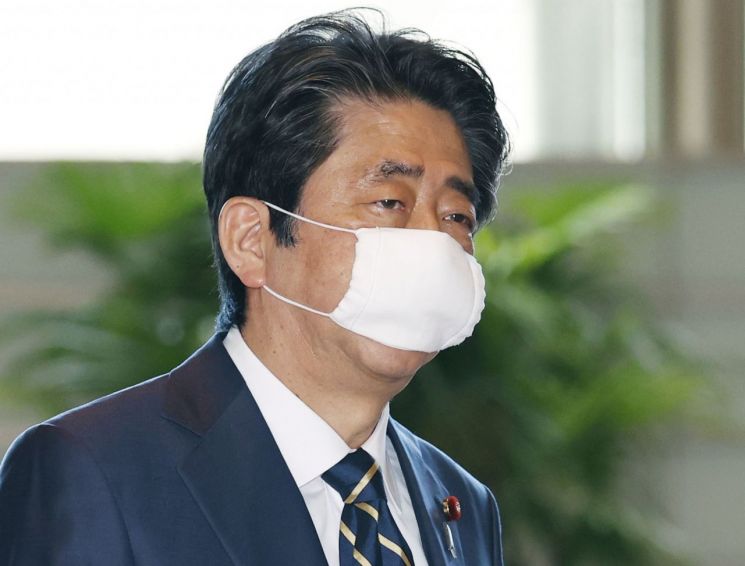
 Japanese Prime Minister Shinzo Abe is entering his official residence wearing a mask on the 14th (local time). [Image source=Yonhap News]
[Asia Economy Reporter Seungjin Lee] The approval rating of Japanese Prime Minister Shinzo Abe's cabinet has plummeted to 27%, the lowest level since he began his second term in December 2012. This sharp decline appears to be largely influenced by the recent scandal involving pro-government prosecutors playing 'gambling mahjong.'
According to a telephone survey conducted on the 23rd by the Mainichi Shimbun in collaboration with the Saitama University Social Research Center, targeting 1,019 voters nationwide (valid responses), the Abe cabinet's approval rating recorded 27%, a 13 percentage point drop from the previous survey announced on the 6th, which was 40%.
On the other hand, the percentage of respondents who said they 'do not support' the cabinet reached 64%, a 19 percentage point increase compared to 45% in the survey on the 6th. This is the third joint public opinion survey conducted by Mainichi Shimbun and the Social Research Center.
Compared to the first survey on the 8th of last month, when the Abe cabinet's approval rating was 44%, it has fallen 17 percentage points in just a month and a half. Although the survey methods differ, this figure is close to the 26% recorded in July 2017, when public criticism was high due to the 'school scandal.'
The recent sharp decline in the Abe cabinet's approval rating is analyzed to be significantly influenced by a series of controversies surrounding the administration's alleged control over the prosecution, amid criticisms that it has failed to respond adequately to the novel coronavirus disease (COVID-19).
Regarding allegations that the cabinet arbitrarily extended the retirement age of Kurokawa Hiromu (?川弘務), Tokyo High Public Prosecutors Office Chief Prosecutor, at the end of January to appoint him as the next Prosecutor General, 47% of respondents said 'both Prime Minister Abe and Justice Minister Mori Masako (森昌子) are responsible,' and 28% said 'Prime Minister Abe is responsible,' totaling 75% holding Abe accountable.
Kurokawa Hiromu, Chief Prosecutor of the Tokyo High Public Prosecutors Office, was found to have ignored health guidelines and enjoyed 'gambling mahjong' with reporters even during the COVID-19 state of emergency, leading to his resignation on the 21st.
In particular, in this survey, 52% of respondents said that the Tokyo High Public Prosecutors Office Chief Prosecutor should be 'dismissed with disciplinary action,' exceeding half, reflecting strong criticism of the light 'reprimand' given and acceptance of his resignation.
Kurokawa's resignation is expected to become a political burden for Prime Minister Abe. Consequently, the revision of the Public Prosecutor's Office Act, which centered on extending the retirement age of prosecutors with cabinet approval, has effectively been abandoned.
The survey also showed that support for the ruling Liberal Democratic Party (LDP) fell 5 percentage points from 30% in the previous survey to 25%. Compared to the survey on the 8th of last month (34%), the LDP's support rate has dropped sharply by 9 percentage points. It is analyzed that as the Abe cabinet's approval rating falls, the LDP's support base is also shaken.
Among other parties, support for the main opposition Constitutional Democratic Party rose from 9% to 12%, and the Communist Party also advanced from 5% to 7%. The Japan Innovation Party, which is closer to the ruling side, remained stagnant at 11%, and the coalition partner Komeito's support slightly declined from 5% to 4%.
© The Asia Business Daily(www.asiae.co.kr). All rights reserved.

![User Who Sold Erroneously Deposited Bitcoins to Repay Debt and Fund Entertainment... What Did the Supreme Court Decide in 2021? [Legal Issue Check]](https://cwcontent.asiae.co.kr/asiaresize/183/2026020910431234020_1770601391.png)














