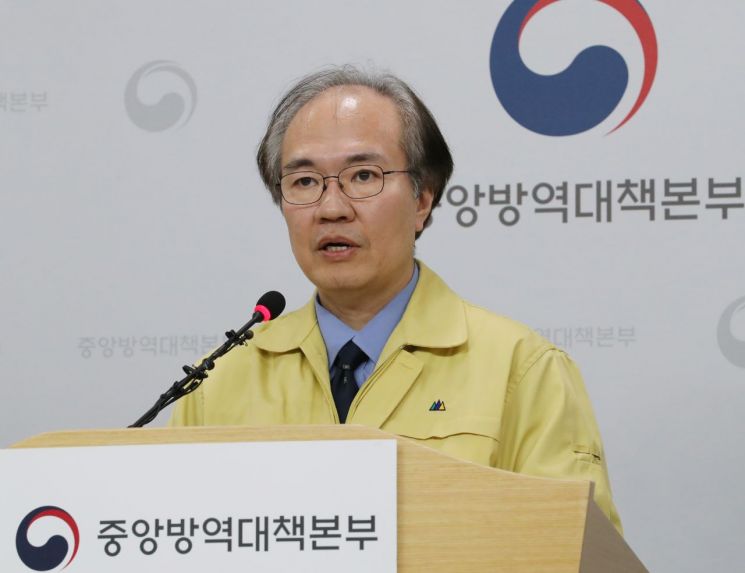
 Kwon Jun-wook, Deputy Director of the Central Disease Control Headquarters (Director of the National Institute of Health) [Image source=Yonhap News]
[Asia Economy Reporter Seungjin Lee] Although the novel coronavirus infection (COVID-19) has caused over 5.14 million confirmed cases worldwide, no significant genetic mutations have been observed so far.
On the 23rd, Kwon Jun-wook, Deputy Director of the Central Disease Control Headquarters (CDCH), stated at a regular briefing held at the Korea Disease Control and Prevention Agency in Osong, Chungbuk, "There have been no mutations in critical parts such as the region where the virus binds to cells, nor any large-scale genetic changes," adding, "Therefore, the risk of changes in infectivity and pathogenicity or problems arising in the development of treatments or vaccines due to genetic mutations is considered low."
Deputy Director Kwon explained, "Although we need to observe the trend further, it is understood that it is quite difficult for the virus to suddenly mutate into a different virus during the course of infection."
Researchers worldwide have been concerned that mutations in the COVID-19 virus could complicate the development of treatments and vaccines.
Meanwhile, the CDCH disclosed the results of viral genome sequencing conducted on 142 confirmed domestic COVID-19 cases the previous day. The virus types were classified into S, V, and G groups based on amino acid changes resulting from differences in the viral genetic sequences.
The S and V groups are mainly prevalent in China and other Asian regions, while the G group is prevalent in Europe and the United States.
Based on the finding that all 14 confirmed cases related to the Itaewon clubs were infected with the G group virus, the CDCH estimates that these individuals were infected by people who entered from the United States or Europe.
Regarding this, Deputy Director Kwon said, "(The viral genome sequencing results) can be used as a reference when tracing infection routes."
© The Asia Business Daily(www.asiae.co.kr). All rights reserved.

















