[Asia Economy Reporter Kiho Sung] As the 21st National Assembly convenes, tension is rising in the business community. The 'supermajority party,' which secured 177 seats and can now pass bills unilaterally, is raising concerns that it may aggressively push forward 'regulatory bills.' Amid an unprecedented economic crisis caused by the COVID-19 pandemic, there are concerns that 'regulatory bills' will become an additional burden on the economy.
The 20th National Assembly ended as a 'regulatory assembly.' Although many bills aimed at economic revitalization were proposed, reform bills were neglected due to the overwhelming number of regulatory bills. According to the 'Regulatory Information Portal' of the Regulatory Reform Committee under the President, from the start of the 20th National Assembly on May 30, 2016, until now, a total of 3,923 regulatory bills have been proposed by lawmakers. These bills contain 7,277 regulatory provisions.
The problem lies with the 21st National Assembly, where the ruling party can pass bills unilaterally. In the April 15 general election, the Democratic Party of Korea won 177 seats. Conversely, the opposition parties lost seats, eliminating checks and balances to prevent the ruling party's dominance. Furthermore, the Democratic Party has pledged in its 21st general election manifesto to reintroduce many regulatory bills that were abolished in the 20th National Assembly.
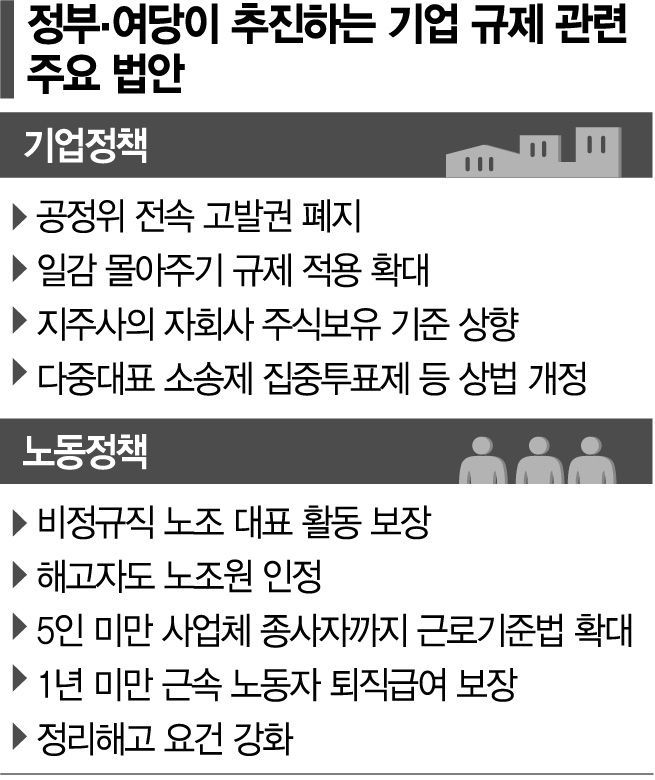
Among these, the business community is most concerned about the amendment to the Commercial Act. Through its 21st general election manifesto, the ruling party plans to reintroduce seven regulatory bills that were pursued in the 20th National Assembly, including ▲the multiple derivative lawsuit system, ▲mandatory electronic signature voting and cumulative voting system, ▲introduction of separate election of audit committee members, and ▲prevention of major shareholder family control strengthening through treasury stocks.
The amendment to the Commercial Act is expected to be led by Representative Yongjin Park. During the 20th National Assembly, Representative Park proposed an amendment to the Commercial Act that prohibits the allocation of new shares through treasury stock split when converting to a holding company via corporate division. He plans to continue pushing the amendment in the 21st National Assembly. If the amendment passes, SK Group, which has recently increased its treasury stocks, will need to reconsider its corporate governance restructuring direction.
The Fair Trade Commission’s exclusive right to prosecute will be abolished, and the Fair Trade Act amendment to strengthen regulations on unfair internal transactions by large and medium-sized enterprises is also expected to be reintroduced. Once the exclusive right to prosecute is abolished, anyone can report corporate unfair practices to the prosecution. The business community fears indiscriminate accusations as a result. The regulation on unfair internal transactions will expand from the current application to affiliates with 30% or more ownership by the controlling family and 20% for unlisted affiliates to affiliates with 20% ownership. If the amendment passes, major companies such as Hyundai Glovis and GS Construction will be included in the regulatory scope.
In the labor sector, comprehensive amendments to the Labor Standards Act and the Trade Union Act are anticipated. These include ▲guaranteeing activities of non-regular worker union representatives, ▲allowing dismissed workers to join unions, ▲guaranteeing severance pay for workers with less than one year of service, and ▲strengthening conditions for layoffs, which restrict labor flexibility.
Additionally, the amendment to the Distribution Industry Development Act, regulations on large franchise store openings, and the consumer class action system are expected to become hot-button 'anti-business bills.'
© The Asia Business Daily(www.asiae.co.kr). All rights reserved.

















