Increase in 'Priteo' Living on Part-Time Jobs
4 out of 10 Adults Say "I am a Priteo"
Experts Say "COVID-19 Impact is Significant"

[Asia Economy Reporter Heo Midam] "I want to get a job too. But there's nothing I can do."
Kim (26), who works at a cafe in Mapo-gu, Seoul, has recently been stressed due to conflicts with his parents.
Kim said, "These days, job postings rarely appear because of COVID-19, but my parents keep telling me to prepare for employment. What can I do if things don't go my way? Just thinking about getting a job stresses me out. Honestly, I think it's not so bad to just keep doing part-time work as I am now."
He added, "When I was a university student, I participated in extracurricular activities and prepared language test scores to get a job. But now, even if I earn less money, I want to live without stress."
Recently, as the job market has tightened, the so-called 'freeter' population?those who sustain themselves through part-time jobs?has been increasing. The term 'freeter' is a compound of 'free' and 'arbeit' (part-time job).
Some have become freeters out of necessity due to the impact of the novel coronavirus (COVID-19), while others deliberately avoid employment to not be tied down to a workplace. Experts analyze that the economic downturn caused by COVID-19 has influenced the rise in freeters.
According to a survey conducted by Albamon in April targeting 2,516 people with part-time job experience over the past year, 42.4% of respondents identified themselves as freeters. This is an increase of 11.4 percentage points compared to last year.
By age group, 30-somethings (53.0%) had the highest percentage identifying as freeters, while those in their 20s (36.5%) and 40s and above (36.8%) were at similar levels.
Among freeters, involuntary freeters (79.5%)?those who live as freeters due to circumstances?outnumber voluntary freeters (20.5%) who choose this lifestyle by their own will. Due to the economic difficulties caused by COVID-19, many have no choice but to become freeters to make a living.
On the other hand, some voluntarily choose to be freeters to avoid workplace stress.
Lee (25), a cafe part-timer, said, "I don't particularly have the intention to find a full-time job. My acquaintances have started getting jobs one by one, but they all say they want to quit. I don't want to get a job just to be stressed out like that."
He added, "Maybe in my late 20s or early 30s, I might want to get a job, but for now, I just want to enjoy this time."
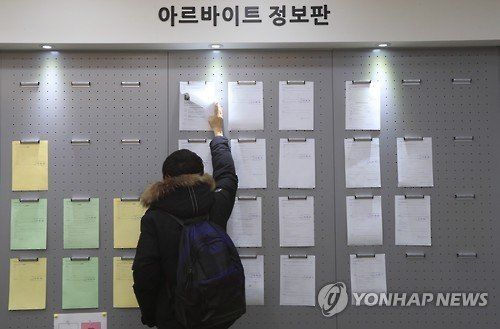
The older generation expresses concerns about the freeter phenomenon. According to a 2017 survey by Embrain Trend Monitor of 1,000 working men and women nationwide aged 19 to 59, 59.6% of respondents in their 50s said they felt 'sorry' for freeters. This is higher than the 44.4% of people in their 20s, 44.8% in their 30s, and 46.8% in their 40s.
Lee (53), who has adult children, also voiced worried concerns about freeters. He said, "My son, who is currently preparing for employment, is working at a logistics job in a supermarket because of COVID-19. We want to support him as much as possible, but we are not financially comfortable, and he seems reluctant to ask us for help."
Experts point to COVID-19 as the reason for the increase in freeters.
Professor Lee Dong-gwi of Yonsei University's Department of Psychology explained, "Many scheduled recruitment processes have been postponed due to COVID-19. Companies also have less capacity to hire new employees, and since the economic downturn is expected to continue, the job market will worsen."
He added, "Some have voluntarily become freeters because working life is tough. Part-timers don't have to deal with workplace relationships or stress from bosses. In other words, they earn as much money as they need and live the life they want."
© The Asia Business Daily(www.asiae.co.kr). All rights reserved.
!["I'd Rather Live as a Glamorous Fake Than as a Poor Real Me"...A Grotesque Success Story Shaking the Korean Psyche [Slate]](https://cwcontent.asiae.co.kr/asiaresize/183/2026021902243444107_1771435474.jpg)

















