Symbol of the June 15 Joint Declaration, Room 615 Occupied by Park Ji-won Followed by DJ's Third Son Kim Hong-gul
Room 325 Taken by Reelected Kwon Chil-seung... 10th Floor Popular for Proximity to Rooftop
Senior Members Occupy Royal Floors... Age Order Applied When Demand Overlaps by Election Number
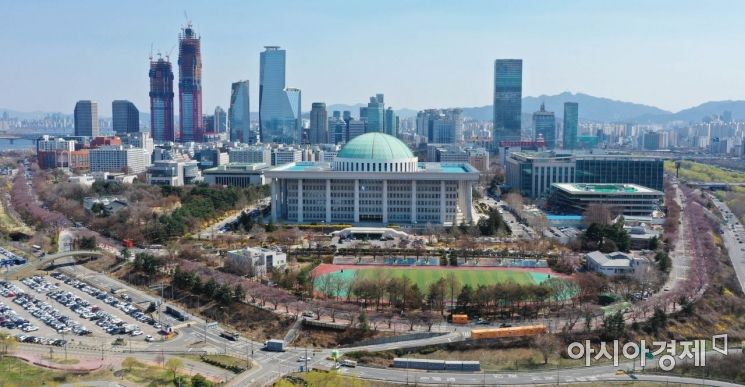
[Asia Economy Reporter Jeon Jin-young] As the 21st National Assembly is about to open, the members' office building is also preparing to welcome new occupants. There appears to be an invisible game of tact among senior and junior lawmakers over the so-called 'prime spots' in the office building, with each member making efforts to be assigned politically meaningful room numbers. Attention was also drawn to who would be assigned rooms previously used by past presidents. On the 21st, the room assignments for the Democratic Party of Korea members were completed. Taking this opportunity, we look into various aspects of the members' office building room assignments.
'Room Numbers' Revealing Lawmakers' Identity
Every time a new National Assembly opens, the 'room numbers' attract attention because they reveal the identity of the lawmakers. Room 615, symbolizing the June 15 North-South Joint Declaration, is inherited by Kim Hong-gul, the proportional representative elected member and third son of the late former President Kim Dae-jung. This was the room where Park Ji-won, a Minsaeng Party lawmaker who served as Kim's secretary, stayed for 12 years. Room 815, representing Liberation Day, is used by Park Chan-dae, who succeeded in his re-election. Room 518, symbolizing the May 18 Gwangju Democratization Movement, was primarily considered for Democratic Party lawmakers elected from Honam, but independent lawmaker Lee Yong-ho decided to stay there consecutively.
'Rooms Passed Through by Past Presidents... Accessibility Also Considered'
Rooms previously used by past presidents are also a point of interest. The third floor, though low and with poor views, is considered a place with good energy as it produced Presidents Moon Jae-in and Lee Myung-bak. Room 325, used by President Moon during the 19th National Assembly, will be occupied by re-elected lawmaker Kwon Chil-seung. The number '325' is the reverse of May 23, the date of the late former President Roh Moo-hyun's passing. Room 312, used by former President Lee, will be assigned to first-term elected member Go Young-in, and room 545, used by former President Park Geun-hye, will be occupied by Lee Soo-jin, a 21st proportional representative and Supreme Council member. Room 328, where former President Kim Dae-jung stayed, is expected to be occupied by a member elected from the United Future Party. Room 638, used by former President Roh, was secured by elected member Jo Oh-seop after fierce competition.
Accessibility is also an important issue. The members' office building has a complex 'ㅂ'-shaped structure, making it easy for first-time visitors to get lost. Lawmakers Lee Sang-min and Choi Hye-young, who use wheelchairs, were assigned rooms 401 and 647 near the elevators, respectively. On the other hand, the 10th floor, which is the top floor with poor accessibility, is used by first-term elected members Jang Kyung-tae, Jang Cheol-min, Kim Nam-guk, Oh Young-hwan, and Jeon Yong-gi. Due to ease of security, it is anticipated that North Korean defector-origin United Future Party members may move in. Tae Young-ho, a United Future Party member who wrote 'The Code of the 3rd Floor Secretariat,' is likely to continue his legislative activities on the 10th floor this time. The same applies to elected member Ji Sung-ho. During the 19th National Assembly, former lawmaker Jo Myung-chul, also a North Korean defector, used the 10th floor. Instead, the 20th National Assembly saw party leader Lee Hae-chan staying there due to its good views and proximity to the rooftop rest area.
Competition Over Prime Spots... Unlucky Rooms Disappear
Seat preference surveys are usually conducted by seniority. If preferred rooms overlap within the same seniority group, assignments are made based on age order. Since preferences vary by floor and room number, competition over 'prime spots' occurs. Floors 6 to 8 are considered royal floors because they offer good views of the National Assembly fountain and easy movement. These are mainly occupied by senior lawmakers.
On the other hand, there are unlucky rooms. The negatively perceived room '444' disappeared entirely starting from the 19th National Assembly. Lawmakers Kim Nak-gi of the 16th and Jeong Jong-bok of the 17th National Assembly, both from the Hannara Party, who used this room, failed to be re-elected.
Seat assignments also reveal factional structures within parties. In the 20th National Assembly, the pro-Park (pro-Park Geun-hye) and non-Park factions gathered on different floors. At that time, lawmakers Won Yoo-chul and Seo Cheong-won, classified as pro-Park, were seated on the 6th floor, while Kim Moo-sung and Kang Seok-ho, on the contrary, took seats on the 7th floor.
© The Asia Business Daily(www.asiae.co.kr). All rights reserved.

















