De Facto Abandonment of One Country, Two Systems Principle
US: "Sanctions if Autonomy Is Taken Away"
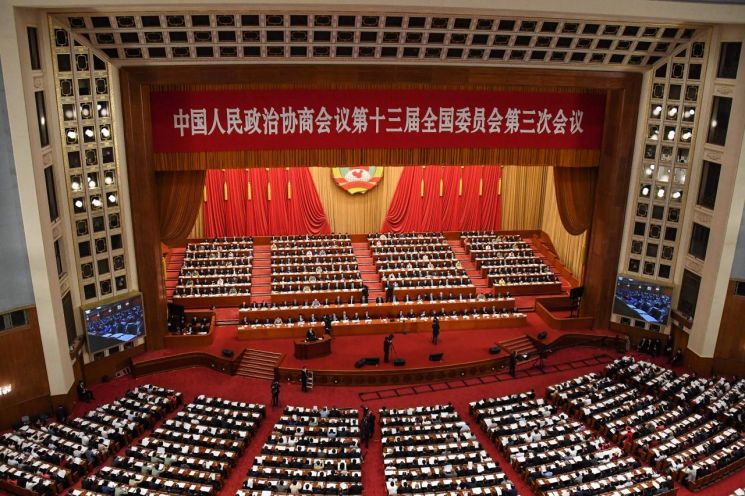
[Asia Economy Reporter Cho Young-shin, New York=Correspondent Baek Jong-min, Beijing=Correspondent Park Sun-mi] The Chinese government announced that it will directly enact the Hong Kong 'National Security Law (Security Law)' during this year's Two Sessions (Lianghui: the National People's Congress and the Chinese People's Political Consultative Conference). The issue of Hong Kong has become a megaton-level adverse factor in the worsening US-China relations, as the US government, including President Donald Trump, responded strongly.
On the 21st, Zhang Yesui, spokesperson for the National People's Congress (NPC), stated, "At the NPC meeting, nine proposals including the 2020 economic development plan will be discussed, and the proposal concerning the enactment of security legislation for the Hong Kong Special Administrative Region is also included." He added, "Hong Kong is an inseparable part of the People's Republic of China, and NPC representatives intend to enact laws to safeguard Hong Kong's national security in accordance with the obligations granted by the constitution." In this regard, the Chinese Ministry of Foreign Affairs reportedly sent letters to embassies in Beijing urging support.
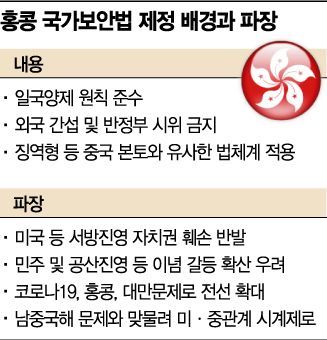
◆ One Country, Two Systems (일국양제, Ilguk Yangje) Put to the Test = The Hong Kong Security Law that China intends to enact primarily prohibits separatist and subversive activities. The core issue is whether the One Country, Two Systems principle will be abandoned. Although China appears to reaffirm that the principle remains unchanged despite the legislation, Western countries including the US fear that Hong Kong's freedoms will be stripped away, ultimately undermining the One Country, Two Systems principle. The New York Times described it as "the clearest message weakening civil liberties since Hong Kong was returned from Britain in 1997 and became a semi-autonomous region," adding that "Hong Kong's pro-China government could be stronger than ever in suppressing activities opposing mainland China."
The Hong Kong government legislated a security law in 2003 that could impose up to 30 years imprisonment on individuals inciting subversion and rebellion, but failed to implement it due to opposition from Hong Kong citizens. The extradition bill (Songhwanbeop) that triggered large-scale protests last year is also seen as an extension of the security law. The newly enacted security law is expected to apply the same legal system as mainland China, including bans on anti-government protests, prohibition of foreign interference in internal affairs, and imprisonment.
Chinese state media unanimously emphasized the legitimacy of directly enacting the security law and supported the Chinese government. On the 22nd, the People's Daily firmly stated, "Hong Kong is part of China," and gave significant coverage to articles asserting that the enactment of the National Security Law is the central government's responsibility and duty to protect national security. Xinhua News Agency reported that "the ongoing violent protests in Hong Kong have seriously threatened the practice of One Country, Two Systems," and conveyed the voices of Hong Kong representatives who expressed firm determination to safeguard national security and hope for the prompt establishment of related systems.
On the other hand, the Hong Kong South China Morning Post (SCMP) reported that it is impossible for the Hong Kong Legislative Council to pass the National Security Law, and that China intends to enact the law instead. It also expressed concerns that the direct enactment of the security law could undermine China's One Country, Two Systems principle. SCMP conveyed voices from Hong Kong opposition politicians stating that the Chinese government's direct enactment of the security law "means the end of China's One Country, Two Systems."
◆ Concerns Over Expansion of Frontlines Beyond US-China to Ideological Conflict = Upon news of the Chinese government's direct enactment of the Hong Kong Security Law, the United States was thrown into turmoil. With the addition of the Hong Kong Security Law to the ongoing US-China conflicts over responsibility for the novel coronavirus (COVID-19), there is a growing atmosphere of confrontation between democracy and communism camps. The US Congress's movements are notable. The Senate is immediately pushing bipartisan legislation to sanction Chinese organizations or individuals threatening Hong Kong's independence. The bill reportedly includes provisions for a 'secondary boycott' against banks that deal with those infringing on Hong Kong's autonomy. A secondary boycott is a law that allows sanctions against third-country companies and individuals involved with the sanctioned country.
Democratic Representative Chris Van Hollen warned in a statement that day, "The US Congress will impose severe sanctions on those attempting to strip Hong Kong of its autonomy," and said the bill is a response to the Chinese Communist Party's "brazen interference" in Hong Kong's autonomy. President Trump, when asked by reporters at the White House about China's push to directly enact the security law, said, "No one knows yet, so I don't know what it is," but warned, "If it happens, we will deal with that very strongly."
The Wall Street Journal (WSJ) expressed concern, stating, "This decision exemplifies Xi Jinping's uncompromising and autocratic leadership based on the belief that authoritarianism is superior to Western-style democracy." The British daily The Guardian evaluated the Hong Kong Security Law as "signifying the end of Hong Kong."
© The Asia Business Daily(www.asiae.co.kr). All rights reserved.


















