KOSPI Recovers Above 2000 for the First Time, Top 10 Group Market Cap Up 11.41%
Hanwha's 20.20% Rebound Largest... Lotte and LG Also Show 10%+ Growth
Leading Stock Samsung Electronics Up Only 4.7%
[Asia Economy Reporter Song Hwajeong] The KOSPI recently recovered the 2000-point level during intraday trading, signaling that the stock market is emerging from the shock of the novel coronavirus infection (COVID-19). Since the end of March, the market has continued its rebound, leading to a significant increase in the market capitalization of the top 10 conglomerates. However, Samsung Group's market capitalization growth lagged behind other groups as its flagship stock, Samsung Electronics, showed a sluggish performance during the rebound.
According to the Korea Exchange on the 22nd, the KOSPI rose to 2004.95 intraday, recovering the 2000-point level for the first time since March 6. Based on the previous day's closing price, the KOSPI has risen 16.38% since the end of March, when it began to rebound from the COVID-19 crash. As the KOSPI showed a clear recovery trend, the stock prices of the top 10 conglomerates also rose, significantly increasing their market capitalization.
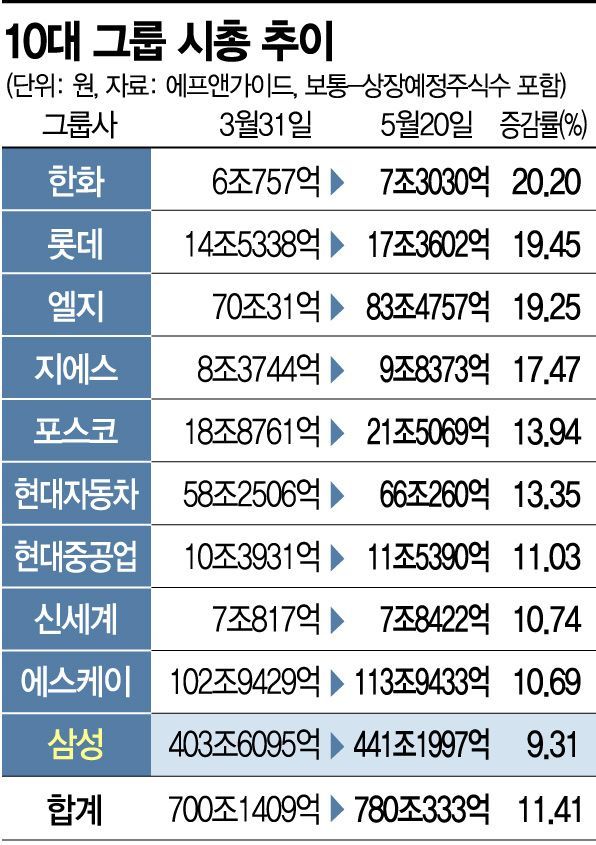
According to financial information provider FnGuide, as of the 20th, the combined market capitalization of the top 10 conglomerates was 780.0333 trillion KRW, up 11.41% compared to the end of March. All top 10 groups saw an increase in market capitalization compared to the end of March. Hanwha led with a 20.20% increase, the largest among the top 10 groups, followed by Lotte (19.45%), LG (19.25%), GS (17.47%), POSCO (13.94%), Hyundai Motor (13.35%), Hyundai Heavy Industries (11.03%), Shinsegae (10.74%), SK (10.69%), and Samsung (9.31%).
Notably, Samsung was the only group among the top 10 with a single-digit growth rate, showing the weakest performance. Its market capitalization increased by only 9.31% during this period, falling significantly short of the top 10 group's average of 14.45%. The sluggish performance of Samsung Electronics, the flagship stock, during the rebound appears to have limited the overall market capitalization growth of the Samsung Group. Additionally, among the six stocks whose market capitalization decreased, three belonged to Samsung Group, accounting for half. Samsung Electronics' market capitalization rose by only 4.71% during the rebound, while Samsung Card (-0.33%), Multicampus (-3.64%), and Samsung Securities (-3.92%) saw declines. Samsung Electronics' stock price gains were limited due to continued foreign selling. Foreign investors sold 646.7 billion KRW worth of Samsung Electronics shares from the end of March to the previous day, the largest amount sold.
Samsung Securities and Multicampus experienced market capitalization declines due to poor first-quarter earnings, while Samsung Card's stock price was weak amid concerns over reduced consumption caused by COVID-19, leading to a decrease in market capitalization. Samsung Securities recorded an operating profit of 22 billion KRW in the first quarter, down 80.7% year-on-year due to poor performance in its asset management division caused by COVID-19. Baek Doosan, a researcher at Korea Investment & Securities, analyzed, "Samsung Securities' first-quarter earnings fell short of consensus due to worse-than-expected asset management losses. The most notable feature of this quarter was the shift to a deficit in asset management and financial income, with significant losses in the hedging of equity-linked securities (ELS) caused by the sharp decline in global stock indices and turmoil in other capital markets."
Multicampus also saw its first-quarter operating profit drop 72.4% to 1.344 billion KRW. Seo Hyewon, a researcher at Kiwoom Securities, said, "Sales were sluggish due to reduced demand for group training and corporate education budgets amid the impact of COVID-19, and profits sharply declined due to increased fixed costs and depreciation expenses. The expected reduction and deferral effects among domestic corporate clients, including group companies, are likely to continue into the second quarter."
Among the top 10 conglomerates, Lotte Himart recorded the largest increase in market capitalization, rising 80.83% compared to the end of March, followed by SK Bioland with an 80.69% increase. Other companies with significant market capitalization growth included LG Hausys (67.38%), NanoEntek (61.28%), Lotte Holdings (55.0%), Robostar (53.43%), and LG International (52.12%). Conversely, LG Display's market capitalization decreased by 4.95% during this period, with SK D&D (-1.79%) and Lotte Chemical (-0.78%) also experiencing declines.
Meanwhile, the KOSPI showed weakness on the day. At 9:10 a.m., the KOSPI was trading at 1995.08, down 0.16% (3.23 points) from the previous session. The KOSPI opened at 2001.60, up 0.16% (3.29 points) from the previous session, but soon fell below the 2000-point level. In the market, individual and institutional investors bought stocks worth 35.4 billion KRW and 25.5 billion KRW, respectively, while foreign investors sold a net 62.3 billion KRW.
© The Asia Business Daily(www.asiae.co.kr). All rights reserved.

















