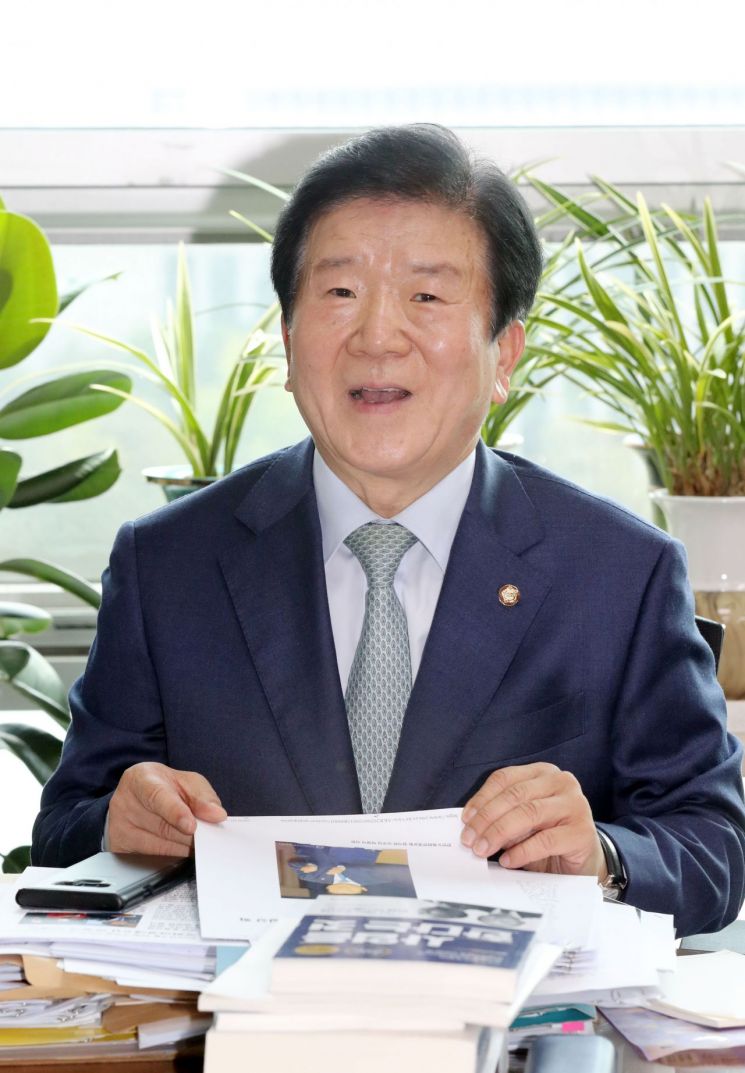
[Asia Economy Reporter Kang Nahum] Park Byeong-seok, the most senior member of the Democratic Party with six terms, is expected to be unanimously elected as the Speaker of the 21st National Assembly for the first half of its term. On the deadline day for candidate registration, the 20th, his competitor, Kim Jin-pyo, a five-term member from the same party, made the decision to "yield."
On that day, Kim stated on his Facebook, "After much deliberation over the past month, I have decided not to register as a candidate for the Speaker this time."
He added, "I believe that the people made the Democratic Party the ruling party with a large majority in this general election because they want the Blue House, the government, and the National Assembly to unite and work together to overcome the COVID-19 crisis, especially the economic crisis. I will devote myself to fulfilling the people's will by focusing on overcoming the economic crisis and preparing for the post-COVID era."
As a result, Park is expected to be elected as Speaker through the plenary session of the National Assembly without an intra-party primary. It is a de facto unanimous election. Park is a six-term senior lawmaker with a background in journalism. After graduating from Daejeon High School and Sungkyunkwan University with a degree in law, he joined JoongAng Ilbo, serving as economic chief and Hong Kong correspondent.
He served as the chief deputy spokesperson of the New Politics National Congress in 1998, head of the practical team for the IMF economic hearing, special advisor to Kim Dae-jung, and was the political deputy mayor of Seoul in 1999. Subsequently, he ran as a New Millennium Democratic Party candidate in Daejeon Seogap in the 16th general election and was elected, serving six consecutive terms. Within the party, he is regarded as having a mild factional color and maintaining harmonious relationships with fellow lawmakers, earning a reputation for excellent interpersonal skills.
There was significant opinion within the party that it would be better to proceed with a consensus-based unanimous election rather than a primary for Park's election as Speaker. In fact, as competition between the two senior lawmakers intensified, concerns among members grew.
This is also related to the recent spreading controversy surrounding the "Yoon Mi-hyang incident." The sexual harassment case of former Busan Mayor Oh Keo-don and various controversies involving elected member Yoon Mi-hyang have created a negative public sentiment that cannot be overlooked. In this situation, if the Speaker election heats up, there was an urgent need to avoid the Democratic Party showing internal divisions both inside and outside before the 21st National Assembly even convened.
Additionally, the fatigue felt by Democratic Party lawmakers from consecutive elections including the general election, floor leader election, Speaker election, and party convention also played a significant role.
Conscious of this intra-party sentiment, the two lawmakers met on the night of the 18th. The day after the meeting, Kim said, "I met with Park to confirm each other's positions. After one more day of consideration, I will announce my final decision." Park also hinted at the possibility of a consensus-based unanimous election, saying, "If necessary, I can meet (with Kim) once more." Ultimately, with Kim withdrawing his candidacy that day, Park secured the Speaker position on his third attempt.
Meanwhile, it appears almost certain that Kim Sang-hee, a four-term female lawmaker, will take the ruling party's Deputy Speaker position. Initially, Byeon Jae-il, who was among the candidates, declared his withdrawal the day before, saying he sympathized with the cause of a "female parliamentary leadership team." Other candidates are also reported to have partially agreed with the emergence of a female Deputy Speaker. If Kim Sang-hee is unanimously elected, she will become the first female Deputy Speaker in the National Assembly.
© The Asia Business Daily(www.asiae.co.kr). All rights reserved.

















