Interview with Lim Young-ik, CEO of Intellicon Research Institute, the First Domestic Legal AI Developer
"Legal AI... Will Be a Tool to Help Improve Lawyers' Skills"
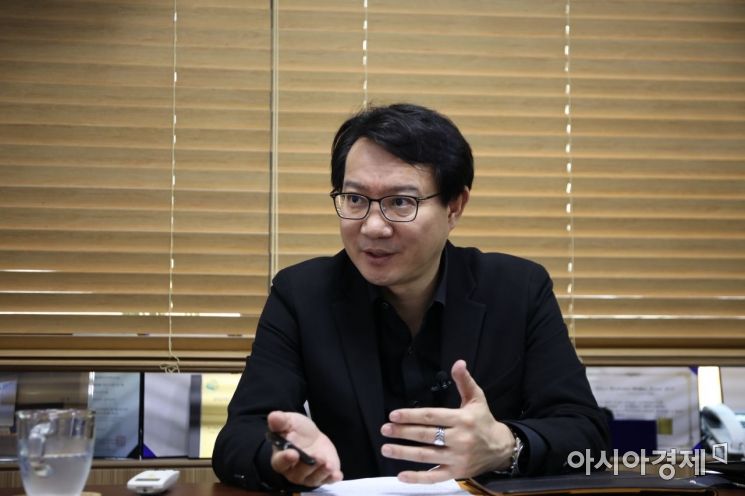 Lim Young-ik, CEO of Intellicon (50), who once ventured into the education artificial intelligence (AI) business but became an anti-AI advocate, explains that he sensed the revolution of artificial intelligence with the advent of deep learning and started developing legal AI. Photo by Yoon Jin-geun PD
[Asia Economy Reporter Kim Heeyoon] "Twenty years ago, after the failure of the educational artificial intelligence (AI) business, I was an anti-AI advocate. However, when I encountered deep learning in the United States in 2005, I decided to join the wave of revolution. The optimal field I chose was law."
Amid social distancing measures due to the COVID-19 pandemic, a free legal consultation website sought by people thirsty for legal advice became a hot topic. Lim Youngik, CEO of Intellicon Research Institute (age 50, Judicial Research and Training Institute class 41), who developed 'BeopryulMeka' (Legal Mecca), said, "The thirst for legal consultation was quenched through a real-time consultation platform, which helped raise awareness of legal AI."
Lim, who consecutively developed a search service (UREX), a Q&A platform (BeopryulMeka), and contract analysis (Alpharo) based on a legal AI inference engine, has previously pointed out resistance as a threat to the development of Legal Tech in Korea. "Korean lawyers had strong psychological resistance to the combination of information and communication technology (ICT) and law. The U.S. also faced considerable resistance at the time of introduction. This is an inevitable phenomenon due to technological development, so I want to turn the question around: why should technology not enter law?" Lim explained, "The introduction of Legal Tech will, conversely, increase lawyers' efficiency and lower costs, helping provide high-quality legal services. The untact environment caused by COVID-19 has become an opportunity to change the perceptions of both lawyers and users about this."
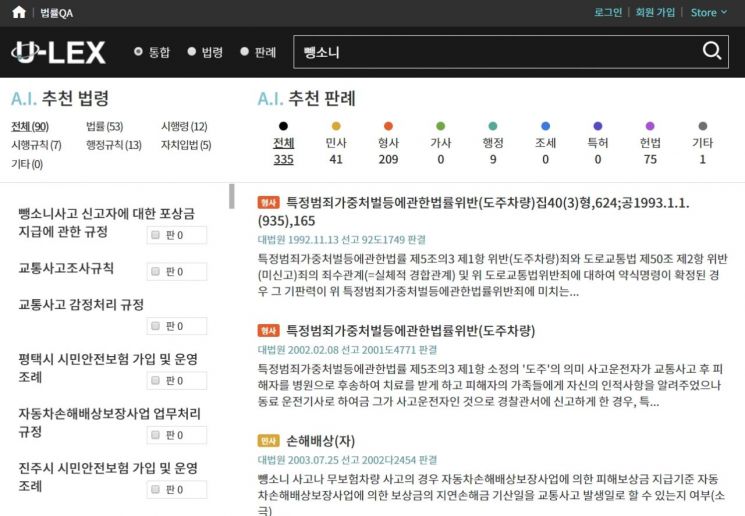 The legal search service 'Urex' recommends relevant laws and precedents even when searched in natural language rather than legal terms.
Legal AI Is Merely a Tool to Assist Lawyers
The legal AI 'Alpharo' developed by him won a landslide victory against human lawyers last year. This raised concerns that AI threatens the expertise of human lawyers and, further, human dignity. Lim said, "The general assessment was that Alpharo won not because it was superior, but because its analysis time was shorter," adding, "It was a kind of Turing test. Current technology only assists human knowledge; technology that infringes on dignity is a story for the distant future."
In 2016, the Korean Bar Association filed complaints against four Legal Tech sites for violating the Attorney-at-Law Act. Since then, claims have emerged that legal AI infringes on the domain of human lawyers. Regarding this, Lim said, "The complaint case was about introducing lawyers through platforms and receiving commissions, and it was dismissed without charges. Legal AI should be seen as a separate issue. In the U.S., there was strong opposition initially, but now there is active support, and ultimately, it will be a tool to improve the skills of young lawyers against former officials and vested interests."
Lim cites 'natural language processing technology' as the core technology for the development of legal AI. Intellicon Research Institute proved its technological prowess by winning the World Legal AI Competition consecutively in 2016 and 2017. However, Lim says that with the current domestic legal data, it is difficult to guarantee competitiveness in the global market.
He stated, "Currently, the Supreme Court does not disclose first-instance rulings, making it difficult to secure deep learning training databases. About three to four years ago, China, which was at a similar level to us, has risen to the world's top level in Legal Tech technology through deep learning as a large amount of legal data was publicly disclosed. Although the amendment of the three data laws will allow freer circulation of pseudonymized information, if the Supreme Court does not disclose rulings, domestic technological development will become increasingly difficult."
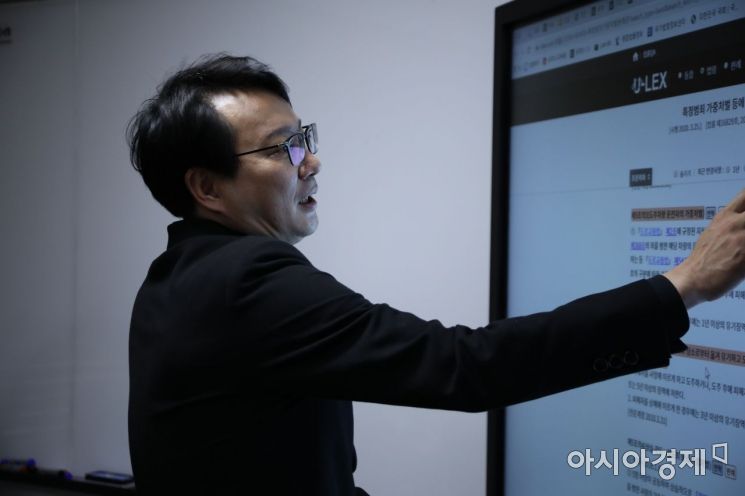 CEO Lim Young-ik demonstrating 'UREX,' a search service based on a legal AI inference engine. Photo by Yoon Jin-geun PD
Hope for Legal Tech Activation Through a Boom in Computerized Law
Lim is not a law major. After majoring in biotechnology at Seoul National University, he went to the U.S. and studied mathematical psychology and neuroscience at Purdue University. Having experienced failure in the educational AI business in Korea before studying abroad, he witnessed the rise of the IT industry and the birth of deep learning in the U.S. "In 2005, when YouTube was acquired by Google and deep learning technology was announced, I felt a new world and revolution had arrived," he said. "I thought law, which proceeds by rules and logic, would be optimal for AI, so I started full-scale development after returning to Korea." Wanting to understand law, he took the bar exam, passed, and during his training at the Judicial Research and Training Institute, he established Intellicon Research Institute, dedicating his days to studying law and nights to AI development, leading to where he is today.
He confesses that he was an 'anti-AI' before deep learning due to great distrust of AI. However, after encountering deep learning and jumping into legal AI development, his life changed. He said, "AI before deep learning was at the level of automation, but now it is different," adding, "The domestic Legal Tech industry is still in its infancy, but my goal is to share the know-how I have through legal intelligence academies and law school academic conferences to spark a boom in computerized law." He predicts that as Legal Tech becomes more active, market competition will intensify, sales will increase, growth will follow, and an ecosystem will naturally be established.
© The Asia Business Daily(www.asiae.co.kr). All rights reserved.

![User Who Sold Erroneously Deposited Bitcoins to Repay Debt and Fund Entertainment... What Did the Supreme Court Decide in 2021? [Legal Issue Check]](https://cwcontent.asiae.co.kr/asiaresize/183/2026020910431234020_1770601391.png)
















