KDI Announces Economic Outlook and Issue Analysis for the First Half of 2020
Assuming Domestic COVID-19 Spread Slows in H1 and Overseas in H2
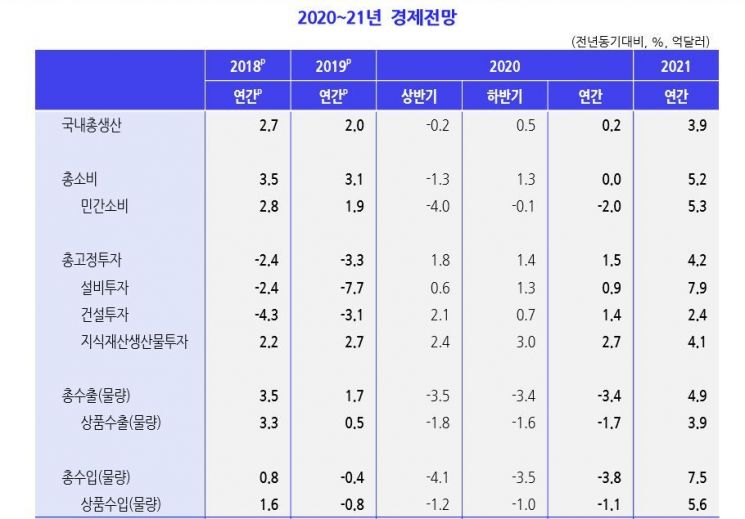
[Sejong= Asia Economy Reporter Kim Hyun-jung] The Korea Development Institute (KDI) forecasted that due to the impact of the novel coronavirus disease (COVID-19) pandemic, South Korea's economic growth rate will slow to the 0% range this year but will show a gradual U-shaped recovery through next year. Employment, private consumption, facility investment, exports, and imports are also expected to follow a similar trend, bottoming out this year.
KDI, a government-funded research institute under the Ministry of Economy and Finance, published the "KDI Economic Outlook (First Half of 2020)" report on the 20th, predicting that private consumption and exports will shrink significantly due to COVID-19, resulting in an annual GDP growth rate of 0.2% this year, followed by a rebound to 3.9% next year. This projection assumes that the spread of COVID-19 will slow down domestically from the first half of the year and globally from the second half, leading to a gradual normalization of economic activities. Additionally, the crude oil import price (based on Dubai crude) is expected to fall about 45% this year to around $35 per barrel and to remain near $40 next year. The Korean won is forecasted to depreciate about 4% this year with little significant change next year, based on these assumptions.
However, KDI also left open the possibility of negative annual growth. Jeong Kyu-chul, head of the KDI Economic Outlook Office, explained, "We expect a significant contraction in our economy's growth, and there is considerable uncertainty regarding the trajectory. Presenting 0.2% means there is a high possibility of positive growth, but the possibility of negative growth is similarly high."
Domestic and external conditions such as private consumption, facility investment, construction investment, exports, and imports are all expected to deteriorate this year. Private consumption is projected to decline by -2.0% this year but recover by 5.3% next year. While service consumption has sharply decreased, domestic consumption by residents is expected to recover relatively quickly as the spread of COVID-19 slows domestically. However, due to ongoing international travel restrictions, residents' overseas consumption is expected to remain sluggish until next year.
Facility investment is expected to grow only 0.9% this year due to economic contraction but is forecasted to increase by 7.9% next year. Despite the recovery in global semiconductor demand and the base effect from last year, the impact of COVID-19 is expected to result in a low growth rate.
Construction investment is an exception, expected to turn positive from last year's -3.1% to 1.4% this year. Improvements in civil engineering, centered on SOC (Social Overhead Capital), are gradually easing the prolonged slump since 2018, with a projected 2.4% increase next year. Furthermore, exports are expected to decline by 3.% this year due to the global spread of COVID-19 but to increase by 4.9% next year in line with the recovery trend. Imports are forecasted to drop by -3.8% this year but to rise by 4.9% next year.
The current account surplus is expected to record a surplus of around $77.8 billion, similar to last year's $76.9 billion, despite reduced export volumes due to improved terms of trade. The surplus is projected to expand to $66.4 billion next year. Consumer prices are expected to show a low growth rate of 0.4% this year amid a continued decline in expected inflation, economic contraction, and falling oil prices, followed by a moderate recovery of 0.8% in 2021.
The unemployment rate is forecasted to rise slightly to 3.9% this year from 3.8% last year due to a significant drop in the economic activity participation rate. The number of employed persons is expected to remain around zero as government policies partially offset employment shocks mainly in the service sector, with a recovery to 200,000 next year.
Jeong said, "The growth path of our economy will vary greatly depending on the scope and duration of COVID-19's spread. If the spread slows rapidly worldwide, our economy will recover quickly from the second half of the year. However, if the pandemic prolongs, economic recovery will be delayed, and the medium- to long-term growth trajectory may be revised downward."
© The Asia Business Daily(www.asiae.co.kr). All rights reserved.
![Clutching a Stolen Dior Bag, Saying "I Hate Being Poor but Real"... The Grotesque Con of a "Human Knockoff" [Slate]](https://cwcontent.asiae.co.kr/asiaresize/183/2026021902243444107_1771435474.jpg)
















