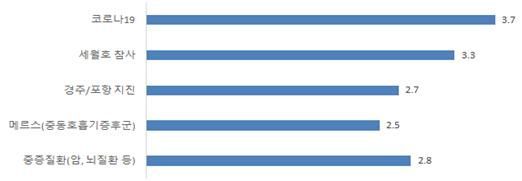
 Stress level from COVID-19. Based on a 5-point scale, it is higher than the stress experienced during the Sewol ferry disaster.
[Asia Economy (Suwon) = Reporter Lee Young-gyu] One in two South Korean citizens has experienced anxiety or depression due to the prolonged COVID-19 pandemic. Furthermore, the intensity of stress related to COVID-19 was analyzed to be greater than that caused by MERS (Middle East Respiratory Syndrome), the Gyeongju and Pohang earthquakes, and even the 2014 Sewol ferry disaster.
The Gyeonggi Research Institute announced on the 19th that according to a "National Mental Health Survey due to COVID-19" conducted last month targeting 1,500 people aged 15 and older across 17 metropolitan cities and provinces nationwide, 45.7% responded that they felt "somewhat anxious or depressed" due to COVID-19, and 1.8% said the level was "very severe."
By age group, the rates of anxiety and depression responses were 40.0% for teenagers, 44.5% for people in their 20s, 46.5% for those in their 30s, 48.2% for those in their 40s, and 52.2% for those in their 50s, showing higher rates with increasing age.
By occupation, full-time homemakers had the highest rate at 59.9%, followed by self-employed individuals at 54.3%, contract workers at 53.4%, middle and high school students at 46.8%, and unemployed persons at 46.7%.
By region, the rate of anxiety and depression among Daegu citizens was 65.3%, about 20% higher than the national average. Gyeonggi Province recorded an average level at 47.6%.
In particular, stress caused by COVID-19 (3.7 points on a 5-point scale) was 1.5 times higher than that of MERS (2.5 points), 1.4 times higher than the Gyeongju and Pohang earthquakes (2.7 points), 1.3 times higher than severe illnesses (2.8 points), and 1.1 times higher than the Sewol ferry disaster (3.3 points), indicating a higher level compared to other disasters.
The degree to which daily life was disrupted (4.1 points) was also higher than that caused by MERS (2.8 points) and the Gyeongju and Pohang earthquakes (2.8 points).
Among the survey participants, 67.3% expressed sympathy and consolation toward confirmed COVID-19 patients, 16.2% felt anger and resentment, and 16.5% reported no particular emotions.
Regarding emotions felt when hearing COVID-19 news, responses included resentment toward the deviant behavior of specific individuals or groups (22.7%), despair over the prolonged pandemic (16.3%), as well as positive responses such as support for frontline medical personnel (19.2%) and encouragement for the government and quarantine policies (12.3%).
Half of the respondents (49.6%) answered that psychological and mental health support services are necessary to alleviate psychological distress caused by COVID-19.
Researcher Lee Eun-hwan of the Gyeonggi Research Institute stated, "As much as the socioeconomic losses, the emergence of the new term 'Corona Blue' shows that the pandemic is having a significant negative impact on the mental health of the public. We must prepare for the spread of national trauma, that is, a mentaldemic."
© The Asia Business Daily(www.asiae.co.kr). All rights reserved.

















