[Asia Economy Reporter Lee Ji-eun] On the 19th, Min Kyung-wook, a member of the Future United Party who claims there was vote manipulation in the April 15 general election, revealed that the ballot sorting machines contain communication devices and spectrum sensors capable of reading QR codes. When asked about the source of the disclosed ballots, he refrained from answering, citing "protection of the informant."
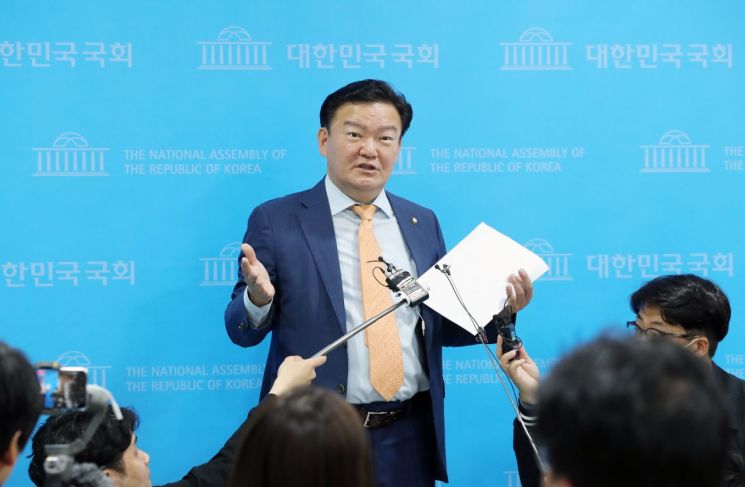
At a press briefing at the National Assembly Communication Office that morning, Min stated, "Based on a tip from a computer expert familiar with the internal affairs of the Election Commission (NEC), we discovered that the ballot sorting machines used in the general election have communication equipment and spectrum sensors that can read QR codes."
Previously, the NEC had stated, "The ballot sorting machines have optical sensors that recognize ballots but cannot recognize QR codes," but Min claimed that the NEC's explanation was false.
He explained, "The vote counting status sheet records the number of voters, the number of ballots issued, votes per candidate, and the number of ballots subject to re-verification, and is printed by an embedded printer. To know the number of voters in the relevant electoral district, wireless communication with the main server is necessary. This status sheet is irrefutable evidence that the ballot sorting machine communicated with the main server."
Min also claimed, "The ballot sorting machines used in this general election were installed in 1,165 units across 251 counting centers nationwide, and the supplier deployed 54 personnel nationwide for technical support. According to what the informant confirmed through a supplier official, there is only one storage device, and the data read and sorted from the ballots were backed up in real-time somewhere. This is also evidence of wireless communication."
He added that by verifying the operating device, a laptop, the backup route through the relay can be confirmed, saying, "Verification of related devices can no longer be delayed," and strongly urged, "The Central Election Commission should cooperate regarding the verification of the ballot laptops instead of repeating opaque explanations."
When asked by reporters about the source of the tip, Min refrained from answering, saying, "Revealing the identity would violate criminal law."
Regarding the acquisition route of the ballots disclosed on the 11th, he responded, "As a recipient of a public interest whistleblower, I cannot discuss that matter."
He also refused to answer about Lee Jun-seok, the Future United Party Supreme Council member, proposing a public broadcast debate, saying, "Please ask another question." Min had also offered a reward on Facebook for whistleblowers regarding election manipulation. He said, "There are a few tips, but none sufficient to announce."
When asked if these suspicions were cross-checked with the NEC, he retorted, "Cross-checking requires trust," and questioned, "To resolve the suspicions, they should publicly demonstrate the ballot sorting machines, laptops, issuing devices, QR code generators, and decoders. Why don't they?"
© The Asia Business Daily(www.asiae.co.kr). All rights reserved.

















