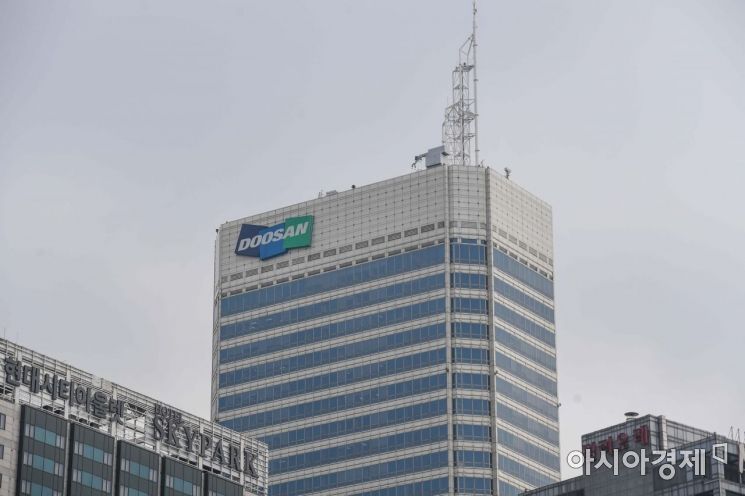
 On the 27th, the Doosan Tower building in Dongdaemun-gu, Seoul, is visible as the government decided to inject 1.6 trillion won into Doosan Heavy Industries, which is experiencing financial difficulties, through the Korea Development Bank and the Export-Import Bank of Korea. Photo by Kang Jin-hyung aymsdream@
[Asia Economy Reporter Ki-min Lee] Doosan Group, which received 2.4 trillion KRW in support from creditors due to management difficulties, is accelerating procedures to secure liquidity. However, industry insiders predict that Doosan's announced goal of securing more than 3 trillion KRW in liquidity through self-help measures will be difficult, as each matter faces obstacles.
According to the industry on the 16th, Doosan Group is conducting all-out activities to gather liquidity, including selling affiliate shares and business units, various asset sales, and workforce restructuring.
The assets currently on the market include 61% of Doosan Solus shares owned by Doosan Co., Ltd. and special related parties such as Doosan Group Chairman Park Jeong-won, Doosan Tower in Dongdaemun-gu, Seoul, which is the face of Doosan, and Club Mow CC, a golf course subsidiary of Doosan Heavy Industries & Construction. Doosan expects the sale price of Doosan Solus shares and management rights to exceed 800 billion KRW. Additionally, Doosan is in final negotiations to sell Doosan Tower to Maston Investment Management, a real estate investment management company, for 700 to 800 billion KRW. Doosan Heavy Industries & Construction is reportedly selecting buyers to sell Club Mow CC. The company plans to recover funds unnecessarily outflowed due to Club Mow CC through this sale. The investment industry expects the transaction price of Club Mow CC to be around 140 billion KRW.
Doosan Group has also given up dividends for the first quarter of this year for Doosan Co., Ltd. to improve its financial structure. The company explained that the spread of COVID-19 caused domestic and international financial markets to tighten, making it inevitable to review the existing dividend policy. Doosan Co., Ltd. paid dividends exceeding 100 billion KRW annually, including 100.4 billion KRW in 2016 and 2017, and 102.4 billion KRW in 2018. Last year's dividend scale also reached 100 billion KRW. About half of the dividends went to Doosan Group owners such as Chairman Park Jeong-won and Vice Chairman Park Ji-won. As of the end of last year, the largest shareholders and special related parties held 47.24% of Doosan Co., Ltd.'s common shares.
Workforce restructuring is also underway. Doosan Heavy Industries & Construction completed the voluntary retirement process for about 650 employees aged 45 in February and March this year. Additional voluntary retirement applications were accepted from the 11th to the 15th of this month. Depending on the results of the voluntary retirement applications, Doosan Heavy Industries & Construction plans to begin temporary layoffs of some idle personnel as early as the 21st. The Metal Workers' Union Doosan Heavy Industries Branch opposes this workforce restructuring, citing the lack of labor-management consultation. They are also concerned about the outflow of skilled nuclear and thermal power plant technicians due to retirements.
Even if Doosan sells all these assets, it is unclear whether it can raise 3 trillion KRW. Most of the shares of Doosan Co., Ltd., Doosan Solus, and Doosan Fuel Cell held by the Doosan family are already pledged as collateral. Earlier, the creditors set a pledge on 8 shares of Doosan Co., Ltd. held by Vice Chairman Park Ji-won among 7,208,417 shares held by 27 people including Chairman Park Jeong-won in mid-last month, and signed a subordination pledge contract on the remaining 7,208,409 shares already pledged. The situation is similar for Doosan Solus and Doosan Fuel Cell. Among 14,602,910 shares of Doosan Solus held by the family, 10,359 shares (0.07%) including 9,824 shares of Chairman Park Jeong-won and 535 shares of Vice Chairman Park Ji-won were set as senior pledge, and the rest were subordinated. Doosan Fuel Cell also set a senior pledge on 0.07% of the owner family's shares. Additionally, Doosan received 400 billion KRW in corporate bonds and secured loans in 2018 using Doosan Tower as collateral. After deducting deposits and taxes, the amount Doosan will actually receive from selling Doosan Tower is estimated to be between 100 and 200 billion KRW.
Meanwhile, the sharp decline in first-quarter earnings this year due to COVID-19 and restructuring costs is also an obstacle. Doosan Co., Ltd. posted a consolidated net loss of 379.9 billion KRW in the first quarter, turning to a deficit from a net profit of 54.9 billion KRW in the same period last year. This is the largest loss in five quarters since a net loss of 524.9 billion KRW in the fourth quarter of 2018. Doosan Co., Ltd.'s consolidated first-quarter sales were 4.4271 trillion KRW, down 1.2%, and operating profit plunged 74.4% to 90.9 billion KRW. Doosan Heavy Industries & Construction, at the center of management difficulties, posted a consolidated net loss of 371.4 billion KRW in the first quarter, turning to a deficit. Its first-quarter sales increased 0.2% to 3.837 trillion KRW, but operating profit plunged 82.5% to 56.5 billion KRW. On a separate financial statement basis, which shows Doosan Heavy Industries & Construction's standalone business performance, sales increased 6.2% to 924.9 billion KRW, but operating loss of 59.2 billion KRW was recorded, turning to a deficit.
© The Asia Business Daily(www.asiae.co.kr). All rights reserved.
![Clutching a Stolen Dior Bag, Saying "I Hate Being Poor but Real"... The Grotesque Con of a "Human Knockoff" [Slate]](https://cwcontent.asiae.co.kr/asiaresize/183/2026021902243444107_1771435474.jpg)
















