Operating Profit Increased by 22% in Q1
Sales Increased Despite the Spread of COVID-19
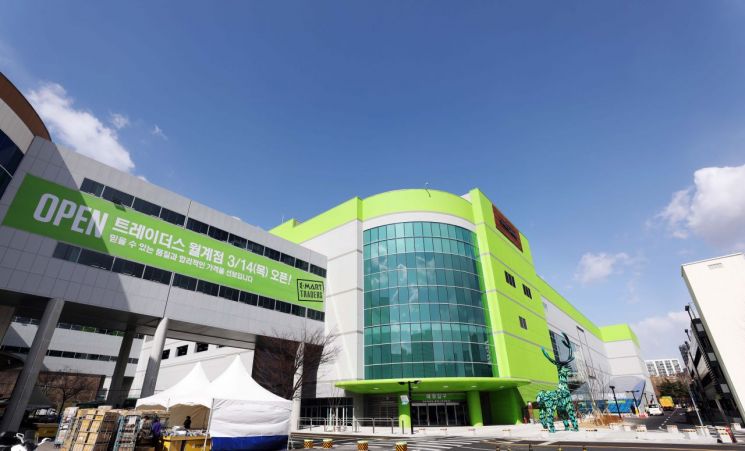
[Asia Economy Reporter Lim Hye-seon] When the growth of Emart, the core of the Shinsegae Group, stagnated in 2010, Vice Chairman Chung Yong-jin sought new growth engines. Choosing a warehouse-style discount store that could create synergy without feeling out of place with Emart, Vice Chairman Chung enhanced price competitiveness and opened stores first in major provincial cities with large populations instead of Seoul. His insight and decisiveness were rewarded with strong performance.
Since the opening of the first Traders store in 2010, sales have increased 30-fold in seven years, and since 2015, sales have grown by more than 20.0% year-on-year. It took six years to surpass 1 trillion KRW in sales, but it broke through 2 trillion KRW in just three years. The spread of COVID-19 presented an opportunity for Traders to grow. More people sought to purchase fresh food and other items in bulk to avoid face-to-face contact. While most retailers experienced negative growth in Q1, Traders achieved double-digit growth.
According to Emart on the 14th, Traders’ sales and operating profit in Q1 increased by 21.8% and 22.4% respectively compared to the same period last year, successfully achieving both external growth and internal stability. During the same period, Emart’s overall operating profit fell by 34.8% to 48.4 billion KRW, highlighting the contrast. The start of Q2 is also promising. Traders’ sales in April reached 222.3 billion KRW, up 29.7% year-on-year, raising expectations.
Unlike its competitor Lotte Mart’s Big Market, which failed to expand its business scale due to poor performance, Traders is evaluated as having successfully established itself in the warehouse discount store market. The differentiated strategy of an “open warehouse store” led by Vice Chairman Chung proved effective. Traders is accessible to anyone without an annual membership fee. By 2018, 15 stores had opened, and last year, including the Wolgye store in Seoul, three stores were added, making it the largest warehouse-style store chain in Korea.
The main drivers of Traders’ growth are “food” and “price competitiveness.” Last year, food accounted for a remarkable 74.3% of Traders’ total sales, about 17% higher than Emart’s food sales ratio. Among these, fresh food accounted for 41% of Traders’ total sales. In Q1 this year, the food sales ratio increased further to 78%, with fresh food sales rising to 43%. An Emart official explained, “In Q1, the top five best-selling products at Traders were all fresh food items. In particular, meat accounted for 15% of total sales, ranking first in the category.” Traders’ meat section attracts attention because of three strategies: large volume operation, reduced distribution stages, and pre-planning, which enable ultra-low prices. Prices are about 15-20% cheaper than similar products at general large marts. For ready-to-eat foods, sales growth was 37.5%, the highest among Traders’ food categories.
There is also a “hot deal” policy. Frequently purchased food and daily necessities are sold 20-30% cheaper. About 20 types of essential items such as ramen, dumplings, red pepper paste, and detergents were launched in February. By the end of this year, about 100 products will be introduced. A subscription service that offers additional discounts when a certain amount is paid monthly by card also contributes to performance improvement. Coffee subscriptions were launched in March-April, and pizza subscriptions in April-May. For example, purchasing a 4,980 KRW monthly coffee subscription with a Samsung Card provides one free Americano daily.
Differentiated products also attract customers. The “Steak Zone,” reflecting meat consumption trends, has been expanded, and a premium aged meat corner was newly established. Australian Wagyu is 40-50% cheaper than department store average prices. Exclusive products such as live flatfish sashimi made only from flatfish over 2kg and air fryers are offered. Parallel imported products like Canada Goose and Lacoste pique shirts are 20-30% cheaper than domestic retail prices. Emart plans to increase Traders stores to 50 by 2030 and achieve annual sales of 10 trillion KRW, building warehouse store-specialized infrastructure such as dedicated logistics and meat centers.
© The Asia Business Daily(www.asiae.co.kr). All rights reserved.
![User Who Sold Erroneously Deposited Bitcoins to Repay Debt and Fund Entertainment... What Did the Supreme Court Decide in 2021? [Legal Issue Check]](https://cwcontent.asiae.co.kr/asiaresize/183/2026020910431234020_1770601391.png)















