[Asia Economy Reporter Ki-min Lee] A study has found that an increase in single-person households can have a negative impact on the economy, highlighting the need for policies aimed at transitioning to multi-person households.
The Korea Economic Research Institute (KERI) announced on the 14th through its report titled "Analysis of Characteristics and Economic Impact of Single-Person Households" that an increase in single-person households could negatively affect the economy by worsening income distribution and poverty levels.
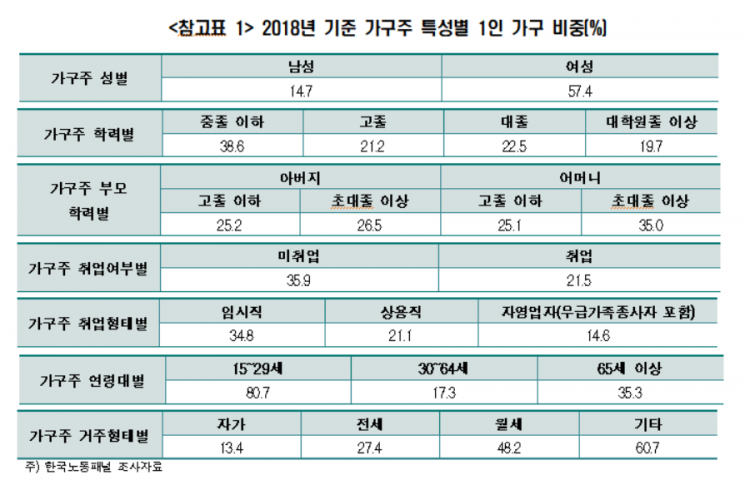
According to KERI's analysis of the 21st Korean Labor Panel Survey data (2018), the proportion of single-person households varies depending on household characteristics such as the gender of the household head, education level, employment type, and housing type. When estimating the proportion of single-person households based on the gender of the household head, the proportion among female household heads was 57.4%, about four times higher than that of male household heads at 14.7%. Additionally, the proportion of single-person households was higher when the household head had a lower education level. As of 2018, the proportion of single-person households among household heads with middle school education or below was 38.6%, nearly twice that of household heads with graduate-level education or higher, which was 19.7%.
Furthermore, among unemployed household heads, the proportion of single-person households was 35.9%, approximately 1.7 times higher than the 21.5% proportion among employed household heads. Among employed household heads, the highest proportion of single-person households was found among temporary workers (34.8%), while the lowest was among self-employed household heads (14.6%). The analysis also showed that single-person households were more prevalent among those living in rented housing or other types of residence compared to homeowners. The proportion of single-person households by housing type was 13.4% for homeowners, but 48.2% for monthly renters and 60.7% for others (including free housing and company-provided housing).
KERI explained that the probability analysis of causal relationships among key factors determining single-person households showed that housing type had a relatively large impact. Compared to households owning their homes, the likelihood of being a single-person household increased by about 8-9 percentage points for those in jeonse (long-term deposit lease) housing. For monthly renters, the increase was about 26 percentage points, and for others, about 38 percentage points.
Additionally, compared to unemployed household heads, the probability of being a single-person household decreased by about 5 percentage points for those in regular employment and by 5-6 percentage points for self-employed household heads.
Ultimately, KERI's analysis concluded that the increase in single-person households worsens income inequality and poverty rates. A 10% increase in single-person households raised the Gini coefficient by approximately 0.006, which is a 1.7% increase compared to South Korea's 2018 Gini coefficient of 0.3485. The poverty index also rose by about 0.007 (a 3.6% increase compared to the poverty index of 0.1972). The Gini coefficient and poverty index measure income distribution inequality and poverty levels, respectively. Both indicators are better when closer to 0 and more severe when closer to 1.
Researcher Jin-sung Yoo stated, "Based on the analysis results, policies focused on single-person households are necessary, but it is also important to promote policies that encourage transitioning single-person households into multi-person households. In the future, housing and employment policies will be crucial to reducing the proportion of single-person households."
Regarding this, Yoo suggested improving housing-related financial and tax policies to expand opportunities for securing stable living spaces. He also emphasized the need for household policies that strengthen housing support for newlyweds to encourage marriage and childbirth. Additionally, he added that exploring ways to increase quality jobs, such as relaxing protections for regular employment and promoting employment flexibility, is necessary.
© The Asia Business Daily(www.asiae.co.kr). All rights reserved.

















