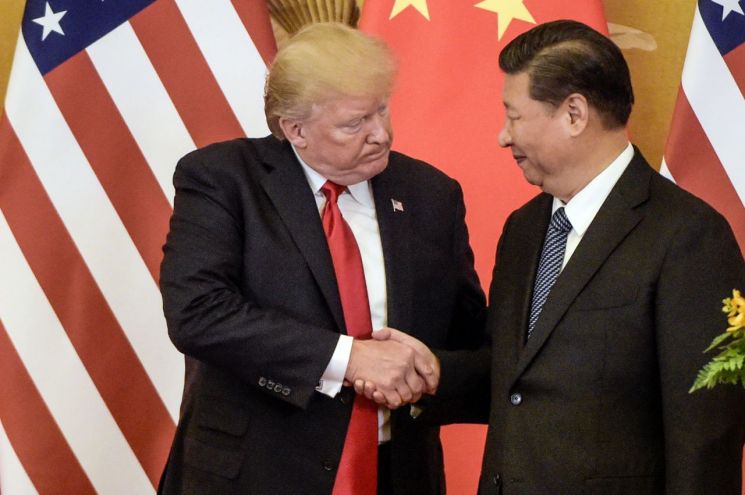
[Asia Economy Beijing=Special Correspondent Park Sun-mi] China’s imposition of a new 80% tariff on Australian barley and the suspension of some beef imports are being seen as potentially having a positive effect on the implementation of the Phase One trade agreement between the U.S. and China.
On the 13th, Hong Kong’s South China Morning Post (SCMP) reported that among experts, there is a growing sentiment that China’s regulatory measures on Australian barley and beef could create room for importing more U.S. barley and beef, thereby helping to meet the requirements of the Phase One trade deal.
Zhou Weihuan, an international economic lawyer at the CIBEL Center of the University of New South Wales Law School in Australia, explained, “This move will help China purchase $12.5 billion worth of U.S. agricultural products in 2020 and $19.5 billion in 2021.” He added, “China is seizing the opportunity to buy more from the U.S. instead of Australia, which will aid in the implementation of the Phase One U.S.-China trade agreement.” He further noted, “How much barley and beef China buys from the U.S. depends on how much the U.S. exports to China. The U.S. has not exported large quantities of barley to China in recent years.”
China, which has clashed with Australia over the international investigation into the origin of the novel coronavirus (COVID-19), announced the suspension of some Australian beef imports the day before. Zhao Lijian, spokesperson for the Chinese Ministry of Foreign Affairs, confirmed at a regular briefing on the 12th, “To protect the health and safety of Chinese consumers, we have decided to temporarily suspend imports of beef products from four Australian companies.” Zhao explained the background of the measure, saying, “China Customs has repeatedly detected cases where some Australian companies violated China’s quarantine requirements during inspections of imported meat products.”
However, China had earlier announced tariffs of up to 80% on Australian barley amid anti-dumping allegations, raising suspicions that these series of measures are retaliatory economic actions against Australia amid disputes over the international investigation into the origin of COVID-19. The four major Australian meat companies blocked by China account for over 30% of Australia’s total beef exports to China, and about half of Australia’s barley exports go to China.
This is not the first time China has taken retaliatory economic measures against countries with which it has conflicts. Last year, when tensions arose with Canada over the arrest of Huawei’s vice-chairman, China retaliated by suspending imports of Canadian canola oil and meat products. In 2010, after the Norwegian Nobel Committee awarded the Nobel Peace Prize to Chinese dissident Liu Xiaobo, China halted imports of Norwegian salmon.
On the other hand, despite the reduced demand due to COVID-19, China is making efforts to fulfill its commitments to purchase U.S. products. Chinese officials have reportedly held multiple discussions over the past few months on how to implement the trade agreement with the U.S. as fully as possible. While some voices call for renegotiating the trade deal to favor China, the overall atmosphere favors maintaining and implementing the agreement without breaking it.
As pressure from the U.S. to implement the trade agreement continued, the Chinese government announced the day before that it would exempt 79 types of U.S. products from retaliatory tariffs. The 79 exempted items include rare earth ores, gold and silver ores, aviation radar, and medical disinfectants. The tariff exemption period will last for one year starting from the 19th. In February, China also exempted tariffs on 696 U.S. products, including key items such as soybeans and pork.
At a briefing the day before, the Chinese Ministry of Foreign Affairs stated, “The Phase One trade agreement benefits China, the U.S., and the entire world. We will work together to implement the agreement based on the principles of equality and mutual respect.”
© The Asia Business Daily(www.asiae.co.kr). All rights reserved.

![User Who Sold Erroneously Deposited Bitcoins to Repay Debt and Fund Entertainment... What Did the Supreme Court Decide in 2021? [Legal Issue Check]](https://cwcontent.asiae.co.kr/asiaresize/183/2026020910431234020_1770601391.png)