Establishment of Smart Information Division in January, Full Department Collaboration to Launch Detailed Projects in 4 Areas... Formation of 'Gwanak-type Living Lab' Comprising Residents and Experts... Accelerating Innovative Smart Projects to Enhance Residents' Quality of Life
[Asia Economy Reporter Jongil Park] Gwanak-gu (Mayor Park Junhee) announced that the “Together Human Smart City Creation,” which utilizes 4th Industrial Revolution technologies to solve urban problems and improve residents' quality of life, is progressing smoothly.
Since the launch of the 7th local government, Gwanak-gu has pledged to create a “Smart City” and formed a dedicated team in January 2019. It has carried out various projects to make residents' lives smarter, including ▲installation of a smart crosswalk pedestrian safety system ▲installation of IoT urban data composite sensors ▲establishment of a fine dust prevention system for vulnerable groups.
Additionally, Gwanak-gu signed agreements with five institutions, including the Sogang University ICT Convergence Disaster Safety Research Institute, to accelerate the smart city creation project based on safety by combining the efforts of government, industry, academia, and research.
In 2020, to strengthen expertise in promoting the smart city creation project, Gwanak-gu established a dedicated department, the Smart Information Division. All departments of the district office collaborate to actively promote detailed projects in four areas: ▲Resident-led Smart City Gwanak ▲Safe Smart City Gwanak for residents ▲Smart City Gwanak that residents can feel ▲Establishing the foundation for smart city creation.
A district official stated, “We plan to build a ‘Gwanak-type Living Lab’ composed of residents, technology experts, and local governments to create a ‘resident-centered safe smart city Gwanak’ that solves various urban problems using information and communication technology (ICT).”
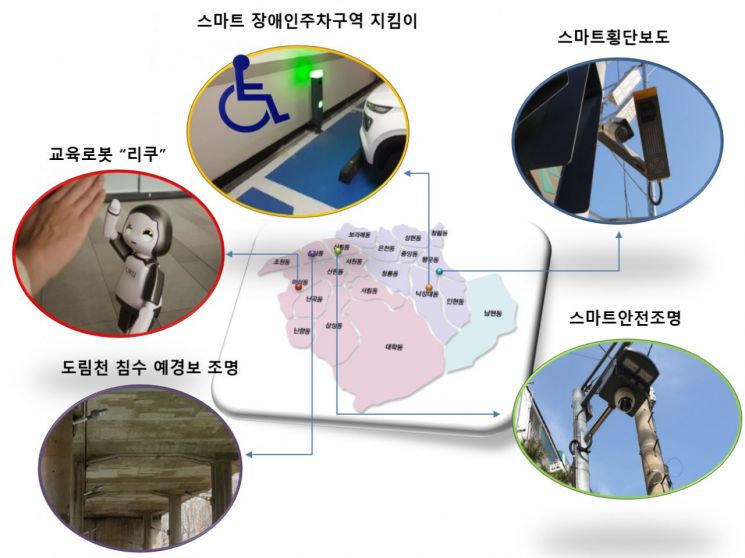
Last March, reflecting the characteristics of areas with many multi-family houses and single female households, the district pilot-installed “Smart Safety Lighting,” which integrates video and audio analysis devices with CCTV, in the Sinlim-dong area, where one-room and multi-family houses are densely located.
“Smart Safety Lighting” is a system that notifies the integrated control center’s situation room when dangerous situations such as screams or assaults are detected, allowing controllers to take actions such as reporting.
The district plans to comprehensively analyze the effectiveness of the project through pilot operation and, depending on the effectiveness, upgrade the system functions and expand the target areas in the second half of the year.
Also, Gwanak-gu is the first in the nation to support wristwatch-type wandering detection devices equipped with GPS for women with intellectual disabilities, helping guardians check the real-time location of the protected person via a smartphone app, thereby striving to create a safe living environment for women with disabilities.
Along with this, the district plans to install an “IoT Disabled Parking Zone Guardian” using the Internet of Things (IoT) in parking spaces exclusively for disabled persons to facilitate parking convenience for disabled drivers. When a general vehicle enters a disabled parking zone, the IoT sensor detects it and warns with a flashing light and voice to induce movement; if the vehicle does not move, enforcement and administrative measures are taken.
Furthermore, the district installed a “Traditional Market Wireless (IoT) Fire Alarm Facility” that detects heat and smoke via IoT sensors during fires and notifies fire stations and merchant associations to prevent large-scale fires, thereby working to create a safe traditional market environment. It also plans to implement a “Smart Plug Safety Check Service” using IoT sensors to monitor the safety of middle-aged single-person households at high risk of solitary death.
Gwanak-gu has been selected as a finalist in public contests hosted by central government ministries such as the Ministry of the Interior and Safety and the Ministry of Trade, Industry and Energy, and will accelerate the realization of a smart city through organic cooperation with central government ministries.
Through contests, the district will implement ▲“Integrated Disabled Childcare Smart Guardian Service” (Ministry of the Interior and Safety) to prevent missing children in daycare centers using a movement detection system ▲“Robot Utilization Socially Vulnerable Benefit Support Project” (Ministry of Trade, Industry and Energy) that provides one-on-one customized education on digital device usage for the elderly, expected to provide residents with more tangible smart services.
Additionally, the district plans to activate resident participation in smart city creation projects by conducting its own contest to discover smart technology ideas that solve various urban problems or improve residents' quality of life in Gwanak-gu.
Mayor Park Junhee said, “In line with the 4th Industrial Revolution, we established the Smart Information Division this January and are striving to discover life-close projects using advanced ICT together with residents. Going forward, we promise to transform residents' lives to be more convenient and smarter through innovative smart city policies centered on people.”
© The Asia Business Daily(www.asiae.co.kr). All rights reserved.

















