Leading Market Innovation with O4O Strategy... Sustained Growth Despite COVID-19
#. On the 29th of last month, 'Cookat Market Starfield COEX Mall Branch' opened on the B1 floor of Starfield COEX Mall in Samseong-dong, Seoul, covering an area of 353㎡ (107 pyeong). This place is an offline store of Cookat, which operates an online food market. With the concept of a 'grocerant' combining a grocery store and a restaurant, consumers who want to purchase ingredients on-site and taste them immediately are continuously visiting.
#. Near Hongdae Entrance Station in Mapo-gu, Seoul, a bustling area filled with trendy stores mainly visited by people in their 20s and 30s, there is a distinctive restaurant unlike any other. Named 'Idus Craft House,' it is an offline store operated by the handmade online market 'Idus.' Based on the food products sold on Idus, this place sells various meals and traditional liquors and has emerged as a popular spot even among foreigners in less than a year.
The offline 'rush' of online-based startups is gaining momentum. This is an 'O4O (Online for Offline)' strategy that expands business areas offline based on customer information and assets secured online. They aim to lead market innovation by applying the influence and technology secured online to offline. Consumers are also responding enthusiastically to these startups' offline challenges.
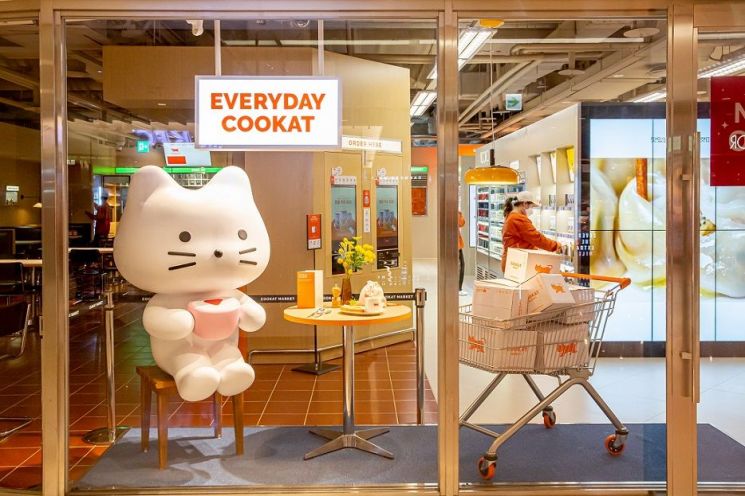
According to Cookat on the 12th, the average sales of 'Cookat Market Jamsil Branch,' which opened in the basement of Lotte Department Store Jamsil in April last year, over the past three months, grew by 56% compared to the average sales in the first three months after opening. Despite the impact of the novel coronavirus disease (COVID-19), offline store sales have continuously increased. This laid the foundation for Cookat to fully implement the 'O4O' strategy by opening its second offline store, Starfield COEX Mall Branch, last month.
The newly opened Cookat Market COEX Mall Branch consists of three sections: PB product section, restaurant section, and liquor section. In the PB product section, about 130 products are sold at the same prices as online, and in the restaurant with 68 seats, customers can enjoy 10 dining menus cooked directly by a master chef using Cookat PB products. The liquor section sells 40 carefully selected Korean traditional liquors. Lee Moon-joo, CEO of Cookat, said, "To provide more diverse brand experiences beyond online to the 600,000 Cookat Market customers, we opened a grocerant concept store in Starfield COEX Mall, a hot place in Gangnam, Seoul."
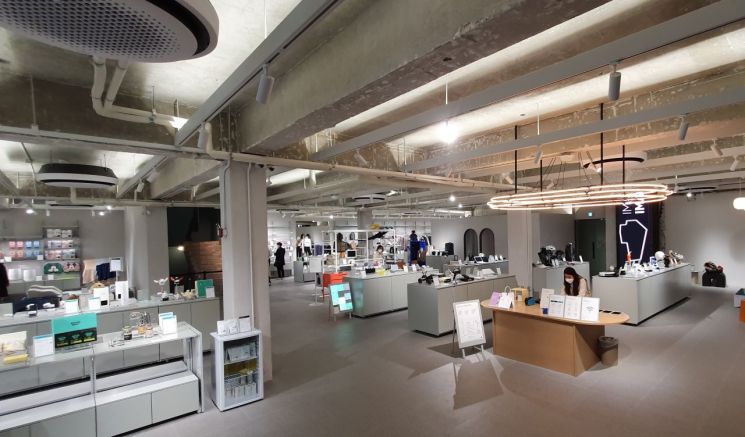
Crowdfunding platform Wadiz is also a representative company that recently expanded from online to offline. 'Space Wadiz,' which opened on the 23rd of last month in Seongsu-dong, Seoul, has a dedicated area of 343 pyeong (1,133㎡) and consists of four floors in total, from B1 to the rooftop including three above-ground floors. The basement floor is a multipurpose space where various startup-related events can be held, and on the first floor above ground, you can see products currently being funded on Wadiz. The second floor is designed so that products that have successfully completed funding can be purchased immediately.
Shin Hye-sung, CEO of Wadiz, said, "Space Wadiz is a place where makers who constantly try new things and supporters who participate with a heart to support and encourage meet and communicate," adding, "We plan to focus on the role as an interactive communication platform and work hard to create a startup ecosystem where various challenges continue."
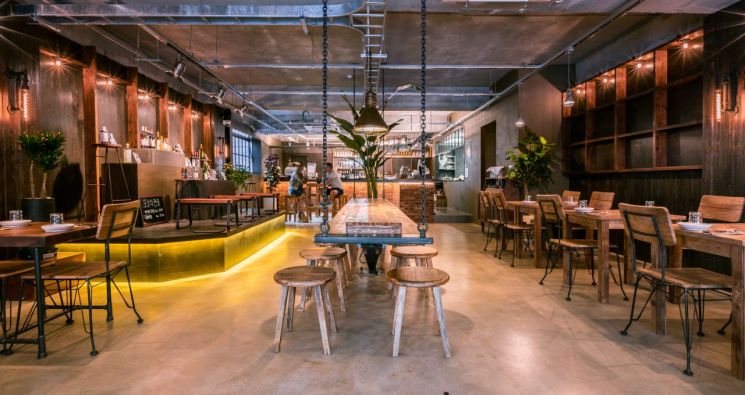
Backpacker, which operates Idus, plans to rename and renew 'Idus Craft House,' which opened last September and has become a landmark in Hongdae, to 'Idus Table' next month. The concept is a 'dining pub' where the space and all menus are composed of and created by handmade artists registered on Idus. The seating capacity is about 50 seats, and it can accommodate up to 80 people for events, making it a space specialized for various gatherings.
In the global market, online-based companies actively create offline stores like this. Amazon's 'Amazon Go' and Alibaba's 'Hema Xiansheng' are representative examples. In Korea, e-commerce company TMON has operated an offline store called 'TMON Factory.' An industry insider said, "Online-based startups recognize offline spaces as opportunities to demonstrate accumulated advanced technologies," adding, "Especially startups strong in data analysis will continue the trend of transplanting their own success formulas offline."
© The Asia Business Daily(www.asiae.co.kr). All rights reserved.
![Clutching a Stolen Dior Bag, Saying "I Hate Being Poor but Real"... The Grotesque Con of a "Human Knockoff" [Slate]](https://cwcontent.asiae.co.kr/asiaresize/183/2026021902243444107_1771435474.jpg)


















