Sejong Center & Hyundai Motor Chung Mong-Koo Foundation Co-Produce 'Kim Deok-Soo Exhibition' Performance at M Theater from 28th to 31st
'Samulnori Founder' Kim Deok-Soo's 68 Years of Life and Art Explored... Kim Deok-Soo Says "Kim Deok-Soo Exhibition Feels Unfamiliar... I Feel the Pressure"
"First Samulnori Performance at 'Gonggan Sarang' Remains Memorable... Samulnori Creatively Inherits Tradition"
[Asia Economy Reporter Park Byung-hee] Yein Kim Deok-su, the "founder of Samulnori," was born during the Korean War (1952). At the age of five, he joined the Namsadangpae, inheriting the tradition from his father. During the era of rapid economic development when "export was the only way to survive," Kim Deok-su was part of the Korean Folk Dance and Music Troupe and the Little Angels. He traveled around the world promoting Korea. In 1978, to preserve the legacy of traditional arts which were losing ground, he created Samulnori. During the June 1987 democratization movement, he participated in the shamanistic dance "Baram Maji" to console the spirit of Yonsei University student Lee Han-yeol, who died from police tear gas during protests.
Out of 68 years, 63 years of Kim Deok-su’s life as a yein (traditional artist) have traversed the turbulent modern history of Korea. This is why the musical drama "Kim Deok-su Jeon (傳)" is scheduled from the 28th to the 31st at the Sejong Center M Theater. It is a master series jointly planned by the Sejong Center and the Hyundai Motor Chung Mong-koo Foundation, offering an overview of Kim Deok-su’s life and artistic world. The performance is divided into two parts. Part 1 covers the period before the birth of Samulnori, focusing on Kim Deok-su’s childhood and his travels around the world as a cultural envoy.
At a press conference held on the 11th at the Sejong Center S Theater, Kim Deok-su said, "At the age of five in 1957, I inherited the tradition from my father and joined the Namsadangpae. It was a time when people said 'export is the only way to survive.' In 1960, an arts troupe called the Korean Folk Dance and Music Troupe was founded. That was when I first went on overseas performances. Later, as a member of the Little Angels, and from the 1968 Mexico Olympics, I toured abroad with the Korean Folk Arts Troupe. I spent six months a year overseas."
Kim Deok-su also recalled the late Chung Ju-yung, honorary chairman of Hyundai Group. "I met him several times during overseas performances. I remember he always treated us to delicious meals."
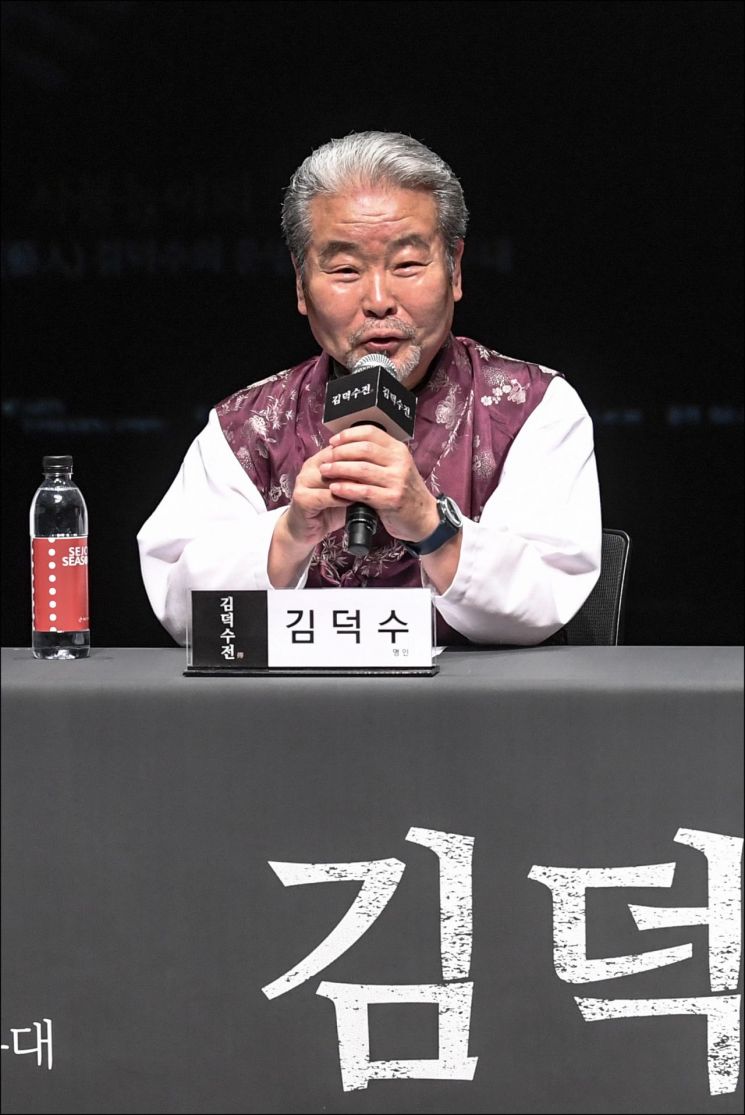 Kim Deok-su is answering reporters' questions at the 'Kim Deok-su Exhibition' press conference held on the 11th at the Sejong Center M Theater.
 [Photo by Sejong Center]
Kim Deok-su cited the first Samulnori performance in 1978 as the most memorable moment in his life as a yein. He emphasized that Samulnori was "a creative succession of the tradition inherited from my father’s generation by our generation."
"Whether it’s talchum (mask dance) or pungmul (folk percussion), the stage is directly connected to the yard. The yard is the fundamental and indispensable root of the most Korean aesthetic. From the 1960s, performing in the yard meant getting arrested under the Gypsies Act or Road Traffic Act. Traditional artists like us had to find a way to survive. It was the time when small theaters were just emerging. The question of how to perform in a small theater was the background for the birth of Samulnori. The issue was how to transform an indoor space into a yard. In fact, besides the geomungo and daegeum, many performances with our instruments were held indoors. There was also the seated ritual called 'sitting ban gosa.' I viewed the narrow stage as a large wooden floor, set up folding screens, spread mats, and created a ritual table. It was the interior of a village house I saw during my Namsadang days. The theater lobby became the village entrance."
On February 20, 1978, Kim Deok-su held the first Samulnori performance at 'Gonggan Sarang,' a small theater next to Changdeokgung Palace designed by architect Kim Swoo-geun. Samulnori received explosive acclaim both domestically and internationally right after its debut, becoming one of Korea’s representative cultural forms known worldwide. However, within the traditional arts community, there was considerable debate about whether it truly preserved tradition. Even now, some hold negative views of Samulnori. Kim Deok-su said, "Many people criticize Samulnori for breaking the original form of pungmul in the yard, but I have a completely different perspective. Samulnori is a maximization of auditory enjoyment from what was originally a visually enjoyed play."
Kim Deok-su also recalled the Pyongyang performances and the 1987 Baram Maji performance. He performed twice in Pyongyang, in October 1990 at the Pan-National Unification Music Festival and in November 1998 at the Yun Isang Unification Music Festival.
"We are one. I felt that blood is thicker than water. We received a welcome that I have never experienced in any other country. The Baram Maji performance at the Yeonwoo Small Theater in 1987, when Park Jong-chul and Lee Han-yeol died, is also an unforgettable performance. At the time, I didn’t realize it, but later I thought it showed the spirit of a socially engaged clown."
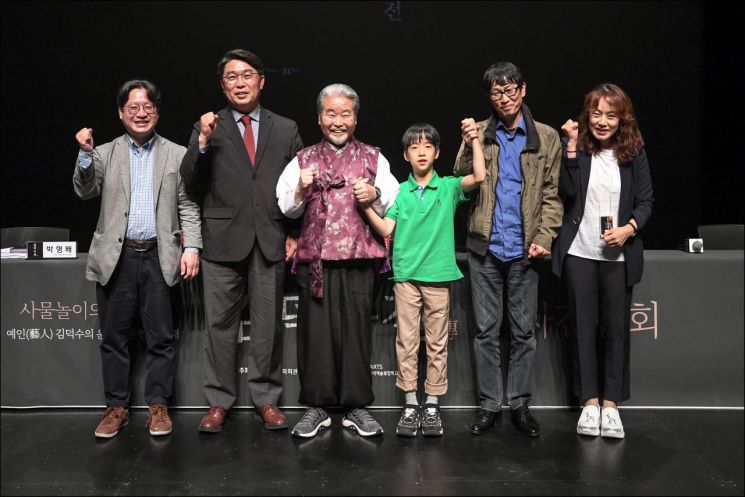 From the left, Lee Dong-yeon, Professor at the School of Traditional Arts, Korea National University of Arts; Park Hyung-bae, Secretary General of Hyundai Motor Chung Mong-koo Foundation; Kim Deok-su; Kang Ri-woo, who played young Deok-su; Park Geun-hyung, Director; Oh Jung-hwa, Head of Performance Planning Team at Sejong Center for the Performing Arts.
 Photo by Sejong Center for the Performing Arts
"Kim Deok-su Jeon" is based on seven oral interviews conducted over a year with Kim Deok-su. Lee Dong-yeon, professor at the Korean National University of Arts’ Traditional Arts Department, is the general producer and scriptwriter, and Park Geun-hyung, head of the theater company Golmokgil, is the director and adapter. Dancer Jung Young-doo plays the role of Kim Deok-su’s father, performing both acting and dance, while the traditional music group "Ensemble Sinawi," which has worked with Kim Deok-su for a long time, performs the music. Kim Deok-su himself will also appear on stage to showcase the skills he has accumulated over more than 60 years as a yein. The performance is structured as a stage where the comprehensive artistic aspects of Korean traditional arts can be seen, and the epilogue will feature the debut of "Deoksu Taryeong."
The second part of the performance will cover the heyday of Samulnori and stories about Kim Deok-su’s family and colleagues. Kim Deok-su plans to pay tribute to the original members who co-created Samulnori. He said, "I am unsure how to express the monologue-like scenes; it is ultimately a confession and the most difficult part." He also said, "As time has passed, I have heard of Hong Gil-dong Jeon, Chunhyang Jeon, and Heungbu Jeon, but 'Kim Deok-su Jeon' was very unfamiliar. I felt the pressure."
Director Park Geun-hyung said, "I want to show not only the aspects of a master and artist but also the person and human being. Behind the exciting performance, there must have been hardships and just as much effort. I hope the audience can feel those sides. I want to let people realize how much rain and wind an ordinary person endured and overcame to become a great mountain. Also, through the performance, I hope it becomes an opportunity to reflect on the times when our elders lived warmly despite poverty."
© The Asia Business Daily(www.asiae.co.kr). All rights reserved.


















