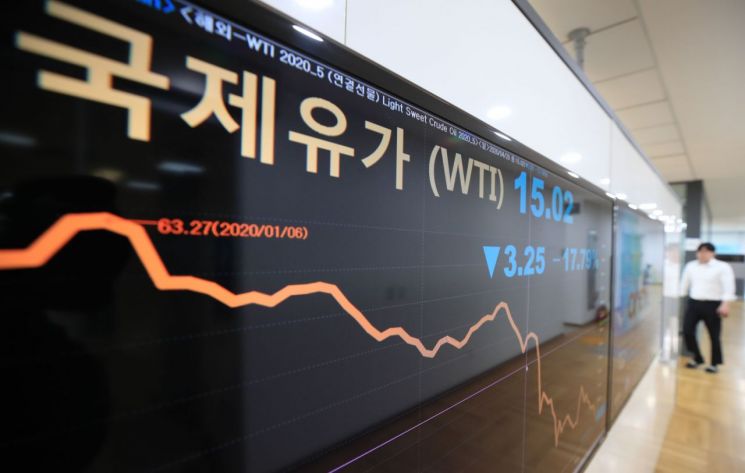
[Asia Economy Reporter Jang Sehee] As international oil prices decline with a time lag, the possibility of a negative consumer price inflation rate in May has increased.
According to price statistics from Statistics Korea and the Bank of Korea on the 10th, assuming the May Consumer Price Index (CPI) shows a month-on-month increase at the average level, the year-on-year inflation rate appears to remain flat.
Over the past 10 years (2010?2019), if the May month-on-month CPI increase of 0.1% is maintained this May, the year-on-year inflation rate for May is expected to stay at 0.0%.
Considering the economic shock factors caused by the COVID-19 pandemic, there are concerns about a further decline in consumer prices.
This is because the low inflation situation has intensified since April due to demand slowdown, a sharp drop in international oil prices, and a decrease in public service prices.
The April CPI rose by only 0.1% year-on-year. This was the lowest level since last September (-0.4%), when a negative inflation rate was recorded, and October, when it was 0.0%.
According to the Korea National Oil Corporation’s oil price information service Opinet statistics, the nationwide gasoline retail price in the first week of May fell by 16.8 won from the previous week to 1,257.7 won per liter, continuing the downward trend this month as well.
This is because there is about a three-week time lag before the decline in international oil prices is reflected in domestic petroleum product prices.
Earlier in April, petroleum product prices fell by 6.7% year-on-year, pulling down the overall inflation rate by 0.28 percentage points.
© The Asia Business Daily(www.asiae.co.kr). All rights reserved.

















