First Introduced 9 Years Ago at Seoul Shilla Hotel
Signature Menu Sales Increased by 30% Last Year
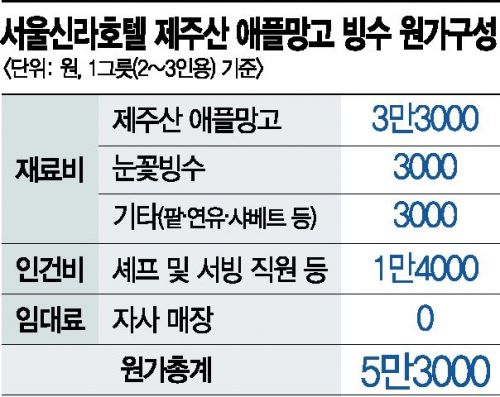
Low Yield Fruit... Cost Price 53,000 Won
Growing the 'Jeju Apple Mango' Brand Together with Farmers
[Asia Economy Reporter Cha Min-young] The price of the 'Apple Mango Bingsu' at the Seoul Shilla Hotel is 54,000 KRW per bowl (serving 2-3 people). This price is comparable to that of a high-end traditional Korean dinner, earning it the nickname "golden-priced bingsu." Many perceive that the price is set higher than the cost because it is sold at a hotel, but the actual cost calculation tells a different story.
On the 8th, after calculating the total cost of the Seoul Shilla Hotel's 'Apple Mango Bingsu,' it was found that the raw material cost excluding labor was 39,000 KRW, and the total cost including labor reached 53,000 KRW. The main ingredient, Jeju-grown apple mango, costs 33,000 KRW. A total of 850g, equivalent to about one and a half to two mangoes per bowl, is used, of which approximately 410g is pure flesh after removing the skin and seeds. Due to the high loss rate typical of fruit ingredients, the yield is about 48%. What about the retail price? According to Gmarket, the top-selling 'Jeju Apple Mango Extra Large (3kg)' product is sold for 168,300 KRW. This equates to about 56,100 KRW per kilogram, or approximately 47,685 KRW for the 850g used in one bowl of apple mango bingsu. The hotel lowers the purchase price by buying in bulk directly in advance compared to general consumer retail prices.
Additionally, the finely shaved frozen milk snow bingsu costs about 3,000 KRW, and other materials such as red beans, condensed milk, sherbet, and puree cost another 3,000 KRW. Labor costs for the 5-star hotel chef and hall staff amount to 14,000 KRW. From the moment the staff takes the order until the chef finishes preparation and serving, about 30 minutes of labor is involved. Adding all these costs together, the total cost reaches 53,000 KRW. This year, the selling price of bingsu at the Seoul Shilla Hotel is 54,000 KRW, but excluding taxes and service charges, it amounts to 44,630 KRW.
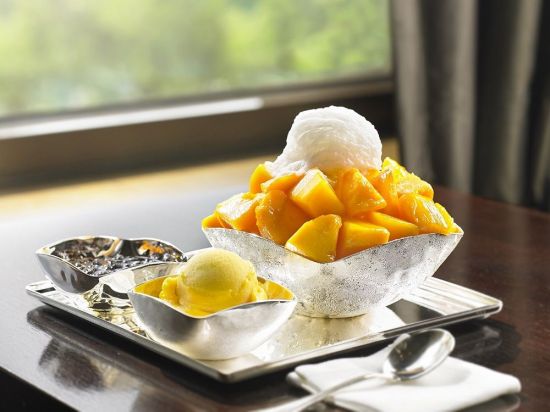
Apple Mango Bingsu was first introduced in 2011 at the Shilla Hotel's 'The Library' in Jangchung-dong, Seoul. This followed positive customer responses after its launch at the Jeju Shilla Hotel in 2008. The bingsu became a hot topic immediately after its release. Firstly, it earned a provocative nickname as "bingsu more expensive than rice served at a luxury hotel," and secondly, its "taste" attracted customers. It especially targeted the preferences of young women in their 20s and 30s who lead trends. As the number of fans eagerly awaiting the annual release of 'Aemangbing' grows, sales have also been on the rise. Sales increased by more than 30% last year alone. Although it is a signature summer menu, the hotel faces many concerns due to the rising cost ratio.
Using imported Peruvian mangoes available in the market could significantly reduce costs, but the Shilla Hotel insists on Jeju-grown mangoes. This is because the taste and quality can only be guaranteed by sourcing domestically. In 2018, the hotel even considered discontinuing sales, but internal opposition citing "our hotel's pride" led to the implementation of a "cost-linked pricing system" as a last resort. Moreover, there is the issue of regional cooperation. The hotel cannot break the mutual trust with local farmers who have helped grow the high-value brand "Jeju Apple Mango."
Especially this year, with the added impact of the COVID-19 pandemic, farmers have faced difficulties as their B2C sales channels were blocked. In response, the Shilla Hotel launched the bingsu menu a month earlier than usual on the 29th of last month. Since about 20 tons of bingsu are consumed every summer at Seoul hotels alone, the hotel judged this would help the farmers. Although the early sales increased the cost burden slightly this year, considering the economic downturn, the consumer price was frozen at last year's level.
© The Asia Business Daily(www.asiae.co.kr). All rights reserved.


















