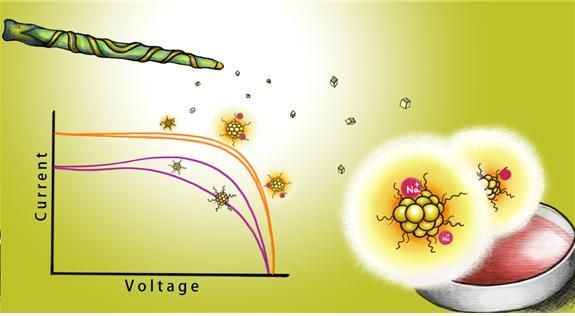
[Asia Economy Reporter Junho Hwang] Domestic researchers have announced a study result showing that the efficiency of a solar cell light absorber composed of gold nanoclusters can be enhanced through sodium ions. This provides a clue to improving the photoelectric conversion efficiency and stability of metal nanocluster-sensitized solar cells, and is expected to lay the foundation for the development of non-toxic and eco-friendly solar cell systems in the future.
The National Research Foundation of Korea announced on the 7th that a research team led by Professor Jin-Ho Bang of the Department of Bio-Nano Engineering at Hanyang University identified that sodium ions in the salt used during the electrode manufacturing process are a factor affecting the efficiency of gold nanocluster solar cells.
Gold nanoclusters, an eco-friendly light absorber, are considered one of the next-generation solar cell materials. However, gold nanoclusters have a photoelectric conversion efficiency more than five times lower than conventional silicon solar cells, making commercialization challenging.
The research team, while seeking ways to improve the efficiency of gold nanoclusters, discovered that sodium ions used in the electrode manufacturing process help the adsorption between gold nanoclusters and the electrode. When light is absorbed by the gold nanoclusters, electrons are generated and move to the semiconductor oxide electrode (TiO2) to which they are bonded. Then, as electrons are transported to the platinum counter electrode, electricity is generated. At this time, sodium ions induce strong adsorption between the light absorber and the oxide electrode. They also promote the separation of generated electrons and smooth transport, thereby enhancing photoelectric conversion efficiency.
The research team expects that although gold nanoclusters currently lack price competitiveness compared to other light-absorbing materials, commercialization of this technology will be possible if various systemic factors to improve photoelectric conversion efficiency are optimized.
Meanwhile, this research result was published in the international energy journal 'ACS Energy Letters.'
© The Asia Business Daily(www.asiae.co.kr). All rights reserved.

















