[Asia Economy reporters Seokjin Choi and Aeri Boo] VCNC, the operator of Tada, has filed a constitutional complaint against the amendment to the Passenger Transport Service Act, known as the 'Tada Prohibition Act,' sparking various speculations about the background. While some view it as a faint hope for business resumption or a way to save face considering investors, the dominant opinion is that it aims to restore the honor of Lee Jae-woong, former CEO of Socar. As a first-generation venture entrepreneur and an icon of innovation, Lee positioned himself as a 'fighter' against the Ministry of Land, Infrastructure and Transport and the National Assembly, but faced a bitter defeat when the amendment passed with over 90% approval from attending lawmakers in March. During this process, he also suffered the humiliation of being labeled by some lawmakers as a 'fraudulent group disguised as innovators.' Having his pride wounded, some interpret that through the constitutional complaint, he seeks to confirm that his choice was not wrong.
◆ A decisive move considering pride restoration and investor sentiment improvement = Tada's 'Basic' service has been indefinitely suspended since the 11th of last month. Given that the constitutional complaint procedure requires considerable time and cost, it can be seen as a last-ditch effort for Tada's dramatic revival. An industry insider said, "From the perspective of the parent company Socar, the Tada business model is necessary," adding, "In Socar's car-sharing business, cars spend a lot of time parked, and fixed costs continue to accrue. From a business standpoint, to utilize fuel assets, they want to gain legal recognition and create a justification to restart the business."
There is also a view that Socar made this decision considering its relationship with investors. Socar, Tada's parent company, received 50 billion KRW in investment last year from Altos Ventures, SoftBank Ventures, and others. However, with the termination of the Basic service, investment losses became inevitable. Even considering the nature of startups where investments carry risks, the Tada incident could lead to a contraction in overall startup investment sentiment. A startup industry insider explained, "While Tada's failure negatively affects startup investments, the constitutional complaint can be seen as Tada taking responsibility until the end."

◆ Constitutional Court likely to weigh infringement on freedom and public interest issues = If the Constitutional Court issues a simple unconstitutional ruling or recognizes partial unconstitutionality, Tada could dramatically revive. The clause VCNC challenges for unconstitutionality is Article 34-2, Paragraph 1 of the amended Passenger Transport Service Act. The amended law directly stipulates in the law the 'scope of lessees for whom driver dispatch is exceptionally allowed,' which was previously regulated by enforcement ordinances, adding several restrictions. Specifically, while previously anyone renting a passenger vehicle with 1 to 15 seats could be provided with a driver, the amendment limits this to cases where the rental time is six hours or more, or the rental or return location is an airport or port. This effectively made the 'Tada Basic' service, which mainly provided short-distance transportation, impossible.
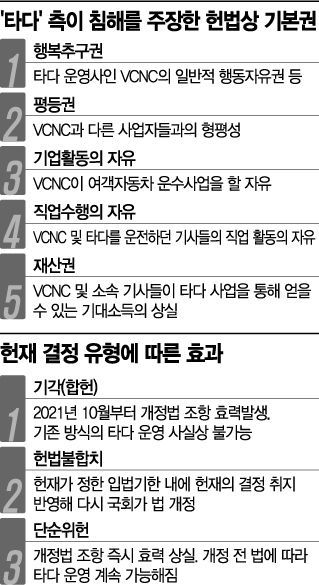
VCNC argues that the additional restrictions in the amended law infringe on the pursuit of happiness and equality rights of the company operating Tada and its drivers, as well as freedom of corporate activities, freedom to perform occupations, and property rights. During the Constitutional Court's review, the key issue is expected to be the balancing of infringement on freedom against the public interest of stabilizing passenger transport services.
If the Constitutional Court upholds the amendment as constitutional and dismisses the constitutional complaint, the amendment will take effect on October 8, 2021, as stipulated in the amendment's supplementary provisions. Conversely, if the Court rules the amendment unconstitutional, the clause will immediately lose effect, allowing Tada services to be provided under the previous provisions. If the Court recognizes partial unconstitutionality and issues a decision of constitutional inconsistency, the National Assembly must revise the law within the legislative period set by the Court to reflect its decision. The constitutional complaint is being represented by Kim & Chang law firm, with lawyers including Kwon Oh-gon, former Deputy Prosecutor of the International Criminal Court, handling the constitutional litigation.
© The Asia Business Daily(www.asiae.co.kr). All rights reserved.


















