[Asia Economy Reporters Koh Hyung-kwang and Song Hwa-jung] Foreign investors, who had consistently maintained a selling trend since the outbreak of the novel coronavirus infection (COVID-19), have for the first time in a while turned to net buying. This is the first time in 12 weeks on a weekly basis. The securities industry is expressing expectations that foreigners might be restarting the 'Buy Korea' movement. However, cautious views remain, as uncertainties such as the possibility of a COVID-19 resurgence and sharp fluctuations in international oil prices persist, making it premature to see this as a fundamental trend reversal.
According to the Korea Exchange on the 4th, foreign investors net purchased 127.4 billion KRW in the KOSPI market last week. This marks a return to net buying for the first time in 12 weeks since the first week of February (net purchase of 234.9 billion KRW). Although the market was open for only three trading days last week (April 27-29), the fact that foreign investors, who had been consistently selling in large volumes, changed their trading pattern is noteworthy.
From February 10 to March 24, foreign investors sold a total of 20.9148 trillion KRW worth of stocks in the KOSPI market over 11 weeks. This was a result of large-scale capital outflows from the domestic stock market amid the spread of COVID-19. During this period (59 trading days), foreign investors recorded net buying on only six trading days. At the peak of foreign selling in the second week of March (9th-13th), they dumped 5.044 trillion KRW worth of stocks, averaging 1 trillion KRW per day. Notably, from March 5 to April 16, foreign investors recorded 30 consecutive trading days of net selling, marking the second-longest streak after 33 trading days in 2008.
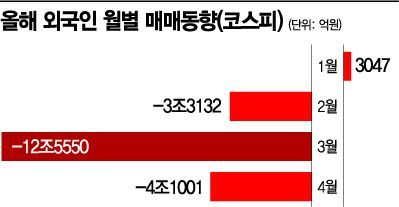
Recently, the selling pressure from foreign investors has somewhat eased. While foreign investors sold 12.555 trillion KRW worth of stocks in the KOSPI market in March alone, this amount decreased by about one-third to approximately 4.1001 trillion KRW in April. The average daily net selling amount noticeably dropped from 570 billion KRW in March to 205 billion KRW in April. Days with selling volumes exceeding 500 billion KRW were 14 trading days in March but only four trading days last month.
With foreign investors turning to net buying last week, expectations are rising that they might be returning to the Korean stock market. Lee Kyung-min, a researcher at Daishin Securities, said, "The peak of foreign selling in the KOSPI market has passed," and predicted, "In the second quarter, amid a phase of global liquidity expansion, foreign net buying inflows into the KOSPI will be only a matter of time." Seo Sang-young, a researcher at Kiwoom Securities, diagnosed, "As the COVID-19 situation clearly eases and the valuation attractiveness of the KOSPI increases, the selling pressure from foreign investors is being limited."
However, some analysts caution that it is too early to conclude that foreign investors have fully switched to buying, given the ongoing risks of COVID-19 resurgence, volatile international oil prices, and North Korean risks. Kim Yong-gu, a research fellow at Hana Financial Investment, explained, "Considering many factors such as the possibility of COVID-19 resurgence, oil price instability, and corporate earnings, it is difficult to make a definitive statement about foreign net buying," adding, "If corporate earnings deterioration in the second quarter materializes, it is expected to be reflected in stock prices, so we need to observe further."
Foreign investors, who have returned to net buying after a long time, mainly purchased IT-related and banking stocks. Last week, they net bought SK Hynix the most, with 91.4 billion KRW. This was followed by LG Chem with a net purchase of 68 billion KRW. Other top net purchases included Samsung Electro-Mechanics (45.7 billion KRW), KB Financial Group (41 billion KRW), Hotel Shilla (40 billion KRW), Hana Financial Group (27.7 billion KRW), Samsung SDI (26.4 billion KRW), Samsung Electronics (21.4 billion KRW), NAVER (19.6 billion KRW), and Hyundai Heavy Industries (14.1 billion KRW).
There has also been a change in the stocks foreign investors bought after turning to net buying. In March, when foreign selling was intense, they sold Samsung Electronics and SK Hynix by 4.9515 trillion KRW and 959.1 billion KRW respectively, and Samsung SDI, LG Chem, NAVER, and Hana Financial Group were among the top net sold stocks. In April, SK Hynix and KB Financial Group remained among the top net sold stocks.
By sector, in March, foreign investors bought bio stocks and untact stocks related to COVID-19 such as Celltrion, Celltrion Healthcare, Pearl Abyss, and Netmarble, but after turning to net buying, they focused on leading IT stocks and banking stocks with eased earnings concerns.
IT stocks are expected to lead the market rise this month as well. Oh Tae-dong, a researcher at NH Investment & Securities, said, "IT is expected to lead due to private and government IT infrastructure investments and deferred consumption of IT products," adding, "An important factor in deferred consumption is mobile phone sales, and deferred consumption of mobile phones will drive IT earnings." Daishin Securities also selected semiconductor, software, and secondary battery sectors as their top preferred IT sectors. Lee Kyung-min of Daishin Securities explained, "With the 4th Industrial Revolution cycle still valid, COVID-19 will accelerate growth speed," and added, "In the process of strengthening the KOSPI's upward trend in May, IT is likely to emerge as a leading sector."
Banking stocks have recently shown strong performance as earnings concerns have eased. Kim Jae-woo, a researcher at Samsung Securities, analyzed, "Following the first-quarter earnings announcements of banks, concerns about second-quarter earnings have eased, and amid the sharp recovery of other sectors' stock prices, the relative attractiveness of banking stocks has increased," adding, "Although a decrease in second-quarter earnings is expected due to limited profit decline compared to the same period last year and offsetting effects of net interest margin (NIM) contraction through high loan growth, there will be no sudden shock."
© The Asia Business Daily(www.asiae.co.kr). All rights reserved.
![Clutching a Stolen Dior Bag, Saying "I Hate Being Poor but Real"... The Grotesque Con of a "Human Knockoff" [Slate]](https://cwcontent.asiae.co.kr/asiaresize/183/2026021902243444107_1771435474.jpg)
















